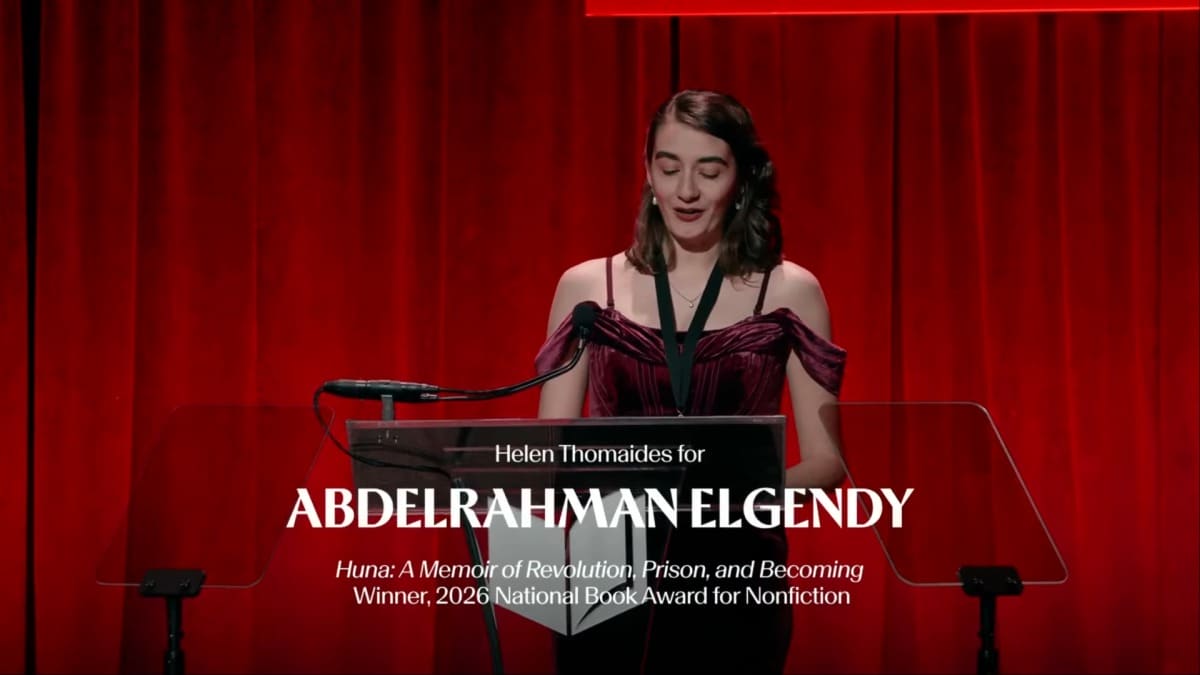
The National Book Awards were held last night in New York City, handing out prizes in fiction to Hannah Lillith Assadi for the book Paradiso 17, in poetry to Brenda Hillman for Still House In The Desert: An Eco-contemplation, in translation to Vicente Luis Mora for Centroeuropa, in young people’s literature to David Levithan and Gabriel Duckels for The Fight Of Our Lives: AIDS In America, and in non-fiction to Abdelrahman ElGendy for Huna: A Memoir Of Revolution, Prison, And Becoming. In the case of the last book, the award was actually accepted by his editor Helen Thomaides, as ElGendy was not allowed to travel to New York after being denied a visa.
ElGendy, who is Egyptian, writes in Huna about being imprisoned as a teenager after the coup d’état in Egypt in 2013; he was released in 2020. “If you’re listening to this, then a yearslong dream of mine has come true, and I’m not there to live it with you,” said Thomaides last night in a speech written by ElGendy, according to The New York Times. “May all borders be abolished, may all prisons fall.” In an article published in The New Yorker last week, ElGendy shares that he was denied a visa under the Immigration and Nationality Act. The author first came to the United States in 2022 for an MFA at the University of Pittsburgh. When ICE began targeting grad students last year, ElGendy made the decision to go to Europe before finishing his degree, worried he would could be taken after writing op-eds arguing that the Israeli government was committing genocide in Gaza.
Per the Times, the rules for eligibility for the National Book Awards were changed in 2024, allowing non-citizens to compete. The Times then made the case that ElGendy would still be ineligible, as he was not living in the U.S. at the end 2025, and the rules state that an author needed to be living in the U.S. as of December 1, 2025. NBA administrators maintain that ElGendy is eligible for the prize and declined to share much about the eligibility criteria with the Times.


 Keep scrolling for more great stories.