Let’s start by dispensing with this: If you’re already a fan of Koei Tecmo’s Nioh franchise—if you enjoy its cheerfully lobotomized, ruthlessly brain-pruned take on From Software’s Souls game formula for brutally punishing action RPGs—then Nioh 3 is almost impossible not to recommend. It’s the best Nioh game, certainly, a high-pressure firehose of candy-flavored gruel that makes a virtue of the inevitable bloated feeling it produces. Its status as a machine designed to generate little bolts of satisfaction in the human brain lines up in near-lockstep with its approach to difficulty, which is to say: They’re both damn near impossible to beat.
For those notalready in the hole for Team Ninja’s ludicrously expansive take on Japanese history and mythology—as expressed through the complex story concept of throwing roughly 8,000 flaming shurikens into rampaging demons’ heads—this is probably going to take a bit more parsing out. It would be reductive, for instance, to suggest that Nioh 3 is better for being dumber than some of its competitors—that by focusing its heart and soul entirely on action instead of burdening itself with plausible aspirations to tell epic or emotionally affecting stories in the vein of a Ghost Of Yōtei, it creates something that burns far purer. Reductive, but also kind of true: It’s not that Team Ninja’s latest doesn’t have some small ambitions towards actual storytelling, as it attempts to craft an era-spanning story of magic rocks screwing up wide swathes of Japanese history. But it’s so well-meaningly inept at these efforts as to render them magically harmless. You’ve got to have something to look at while resting your hands after a marathon run against a particularly pesky boss; cute god-animals mixed with a largely interchangeable cast of good guys and villains passing around stock platitudes and taunts turn out to be as good as anything else. Anyone playing these games for an emotionally impactful story has tohave been burned off, like, two Niohs and a Wo Longago; you’ve either acclimated at this point, or it’s never going to happen.
What we have in place of those narrative pleasures is an attempt to bolt an open world exploration structure onto an existing combat system still happy to eat as much of your reflex-brain as you’re willing to serve it. Every overly complicated system present in the previous Niohs—the stance system that asks you to switch approaches on the fly; the highly customizable weapon combos that force the player to manage complicated button inputs in the middle of pitched battle; one of the single worst and/or most esoteric inventory and loot systems in all of video gamedom—are still right here, front and center, asking for as much of your attention as you’re willing to give. Now, amazingly, they all sit under one more layer of complication: The ability to switch, at will, between “Samurai” and “Ninja” modes, either favoring higher defense and bigger hits, or improved flexibility and movement. These are not lip service alterations, despite them being available at the press of a button: You’re essentially fully running two characters off of the same statline at any given time, managing separate inventories, move customizations, and gear loadouts for each.
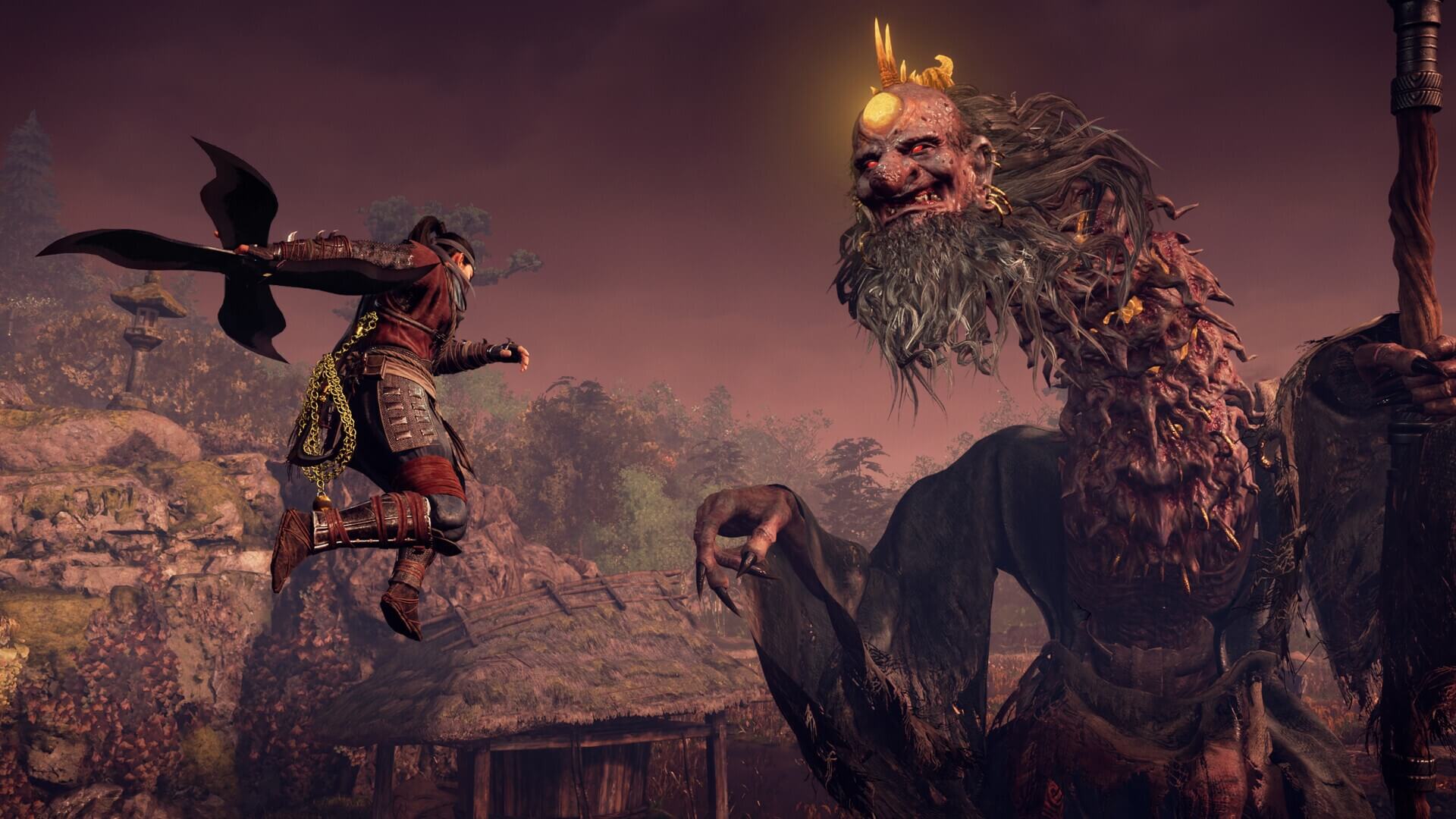
For a game series that should waddle from how overstuffed with system bloat it is, this dual-character thing should be one shuddering, ludicrous step too far. And yet, the brilliance of Nioh’s gameplay has always been the way it lets you dive as deep as your comfort goes, and no further. I’ve played 80 hours of this thing, and only felt the need to switch out of Ninja mode a handful of times; the rest of the time, I’m luxuriating in the speed of my combos, the thrill of landing dodges and backstabs, and the joys of pelting the game’s colorful menagerie of foes with blasts of lightning and whirling pinwheels of death. (Note to Nioh sickos: The ability to recharge Ninja tools mid-fight by landing hits on opponents makes this kind of playstyle way more viable, and fun, than it was in the past.) If a fight gets dicey, I know I can bring out the Samurai to try to overwhelm my opponent with heavier blows—or re-jigger my magic talismans to summon a former boss for a huge burst of damage, or alter my skill distribution to make it easier to negate certain kinds of damage, or try to slow or poison my opponent, or put my focus into my super mode, or… The point is, Nioh’s combat design has always treated its absurd number of systems as tools in the kit, rather than mandatory requirements. By adding even more of them, Nioh 3 expands how players can play it, rather than proscribing certain paths.
That same philosophy also loosely applies to the game’s open world design, which an unkind person might call “Attempting to blindly copy Elden Ring without any of that game’s sense of majesty, wonder, or awe.” Despite offering up the occasional lovely vista overlooking a demon-fucked castle, Nioh’s open world has far more in common with an Ubisoft map-clearing game than anything more mystical or mysterious; it’s a playground filled with little trinkets and buffs, not a living, breathing world. (Bless its heart, the game tries to make some of that loot feel more meaningful, applying upgrades to your various systems as you clear checkpoints off the map, but this is still a game where you hoover up garbage items in the literal thousands.) Nestled within that sprawl are more focused dungeon crawling zones, but Nioh has never paid more than lip service to its map design. It’s here—and with an enemy roster that’s surprisingly unchanged from Nioh 2—that the game’s boundless energy suddenly seems in danger of puttering out. Once you’ve seen one haunted temple aimlessly staffed by goblins, ghouls, and ghost women, you’ve essentially seen them all, no matter how much Nioh 3 tries to switch up its aesthetics with such bold design ideas as “Place where everything is very cold” or “city completely brimming with lava.” If the lack of creativity evident in the game’s storytelling has a certain layer of charm to it, here it’s less endearing. For the first 20 or so hours, a steady influx of new mechanics and unexpected threats is able to spackle over the sameness, but the novelty inevitably wears off.
Nioh 3 is, in other words, a game that exists, thrives, and potentially fails solely in the hands. It will give you as much of itself as you’re willing to accept—regardless of how crammed your gullet already is. It has no soul, and wouldn’t know what to do with one if it did. But it does inspire the kind of fascination inevitably produced by a machine that has been engineered meticulously for a singular purpose. It’s huge, aggressive, and—if I didn’t need to put a few more polish passes on this review—I’d probably be playing it right now. The crux is this: It’s impossible to imagine a better Nioh game. Whether that’s an expression of praise or damnation is left for the reader to decide.
Nioh 3 was developed by Team Ninja and published by Koei Tecmo. Our review is based on the PlayStation 5 version. It is also available for PC.



 Keep scrolling for more great stories.