There’s no correct way to adapt a TV show to a movie. In the last decade, many of television’s most revered shows have made the jump to the big screen (and streaming scene), with Breaking Bad‘s epilogue El Camino, The Sopranos prequel The Many Saints Of Newark, and Deadwood‘s final episode do-over Deadwood: The Movie all arriving in quick succession. All three struggled with how much they should concern themselves with new viewers, but Nirvanna The Band The Show The Movie star, director, and co-writer Matt Johnson offers a refreshing take on the micro-genre. “A successful TV adaptation of a show could work as the beginning of an audience watching that show,” Johnson told Vulture. “For most people, this movie is going to serve as the pilot of the TV series, and they’re going to go from watching the movie to the TV show as a continuation from this.” He pulls this off by creating a sequel that serves as a prequel.
Fittingly, Nirvanna The Band The Show The Movie is the product of many time periods. Surviving multiple 21st-century media pivots, co-creators Matt Johnson and Jay McCarrol somehow brought their alter egos to the movies with their history intact. There was a nine-year gap between the webseries that birthed the characters and their streaming show, and another near-decade between the final episode on Viceland and the feature film. Two decades of Marvel movies have taught apprehensive moviegoers that lore matters, backstory is king, and if they want to understand the present, they’ll need to do their homework. Considering how difficult it is to see their show, how could Johnson and McCarrol get anyone up to speed? Simple: Nirvanna The Band The Show The Movie goes back to the future.
The first thing we see in Nirvanna The Band The Movie isn’t new footage. It’s the opening scene from Nirvana The Band The Show, Johnson and McCarrol’s 2008 webseries. It’s not uncommon for TV-to-movie adaptations to show off the difference between their televised and cinematic incarnations. South Park: Bigger, Longer, And Uncut opens with the “Uncle Fucker” number to signal that this ain’t your daddy’s South Park. Nirvanna The Band The Show The Movie does it to show that not much has changed—when the film cuts to the present day, Matt and Jay are in a slightly bigger space, but their quest remains the same: Play a show at the Rivoli.
Back when the series aired on Viceland, Nirvanna The Band The Show used the cyclical structure of sitcoms to explore other interests. So long as Matt and Jay didn’t play the Rivoli, everything else is fair game, including using elaborate parodies to exploit fair-use laws. “In a traditional movie or TV show you’re not allowed to show licensed for copywritten material without getting approval of the copyright owner,” Johnson explained in a 2018 interview, “but if you need to show that stuff in order to tell the story that you’re telling, and by that I mean if you have a strong narrative reason for using the licenses, then there is a way through fair use that you can use that stuff without informing the copyright holder.” Therefore, the show could justify the use of John Williams’ music by staging painstaking Home Alone and Indiana Jones And The Last Crusade parodies. It also made them adept at inserting characters from other properties, such as Netflix’s Daredevil and Jumanji, into the show. In Nirvanna The Band The Show The Movie, they do the same thing with their past selves.
Nirvanna The Band The Show The Movie wasn’t planned as a time-travel film. But as the movie started taking shape, “We realized that there was an opportunity for us to return to the footage that we shot of ourselves when we were kids,” Johnson told Den Of Geek. After editors Curt Lobb and Robert Upchurch watched 100 hours of DV tape from the mid-’00s, they “wrote the basics of what the film would be in the 2008 section, and told us what they wanted us to shoot.” The result is a play on Back To The Future Part II, in which Matt and Jay return to the past and interact with earlier versions of themselves.
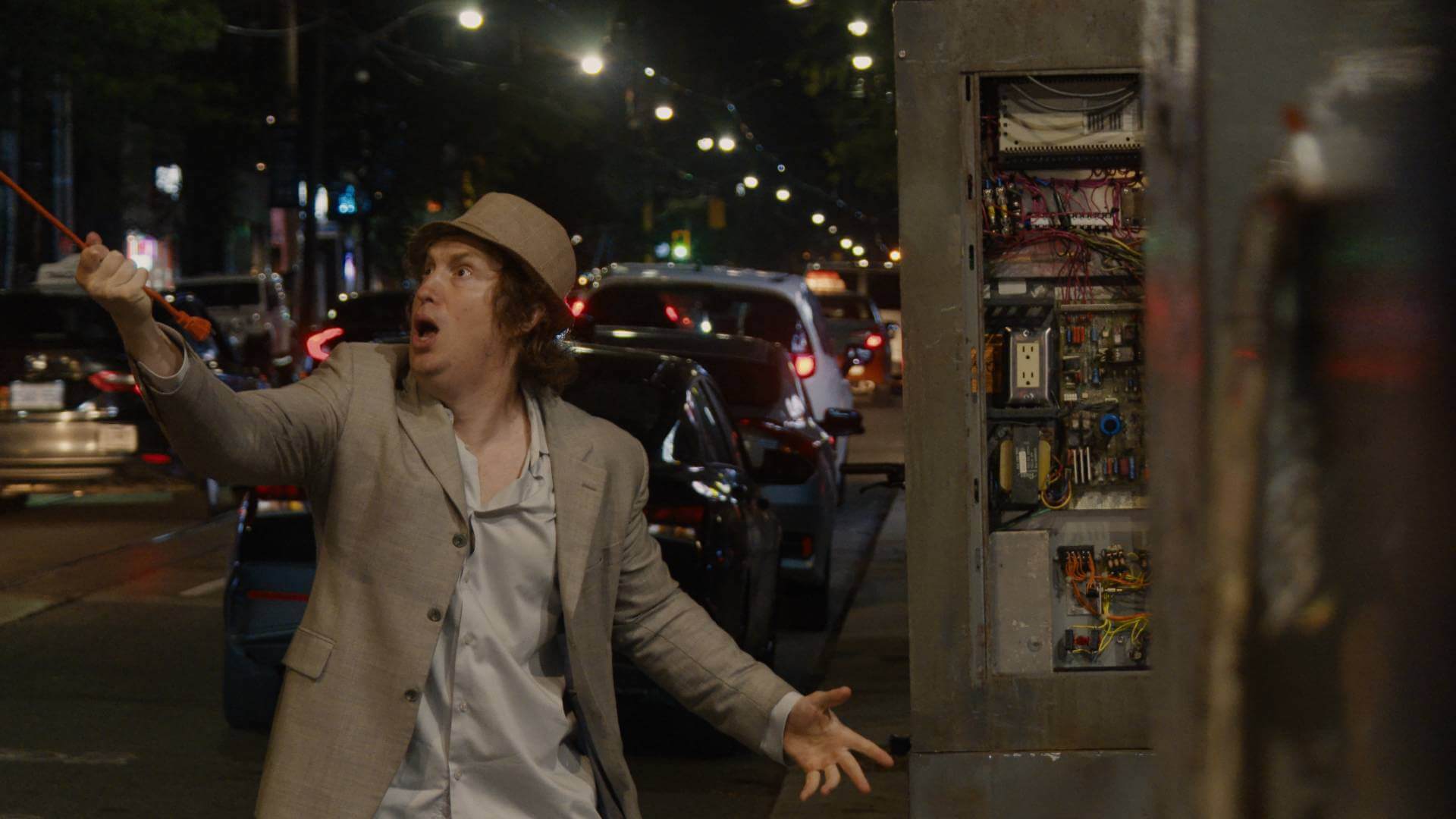
That footage creates an ingenious bit of nostalgia. After Matt spills the last known bottle of Orbitz on his jury-rigged flux capacitor, the Band is sent back to 2008, when Jian Ghomeshi ruled the Canadian airwaves. To bridge the 20-year gap in the footage, Matt hands his trusty DP, Jared Raab, one of the “old cameras” from 2008 to maintain the same digital video look, allowing for easy interplay between new and old footage. A scene in which Matt and Jay sneak into their 2008 apartment allows 2025 Jay to incept 2008 Jay with a hit song, while 2025 Matt poses as a Dickensian spirit. Footage that wasn’t used for the show, like when 2008 Jay is watching TV and asking 2025 Matt for his take on Russel Peters, also finds space for new comedy. It all recalls an unlikely comparison point: fellow TV-to-film time-traveler David Lynch, whose Twin Peaks: Fire Walk With Me recontextualized his series and was later further deepened and overwritten by Twin Peaks: The Return. In Nirvanna The Band The Show The Movie, Jay’s decision to write “Don’t Play The Rivoli” on Matt’s whiteboard in 2008 sets in motion a future in which Jay becomes a successful musician.
Aside from rendering everything that happens after episode one of the webseries non-canon, the ultimate effect is a unique TV-to-film adaptation that satisfies both longtime fans and new audiences. The film rewards older viewers by reckoning with the characters that were, and new fans get up to speed on what these two goofballs are all about. Rather than simply capping things with a long episode or an addendum to the series, Nirvanna The Band The Show The Movie melds all its previous versions into one, definitive expression. By incorporating old footage, it creates a self-referential time loop as sophisticated as it is silly.
Unlike some of the more traditional and prestigious TV-to-film adaptations of recent years, Nirvanna The Band The Show The Movie uses the repetitive template of the sitcom to its advantage, squeezing an endlessly repeatable plot into the mold of one of the most famous time-travel movies ever made. The result is something that neither repeats previous beats nor serves longtime fans at the expense of new ones, instead finding a meta resonance both inviting and deep. In the end, the experiment mostly recalls another recent TV-to-movie adaptation: Jackass Forever, which similarly juxtaposed new and old for an unexpectedly emotional spin on the format. By exploring the past while looking to the future, Nirvanna The Band completes a revolution it started 20 years ago.


 Keep scrolling for more great stories.