James Gray is no stranger to Brooklyn’s south side. Starting with his first film, Little Odessa, he explored the dual stories of New York City: Those who basked in the glow of big city lights, and those who wished to do so. There were stories of those who knew nothing of their neighbor’s real business, and those who knew too much. He moved from the present to the past, tracing the intricate history of the city and how it was shaped by dreamers and villains alike. He continued to explore those variations in many of his other movies, even those that moved away from the working-class neighborhood of Brighton Beach, but with Paper Tiger, he’s returning to the themes and places that made his initial work so vital.
In Paper Tiger, two brothers become a metaphor for a tale of two cities in 1986, just as New York was clawing its way back from the brink of economic collapse in the 1970s. First, there’s Irwin (Miles Teller), a hard-working, play-by-the-book, stand-up kind of guy. He has a wife, Linda (Scarlett Johansson), and two kids, Scott (Gavin Goudey) and Benjamin (Roman Engel), in a cozy Queens house. His brother, Gary (Adam Driver), is a flashier, smooth-talking operator and a former crooked cop who’s freshly divorced and looking for an enterprising opportunity. It arrives in the form of a shady business with the Russian mob, who’re looking to get away with something officials won’t look too kindly on. With Gary and Irwin’s connections and trustworthy faces, they hope to make their legal issues disappear on paper. When an innocent mistake brings about unintended consequences, Irwin realizes he’s gone too far in a part of the city he never understood.
Gray’s film has all the hallmarks of a downer drama from the 1970s. A doomed fatalism hangs over all of the characters once everything falls apart, thoroughly ripping apart the happy home and its happy family. Whatever happens, nothing will ever be the same for them—their notion of what this city is has changed. Gary is the only one with the full knowledge of what’s happening, and what’s about to happen if the situation with their Brooklyn counterparts continues to spiral out of control. On the other hand, Irwin’s essentially fallen into this muck and is panicking to get out, begging his brother to rescue him. Knowing what’s ahead for his family, especially his scared young nephews, Gary steps up to be his brother’s keeper the best he can, even if that only unleashes years’ worth of pent-up resentment between them both.
It’s almost something of a joke that the whole mess starts with a bad deal over the Gowanus Canal, one of the most polluted parts of the city that officials left to fester for decades until its recent revival as the new hot spot for high-end luxury apartments. Gray’s inclusion of the site in his script is no accident; as Irwin enjoys an almost picture-perfect suburban home life and Gary leans into the “greed is good” excess of flashy cars and watches, a waterway of poison runs alongside them, threatening their very existence. The rot runs throughout the city, as shown in Gary’s history on the force, following him as he bribes his connections for information and deals with the mobsters’ code of honor—or dishonor, if the occasion calls for it. In trying to spin gold out of a dump, the men get themselves dirty and put their family in danger.
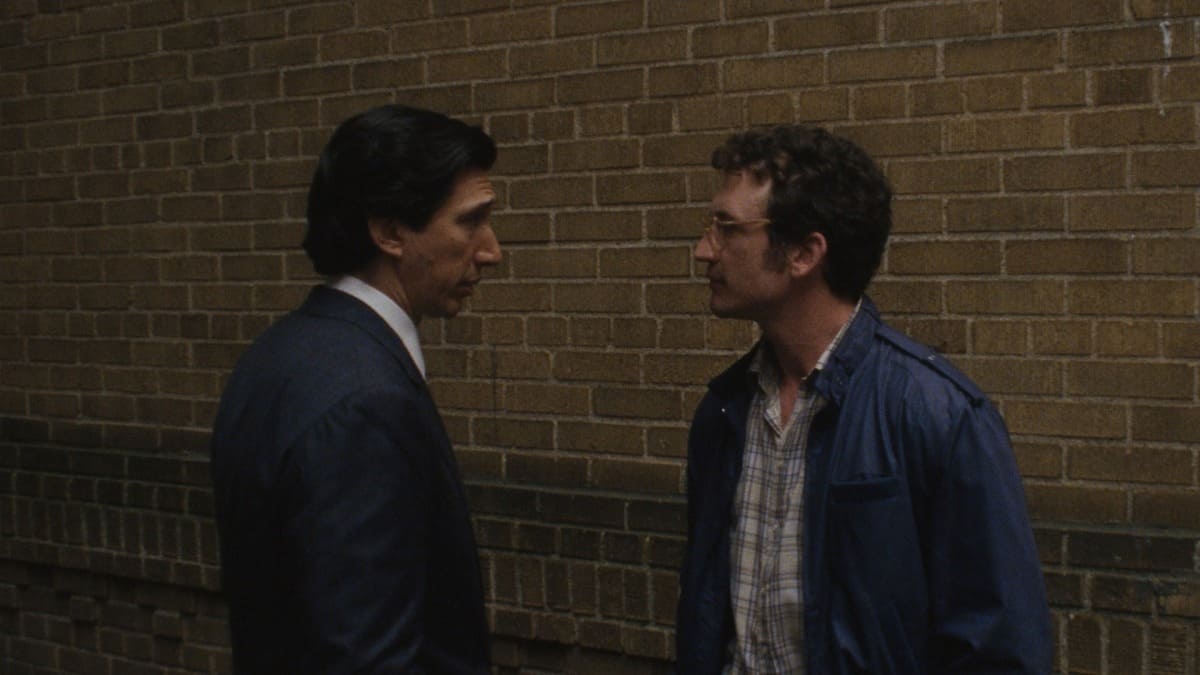
Even more than Gray’s previous film, Armageddon Time, Paper Tiger is dark, almost vintage-looking. The mahogany paneling of Irwin’s home looks so rich, it’s almost too comfortable to leave. From the unkempt wilds of eastern Queens to the grimy Brooklyn backrooms and basements where illicit deals are made, Gray and cinematographer Joaquín Baca-Asay give their film a gloomy warmth, with an almost Godfather-like solemnity and reverence for shadows. Even the costumes and hairstyles are perfectly chosen; you could hear the heavy jewelry Linda is wearing and you can smell the cigarettes on Gary’s jacket after a stressed-out smoke break. Eventually, the film’s darkness adds to the Pearl family’s sense of isolation, separating them from the rest of the neighborhood and becoming a source of danger as their enemies close in.
Each of the stars in Paper Tiger brings a tense insecurity to their performances, leaving their characters taut and vulnerable to anything that might be the final straw. Teller turns in one of his best performances in recent memory, playing a dorky dad who’s trying to motivate his kids, but accidentally puts them in harm’s way when he takes them to his job site, not realizing it’s a front for activities none of them should know about. Irwin quickly loses whatever confidence he had, deferring to Driver’s stern Gary, who has in turn lost his flirty smile and macho bravura. In a Friends Of Eddie Coyle kind of way, Driver evolves his character from a hotshot to a doomed man who knows this story only has one ending, and it’s not a happy one. Johansson also rises above the fray, turning from a busy, stay-at-home mother to a desperate matriarch who steps up to save her family. Linda is a surprising addition to the story; at first, she’s not much of an active participant, but as Gray’s narrative continues, her arc becomes just as serious as the men’s. Interestingly, though, she’s left alone to fight her battles, a challenge Johansson meets with a tearfully stoic performance.
Paper Tiger is a cross-city odyssey that feels of its time but also of the moment. Although its events are set decades earlier, we are still uncovering the ways in which New York has buried its dirty secrets and turned a blind eye—whether to conventional criminal activity or to how its government hid the fact that the dust that covered much of lower Manhattan after the events of 9/11 was indeed toxic. That there are hustlers and bad actors trying to game the system and win lucrative contracts for questionable jobs isn’t just endemic to the city. That goes all the way to the top. The tragedy comes when the people playing these games to get ahead lose, because then, so does everyone around them.
Director: James Gray
Writers: James Gray
Starring: Adam Driver, Miles Teller, Scarlett Johansson
Release Date: November 20, 2026


 Keep scrolling for more great stories.