Pillion is an unconventional love story in more ways than one. Some of these ways are obvious—although they’re no more explicit than an episode of Heated Rivalry, their kinky nature still makes the film’s gay sex scenes feel quite brazen. (How many films have you seen that frame group sex as a romantic gesture?) Others are subtler, but just as radical, as writer-director Harry Lighton uses the story of a timid man swept off his feet by a hot, emotionally unavailable biker to expand the definition of what “happily ever after” can mean.
When we first meet Colin (Harry Melling), he clearly isn’t happy. Things could be worse—his parents Peggy (Lesley Sharp) and Pete (Douglas Hodge) accept his sexuality, and Peggy even sets her son up on awkward blind dates like the one that opens the film. But, aside from singing in a barbershop quartet with his dad, this awkward and passive man has little to look forward to in life. He lives at home, has no real friends, and works a menial job writing parking tickets. He badly needs some excitement, and it arrives on Christmas Eve at the local pub, tall and chiseled and dressed in leather.
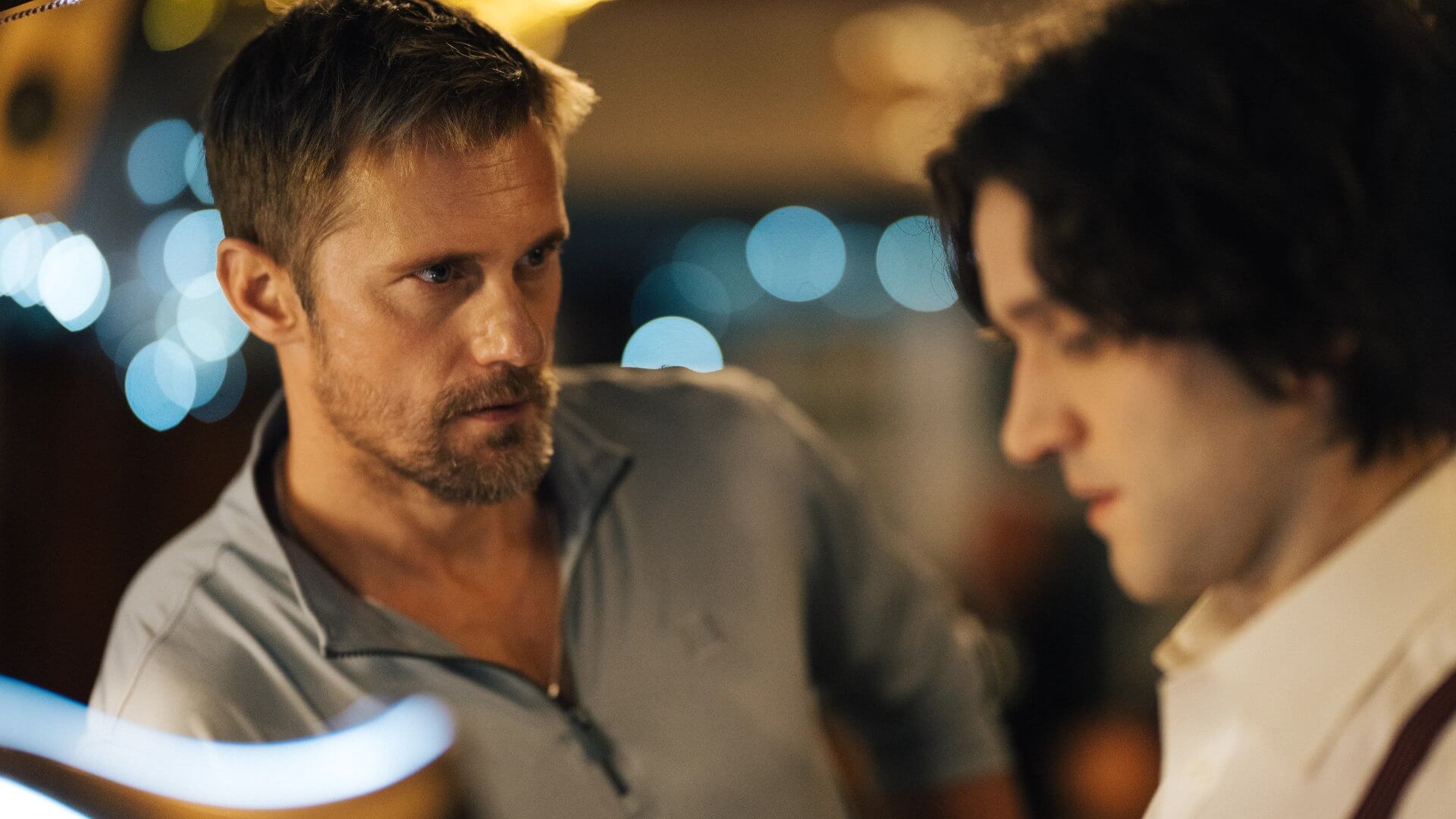
Ray (Alexander Skarsgård) doesn’t belong at this suburban watering hole. He doesn’t belong anywhere, really, except for the hypermasculine fantasy world of a Tom of Finland painting. Ray is hot, suspiciously hot, and Colin is confused as much as anything when Ray instructs him to meet him the next night in the town square. Within minutes, Colin is down on his knees, and Lighton films Ray unzipping his pants in breathless, anticipatory closeup. Again, a slightly dazed Colin just goes with it, until he’s sleeping at the foot of Ray’s bed and wearing a silver chain adorned with a padlock that marks him as Ray’s submissive.
The film’s most transgressive elements have a wholesome veneer to them, which seems ironic until it becomes clear that Lighton truly believes that these are legitimate, even romantic, forms of sexual expression. These scenes are meant to be provocative, and will challenge all but the most open-minded viewers to expand their conceptions of what a loving relationship can look like. At the same time, however, there are moments that are undeniably sweet. Early on in their relationship, Ray tells Colin that he has an “aptitude for devotion,” a comment that Colin proudly repeats to anyone who will listen. And just when it looks like Ray has forgotten Colin’s birthday, he surprises him with a camping trip that tests, then reaffirms, their bond in a scene that serves as a sort of manifesto for the film’s celebration of loving depravity.
Lighton’s rose-colored glasses are particularly prominent in scenes where Ray and Colin hang out with the members of Ray’s queer motorcycle club. Among the leather daddies and their pups, Ray and Colin are accepted unconditionally, and the bikers blend casual sex with more conventional group activities in ways that mirror Ray and Colin’s own private rituals. Another sub, played by Scissor Sisters’ Jake Shears, expresses his concern about the lack of visible affection in Ray and Colin’s relationship—they never break character, and don’t hold hands or kiss each other on the mouth—but Colin says he doesn’t mind. For now.
Like Peter Strickland’s The Duke Of Burgundy, Pillion uses its kinky premise as a springboard to explore ideas about long-term love, and the compromises that are necessary to maintain it. All couples have their own unique power dynamics, but a strict dom/sub relationship like Ray and Colin’s really lays those tensions bare (no pun intended). As the sexual thrill begins to wear off, Colin starts asking for more from Ray, who is ultimately unwilling, or perhaps unable, to let down his guard and engage in emotional intimacy.
We never learn even the most basic facts about Ray—where he’s from, for example, or what he does for a living. He’s a cipher onto which Colin, and the audience, can project their own desires and fears. Combined with the giddy, lovestruck tone, this gives Pillion the feel of a fairy tale, an impression that’s enhanced by a baffling but necessary rug-pull late in the film. (For those who have read the novella, this is a different twist, with different ripple effects.) It’s enough to make you wonder if anything we’ve seen actually happened, or if it was all the hallucination (masturbatory fantasy, whatever) of a lonely and confused man.
Lighton handles this destabilizing transition with grace, guiding viewers through bewilderment and into the hard-earned wisdom of the film’s denouement. Lighton’s thoughtful, controlled direction is remarkable for a first feature; Pillion is full of wonderfully evocative details, from the dorky bow tie Colin wears while performing with the barbershop quartet to the way Lighton marks the passage of time with different seasonal treats. He keeps a tight grip on the film’s tone as well, and without his firm but gentle hand, Pillion simply would not work.
Pillion is a film about self-knowledge, and about asserting one’s needs and boundaries without shame. As paradoxical as it might seem, Colin’s submission gives him the confidence to advocate for himself, with Ray and in other areas of his life. This is where Pillion challenges deeper assumptions about love, and not just sex: For a relationship to be “successful” by mainstream Western standards, it must be exclusive, all-consuming, and lifelong. But what if that’s not the case? What if, just as people want different things from sex, different models for love can benefit human beings as well? If a relationship doesn’t last, but the lessons you learn from it make you a better partner in the future, did that relationship really fail?
Director: Harry Lighton
Writer: Harry Lighton
Starring: Harry Melling, Alexander Skarsgård
Release Date: February 6, 2026


 Keep scrolling for more great stories.