Primer is The A.V. Club‘s ongoing series of beginners’ guides to pop culture’s most notable subjects: filmmakers, music styles, literary genres, and whatever else interests us—and hopefully you.
Nicolas Winding Refn is one of cinema’s latest additions to the enfant terrible canon. Though always grounded in a deep love of color, neo-noir, and stylized violence, the look of Refn’s films have evolved quite a bit since his Danish feature debut, Pusher, in 1996. The son of a director and cinematographer, Refn moved from his hometown of Copenhagen to the New York of the 1980s, picking up an interest in gritty stories set in underground scenes lit only by red or neon lights. Refn returned to Denmark to jumpstart his career in the mid-1990s, and by the following decade, he was in Hollywood directing stars like Ryan Gosling, Oscar Isaac, and Christina Hendricks.
As his filmography intensified, in both its dedication to aesthetics and its depictions of violence, Refn stepped back from traditional narrative stories, choosing instead to explore the darker side of humanity in hyper-stylized realms of make-believe. His latest movie, Her Private Hell, is a complete departure from reality, diving fully into a colorful dream world of sex and murder.
Nicolas Winding Refn 101: Color And Violence
An easy summation of Refn’s aesthetic can be found in New York dive bars—specifically those located in basements lit only by red lightbulbs and anchored by dark corners. These establishments embody Refn’s fondness for drenching a scene in a deep, monochromatic red. It’s there in his early film, Bleeder, when his characters go to the porno section of the video store; it disrupts the grimy period piece Valhalla Rising—which stars Refn’s Copenhagen collaborator Mads Mikkelsen as a viking slave—with flashes of red visions; and it reaches deliriously saturated heights in Only God Forgives, which is full of red lanterns, red hallways, and red lounges, to say nothing of the amount of blood spilled throughout the movie.
There’s very little kindness in Refn’s work. From the start of Refn’s career with Pusher, a movie about a flailing drug dealer who falls deeper and deeper into debt, violence has always been a more reliable force. From threatening arguments in small, run-down apartments to full-on bloody showdowns under a club’s neon lights, Refn keeps his camera close to the action, not necessarily showing every moment of the ultraviolence, but enough to make audiences wince at every or well-timed spurt of blood or bone-crunching sound effect. Sometimes violence happens to everyday people, shattering their reality and plunging them into a bizarre, bloody world. Other times, the heroes of Refn’s movies are criminals themselves, moving through the world the only way they know how.
Despite these continually bleak premises, Refn’s garish colors play an increasingly large part in his films after his first few movies. As Refn left his down-and-dirty Danish era behind, he began to saturate his American films more and more with lurid shades of red—and later, blue and pink—lighting, the hues swallowing whole characters in their anger, grief, or isolation. These are visually striking worlds full of pain.
Only God Forgives heralds Refn’s shift to more pink and blue tones, which go on to dominate the scenery of The Neon Demon, his short film Touch Of Crude, and Her Private Hell. This alternation between various deep shades also permeates his limited series Too Old To Die Young and Copenhagen Cowboy. In all of these projects, color enhances the lonely heroes’ isolation, setting them adrift in a single-shaded sea, emphasizing how they don’t fit in with the rest of a corrupt society that’s only too happy to indulge in exploitation and cruelty.
Refn’s dedication to color and violence has only intensified over his filmography; Her Private Hell is as vivid and visceral as any of his movies. The film’s characters inhabit a highly stylized neo-noir fantasy, the kind that accommodates a space sequence that melds together a colorful Barbarella remakeand the concept art for Alejandro Jodorowsky’s Dune (the legendary Chilean film director is also a friend and inspiration for Refn). The characters are awash in unnatural lights, seemingly detached from each other, united only by the fear of a boogeyman known as The Leatherman, whose preferred way to dispatch a victim is by ripping their chest open to unleash a spray of blood.
Intermediate Studies: Club Neo-Noir
Removed from the classic post-war era of film noir, neo-noir emerged as the subgenre’s ever-evolving offspring, adapting to the times and the fall of the Production Code to include much more sex and violence than audiences in the ’40s and ’50s could have ever imagined. Refn indulges in many archetypes established in noirs—like a lonely hero or a femme fatale—and often sets his movies in some kind of criminal underworld, all with a dance-club influence.
Refn’s follow-up to Pusher, Bleeder isn’t the movie in his oeuvre most devoted to the stylings of neo-noir, but the influence is there. Here, Refn steps up his use of dramatic lighting, something he continues to incrementally increase in each of his subsequent films, and stages scenes so that every row of blinds cast linear shadows across rooms, creating an illusory trap ensnaring the characters in his claustrophobic settings. Equally scrappy, yet somehow more stylized than his debut, Bleeder centers around the desperate antics of Leo (Kim Bodnia, a fixture in Refn’s films until the two fell out) after learning he’s going to be a father. As Leo loses control, he endangers those around him, including his pregnant girlfriend. The self-inflicted harm of Leo’s violent outbursts works against Refn’s protagonist, dooming him like a dead man walking.
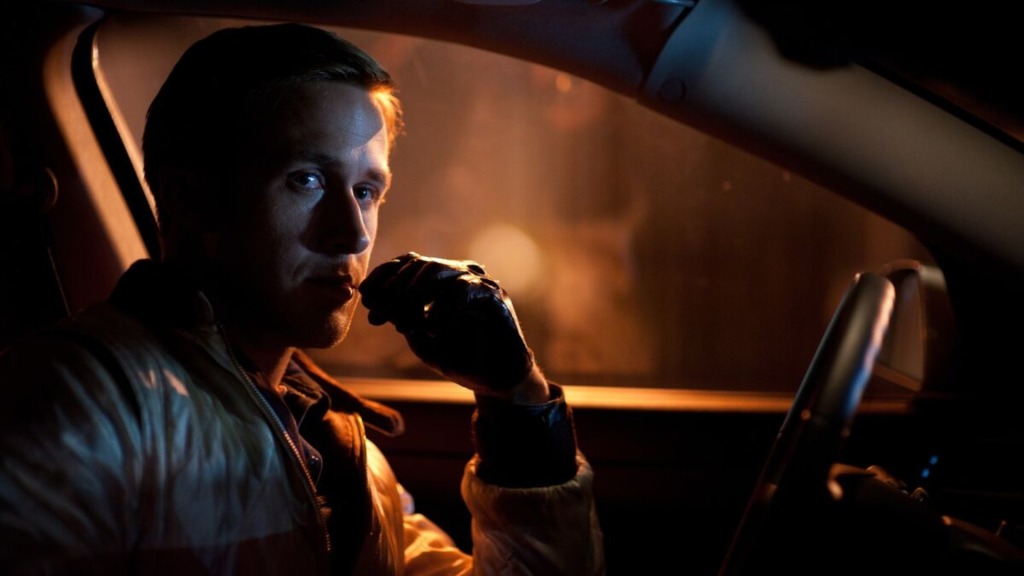
Refn tweaks this old-school genre influence by employing his soundtracks like a DJ, hyping up the audience for an action scene with rock or techno numbers, or in the case of movies like Drive, using a trance-like number to slow down time and play up the character’s feeling of isolation. Cliff Martinez, the composer who’s worked with Refn on four of his projects, gives Ryan Gosling a synth-heavy score worthy of an ’80s Michael Mann movie. It’s deep and brooding yet propulsive, pushing the man in the scorpion jacket forward through the movie’s many brutal moments while also giving him a pensive romantic number that seems to stop the film in its tracks so he can be with the widow he’s trying to protect. It’s just as effective in one of the film’s quieter moments as the music in the nerve-wracking car chases through Los Angeles.
For Her Private Hell, Refn tapped famous giallo composer Pino Donaggio for a sumptuous orchestral score that hearkens back to classic film noirs, using dramatic music to heighten emotions. The effect also emphasizes the feeling of living in a golden cage like the kind the women in the movie are stuck in: rich and vast, yet moody with an underlying sense of unease and dread lurking beneath the surface. In an interview with The A.V. Club, Refn said he moved from his typical synth score for an orchestral one to set his newest movie’s mood. “I realized that to go all the way was to make it an opera,” he said. “Which meant finding a composer who can write opera, but opera in a sense of movie-world opera. Pino [Donaggio] is the last surviving giant of the Italian music club that defines a lot of what we see as popular film music.”
As part of crafting his own flashy brand of neo-noir, Refn mixes in vivid color and evocative music to heighten the style traditionally known for its dark palettes and foreboding scores. Often, he sets up slow tunes in the lead-up to violence: In Her Private Hell, when Charles Melton’s character finds a den of crooks, everything seems at a standstill, including the music, until the fight begins. These atmospheric music-video-like moments are connective tissue meant to be broken open by aggression. Refn’s later works share a vaporwave quality to their visions of sex, death, and violence, one that also takes inspiration from the movies of Michael Mann, Ridley Scott, and David Lynch.
Advanced Studies: The Lonely Hero
As Refn has progressed in his career, traditional narrative arcs have fallen by the wayside. Loosening up his story structure, as he has with Her Private Hell, allows for those opera-sized emotions to fill the void and ideas about isolation and fighting for survival have become a larger theme in his works. His heroes may be isolated, but not always by choice, and now, they’re fighting on behalf of someone else, like in Drive or Fear X, where John Turturro is a grieving man trying to find the truth of what happened to his wife. Disassociating from general society can be a self-inflicted wound or something that comes after a violent trauma, but the feeling of lonesomeness often heightens the character’s paranoia and sense of abandonment. They’re more prone to violence as they lose attachment to the outside world.
The isolation felt by the characters in Drive or The Neon Demon can be traced back to Refn’s gleefully unhinged biopic Bronson. Following the story of a notorious British prisoner who’s rechristened after the American actor Charles Bronson, the movie’s main character (played by Tom Hardy) has a devil-may-care attitude about his many crimes and a fondness for reckless endangerment and kidnapping. His isolated moments are far from silent reflections on his behavior, of course; this is where he imagines himself a kind of clown, laughing at his own cruel antics as if they were charming vaudevillian tricks. Regardless of the jail walls, Bronson is a prisoner in his own mind.
Beginning with The Neon Demon, Refn brought this sense of separation into the world of fashion, making its hyperstylized photo spreads into his cinematic playground. Many of this industry’s characters are less rooted in reality than they are in the strange, surface-level bubble they find themselves in. These movies are less stories and more runways come to life, interrupted by bizarre interludes, like the cannibalism of eating one’s competition in The Neon Demon or the women in Her Private Hell barking at each other mid-conversation. This fashion-forward work is steeped in isolation. When partnering with Prada for a short film to play alongside their 2023 fashion show, Refn created Touch Of Crude, starring his wife and longtime collaborator, Liv Corfixen, and daughters, Lola and Lizzielou. The women are mostly alone and Touch Of Crude uses the camera like a haunting spirit, following subjects who keep looking over their shoulders, looking for something that isn’t there.
Throughout his career, Refn has doubled down on his interests—whether that means in the criminal underworld, in violent confrontations, in color saturation, or even in his use of boundary-pushing music. Over time, his actors have become more deadpan instead of melodramatic, floating into sleek neon-lit underworlds with a disaffected stare, like Elle Fanning wandering into the cutthroat modeling world with only a pensive look as each different stylist and photographer shapes her into someone new. Refn has gone deeper and deeper into these visual and thematic motifs, adding and subtracting different elements while remaking exploitation films like glossy magazine photospreads. Even when it looks like we’ve seen the extent of what his signature red-blue-pink palette can accomplish, he’s back with more ideas to keep his style from ossifying, leaving behind tradition for something more fantastical, heightening the violence until it’s almost cartoonish, venturing further and further into beautiful alienation.


 Keep scrolling for more great stories.