Primer is The A.V. Club‘s ongoing series of beginners’ guides to pop culture’s most notable subjects: filmmakers, music styles, literary genres, and whatever else interests us—and hopefully you.
“I am employed by the myth of Shah Rukh Khan.” This is how Indian actor Shah Rukh Khan described his unprecedented levels of fame during a 2019 episode of Netflix’s My Next Guest With David Letterman. It’s a strange yet poignant admittance of not fully grasping why throngs of people gather outside his sea-facing Mumbai home on an almost daily basis, hoping to catch a fleeting glimpse of their favorite hero, or what it is about him specifically that connects on an elemental level with a population of billions. In the United States (and possibly everywhere else), this type of fan behavior would be considered problematic. However, for better and definitely for worse, feverish idol worship of celebrities is common in India, to the degree that Khan stands in a designated spot on his rooftop to wave at the devoted masses. Letterman, who witnessed this event first-hand, called it a phenomenon in which Khan “transcended his movie star status to something else.”
Anyone who grew up on the subcontinent in the ’90s could tell you how Khan has been omnipresent on the small screen and big for three decades. After making his TV debut in 1988’s Fauji, he turned to movies with 1992’s Deewana (one of four Khan films released that year). The man hasn’t looked back since, nor has his ever-expanding fan base, whether his films are huge hits or major duds. At first, Khan—an outsider in an industry often called out for its nepotism—seemed to symbolize how hard work led to success at a time when the country was starting to come into its own on a global scale, just over 40 years after independence. Today, his appeal remains unmatched, beckoning crowds in full swing as he makes a late-stage pivot to an action star at the age of 60, with recent films like Pathaan, Jawan, and 2026’s upcoming King.
To try to parse his versatile career—which spans more than 25 years, 80 films, and a few TV shows—is a herculean task. But it’s still easier than unpacking why, exactly, his effortless charm, both on- and off-screen, resonates more deeply than that of almost any of his superstar peers. (A speech he gave at Yale University in 2012 about his journey is as good an example as any as to why he leaves an impact.) In order to avoid fixating on his fandom, our Primer is a three-part crash course on the actor, not the myth, that is Shah Rukh Khan.
Shah Rukh Khan 101: The endearing romance era
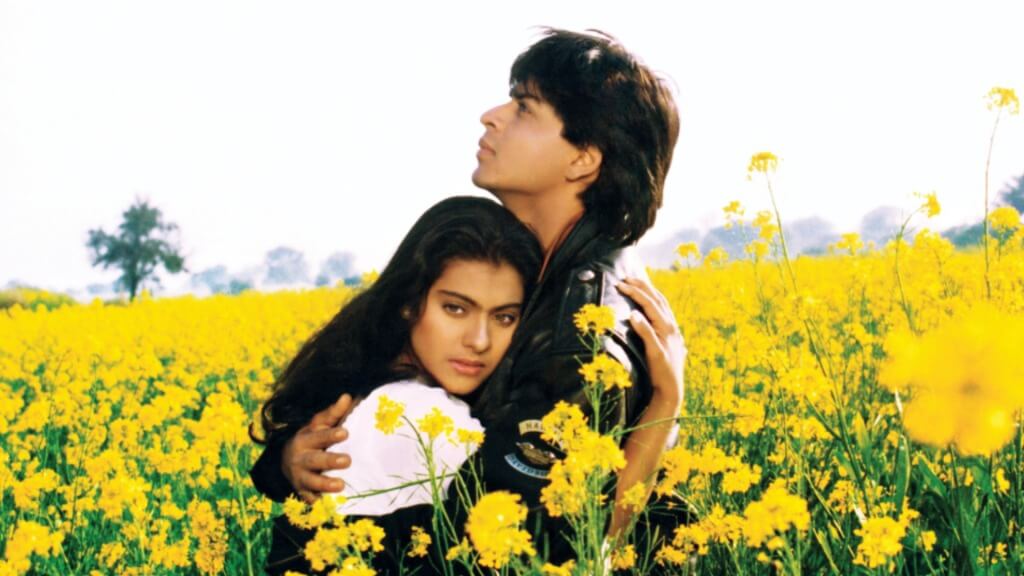
The only real way to begin with Shah Rukh Khan is 1995’s Dilwale Dulhaniya Le Jayenge (DDLJ). This three-hour rom-com, which is still screening in a frequently sold-out Mumbai theater, left a major imprint on Bollywood and beyond. It’s a deceptively simple tale of two people living in London, Raj (Khan) and Simran (Kajol), who fall in love during a month-long trip to Europe with their respective friend groups. Aware that Simran’s father will disapprove, Raj flies to the fields of Punjab to woo her entire extended family so that they don’t marry her off to someone else. While being firmly rooted in tradition, DDLJ still feels cosmopolitan in its international setting and exploration of non-resident Indian (NRI) culture. While it’s Khan’s most popular film, the actor was reluctant to switch into loverboy mode. His claim-to-fame had previously been villainous roles in Darr, Baazigar, and Anjaam, but in the wake of DDLJ‘s success, he necessarily entered his soft guy era.
His pivot from maniacal and obsessive men to someone starry-eyed, vulnerable, and sweet was instantly influential at the time—which is noteworthy because his previous attempt at this archetype, in 1994’s underrated Kabhi Haan Kabhi Naa, didn’t land. Khan went on to cement this romantic persona over the next decade with accessible films like Dil To Pagal Hai, Kuch Kuch Hota Hai, Mohabbatein, Kabhi Khushi Kabhi Gham, Kal Ho Na Ho, and Jab Tak Hai Jaan. These movies aren’t just an intro to Khan, but also to a paint-by-the-numbers version of Bollywood blockbusters, replete with colorful outfits, addictive musical numbers, and sentimental storylines. The beauty of his performances in them, though, is that despite each character’s varying levels of cockiness, Khan makes them both affable and desirable.
It helps that he’s an expressive actor—his intense eyes convey feelings more than any scripted dialogue. In Netflix’s 2023 docuseries The Romantics, Khan recalled why DDLJ director Aditya Chopra wanted to cast him: “He used to always say this, ‘Your eyes have something that cannot just be wasted on action.'” It’s like Khan is staring into your soul through the screen, which makes his work incredibly effective. To cap off this decade-long era, it’s essential to dive into 2007’s Om Shanti Om. A true-blue entertainer, the Farah Khan-directed OSO is equal parts funny, dramatic, and action-packed, taking place in two distinct timelines. In 1977, Om (Khan) is a background artist hopelessly attracted to actress Shanti Priya (Deepika Padukone). 30 years later, Om reincarnates and seeks revenge on the man responsible for his and Shanti’s murder in their previous life. Khan makes a meal out of this deranged Crow-like tale, leaning into the histrionics, but still ultimately delivering that trademark romance hero.
Intermediate Studies: Rising above cheesiness
Khan’s attempts to subvert expectations around that simple trademark are sprinkled throughout several politically-minded films, starting as early as 1998’s Dil Se.. In it, he’s a radio journalist on assignment to interview extremist rebels declaring war on the government. Along the way, he’s smitten by and relentlessly pursues the mysterious Meghna (Manisha Koirala), who has ties to the activities he’s investigating. One shockingly well-lit scene, when they’re stranded in the dunes and have a conversation about their likes and dislikes, is particularly memorable (as is this musical number, which was filmed atop a moving train).
Amar and Meghna’s relationship sits at the core of Dil Se.., but Mani Ratnam’s film actually confronts the country’s political unrest post-independence, and how people are coping with religious and other divisions. Dil Se.. ends in tragedy, but Khan has mostly chosen films about India that tend to carry a message of hopefulness instead of focusing on vitriol and propaganda (an unfortunately common occurrence in Bollywood in recent years), possibly shaped by his own identity as a Muslim.
Look at 2004’s Main Hoon Na, a dramedy about an army man who pretends to be a college student because of his latest mission. MHN presents an ultra-optimistic take on the tumultuous relationship between India and Pakistan in a way that Bollywood often avoids (especially recently). Khan also starred in Veer-Zaara (a star-crossed love story between an Indian man and a Pakistani woman) and Swades that same year. The latter boasts his career-best work as NASA scientist Mohan Bhargav, who confronts his responsibility to his homeland after visiting an Indian village to reunite with his childhood nanny. There’s a romantic subplot, but it’s not the driving force of Swades nor of Khan’s intense but moving performance.
He shows this same type of ferocity in 2007’s Chak De! India as Kabir, the coach of a female-only hockey team struggling to stay afloat. It has the predictable beats of any sports drama about an underdog team, yet Chak De! is special because Khan sheds his go-to techniques. He strips off the armor of charm and flirtatiousness to play a man driven solely by his love of the literal game. 2010’s My Name Is Khan takes place against the backdrop of events like Hurricane Katrina and a major Presidential election. Rizwan (Khan) is autistic, and after his teen stepson is killed in an act of hate post-9/11, he goes on an odyssey across the U.S. to understand why this happened. MNIK isn’t just grappling with geopolitical issues, but portrays someone on the spectrum with nuance.
Even amid his recent swivel to full-throttle action, 2024’s Jawan is a neat reminder of his acting prowess. Plenty of punches are thrown around by Khan’s Vikram, a Special Ops commando, and later, by Azad (Khan), Vikram’s grown-up son. This non-linear, hypnotic, extremely macho story, is still one about vigilantism and corruption in India, with Khan, as ubiquitous as ever, as its face of hope. (During one thrilling scene, he essentially breaks the fourth wall to talk to the nation about why voting—and voting for the right person—matters.)
Advanced Studies: Hidden modern gems
Even someone of Khan’s scale has underappreciated films in which he shines as a performer. 2016’s sleek thriller Fan is a no-brainer, in part because of its astute commentary on what Khan and Letterman discussed in regard to fame and fandom. In a dual role, the actor stars as Aryan, a Bollywood superstar, and Gaurav, an Aryan lookalike in New Delhi who aspires to meet his favorite hero, traveling to Mumbai to get a glimpse of him. Sounds eerily true to life, no? Khan culls from his real experiences to play both parts, selling a provocative tale about blurring boundaries and the parasocial relationships between actors and their audience.
That same year, he also gave an unsung turn in Dear Zindagi, a taboo-breaking Hindi-language drama about therapy. In his supporting role as Dr. Jehangir, who helps a young Kaira (Alia Bhatt) deal with her trauma, he exudes emotional maturity without his character ever needing to woo a woman or groove to a song (although he does politely reject the advances of his patient). It’s a refreshing change of pace for Khan, who, like in Chak De!, rewires the brains of his devoted audience to remind them of his abilities when he’s cast in a role well-suited for his age. Another recent sleeper is 2017’s Jab Harry Met Sejal, in which he’s a jaded tour guide in Europe whose perception of life changes when he’s forced to help a client find her missing wedding ring. The film works as an unexpected romance because Harry (Khan) isn’t a young dude traipsing around like Raj in DDLJ. He’s heartbroken because of his profound experiences, with Khan wearing Harry’s depth and heart on his sleeve.
It’s a skill he can flex no matter the quality of the film, which helps make all his work enjoyable and has helped him rule over Bollywood for decades. But so too has his willingness to adapt to the times and rediscover himself on the screen; his career has had so many mini-phases, from playing it safe with remakes like Don to a failed attempt at sci-fi in Ra.One, that his filmography would need multiple Primers to be fully comprehensive. Ultimately, though, the reason Khan continues to attract a cult-like devotion is that he approaches cinema with a single-mindedness: To entertain at all costs, which includes doing his signature pose a million times. Perhaps it’s that dedication to the form, whatever genre it or tone it may take, that transcends him beyond “movie star” to something else entirely.


 Keep scrolling for more great stories.