It’s into this environment that Barry, a military deserter, gambler, and irascible duelist, brings his horny hot-headed chaos. He’s a rampaging fool loose in a manor, revealing the imperfections of all who reside within. His own self-important mythmaking is punctured plenty, not only by the events of the story but by Kubrick’s camera—a series of slow backwards zooms strand the character in the larger world around him. Like Martin Scorsese’s The Age Of Innocence, Lyndon finds eternal truths in its lush look at the past.
But Kubrick’s biggest swing at human depth was a film he’d made a decade earlier: 2001: A Space Odyssey. His exploratory collaboration with sci-fi royalty Arthur C. Clarke flew from violent earthbound apes to the ends of the universe, containing all of human potential in a transcendent, psychedelic battle between cold logic and sublime emotion—one that just so happened to pioneer visions of spaceflight, futurist design, and artificial intelligence that were on the cutting-edge of real-life science and continue to influence modern science fiction. It’s fitting that a stark black obelisk is so central to 2001, as the film is nothing if not a monolith.
In their attempt to tell the story of everything, HAL 9000 and the Star Child changed it all. No onboard computer or classical-scored space sequence or ambiguous mindfuck ending since 1968 has truly stood alone. Kubrick determined how space looked, sounded, and felt in 2001—graceful and clean; elegant and bouncy; unsettlingly vast—before humans actually landed on the Moon, and he did so while striving for something even loftier. 2001 arrived when mainstream culture was floundering, when the squares were struggling to square up with the ennui of Vietnam and the tail-end of the civil rights movement, and when the counterculture was looking elsewhere for comfort. When 2001 finally found its audience of mind-expanded youths, the film started getting marketed as “the ultimate trip.”
But even a project of this ambition centers around failure, misdirection, and Dr. David Bowman (Keir Dullea) getting in way over his head. The film’s insect-small astronauts must overcome their malfunctioning AI (who fails in his own attempts at making the vessel human-free), the dangers of space travel, and the masking of their real objective. And that’s before Bowman falls headfirst into the Star Gate and all abstract hell breaks loose. Like Dullea’s performance, Bowman is functional and static; there’s a reason people remember HAL, not the humans. But then he’s confronted with something completely foreign to that mode: the curious, colorful, inviting infinite. He sees his end, returns to his beginning, and becomes something greater than petty achievements and failures.
If 2001 stands as Kubrick’s most serious-minded and profound film, it finds its unlikely match with the movie he made right before it, Dr. Strangelove Or: How I Learned To Stop Worrying And Love The Bomb, which tackles a subject of similar profundity with absurd silliness and far more pessimism. An incisive war room satire at the end of the world, Dr. Strangelove is about idiots in the specific, with a cavalcade of dolts played by Peter Sellers alone, and in general—none of the film’s events would’ve escalated if not for humanity’s commitment to geopolitical buffoonery during the Cold War and beyond.
This was the only way to turn Peter George’s novel Red Alert from a harrowing thriller into a more palatable (but no less bleak) comedy. It still mostly looks like a sober Kubrick film, until the end at least, and sounds like one in its dedication to the technical procedures around the dropping of nuclear bombs. But even when Sellers and George C. Scott aren’t mugging, the real workings of governments and militaries are rightfully portrayed as worth laughing at, if only because the alternative is too terrifying to consider. Humankind’s destruction is mutually assured, and Kubrick was able to find that kind of funny.
Intermediate Studies: War and lust
But Dr. Strangelove wasn’t the first time Kubrick would deflate jingoism, nor was it the first time he’d fall head over heels for the goofball antics of Peter Sellers. Before and after his standalone epics, the filmmaker pursued his preoccupations with the major forces in moviemaking—sex and violence—on a smaller, yet no less critical, scale.
The smallest of these is Lolita, his broad and farcical adaptation (scripted by original novelist Vladimir Nabokov) about the downfall of an owlish hebephile. The director’s ability to stage a scene that’s both torrid and distant is a necessity as Humbert Humbert (James Mason) lusts after and eventually rapes his landlady’s adolescent daughter (Sue Lyon). It’s rightfully upsetting and the film is certainly cruel enough to convince its audience that it’s coming from Humbert’s perspective, but what’s less functional is Kubrick’s dry humor (and his indulgence in Sellers’ meandering) throughout. Yet, beyond its central taboo and its endless innuendos, Lolita reveals a glimmer of Kubrick’s abilities with actresses; Lyon is confident and sharp, at times toying with Humbert as a coping mechanism and at others allowing the pain and loathing her character truly feels to bleed through. It’s a complex performance pushing forward material that’s still being misunderstood.
Much of this matures into brilliance more than 30 years later in Kubrick’s final film, Eyes Wide Shut. Take one look at any of the looks Nicole Kidman throws Tom Cruise’s way, and you’ll see a dashed dream in her eyes, one that matches the ethereal and nightmarish ghost town of the film’s New York City. Their marriage has dissolved into cold indifference, though there’s still something primal inside—(un)comfortable love and prickly lust, complacency and jealousy, coexisting. Pushing these forces together, Kubrick ironically utilizes some of his most distancing visual techniques as he sends Bill (Cruise) off on a twilight adventure filled with eroticism that ranges from sadly desperate to ritualistically extravagant.
But the sexual degeneracy of the Epstein elite isn’t really what Eyes Wide Shut is all about, despite its central set piece. It’s about marriage and power, about bringing a self-important man down to earth, crushing him with the boundaries of his social striving and the fantasies of his own (at the time, real-life) wife. Yet, even after the entire film was push-processed to emphasize the unreality of the lights and colors, glowing with a persistence that burns past nostalgia, and Bill survives being unmasked at a secret society’s orgy, the couple ends up back at home, together, ready to overcome the fear of the unknown with a definitively earthy and knowable solution.
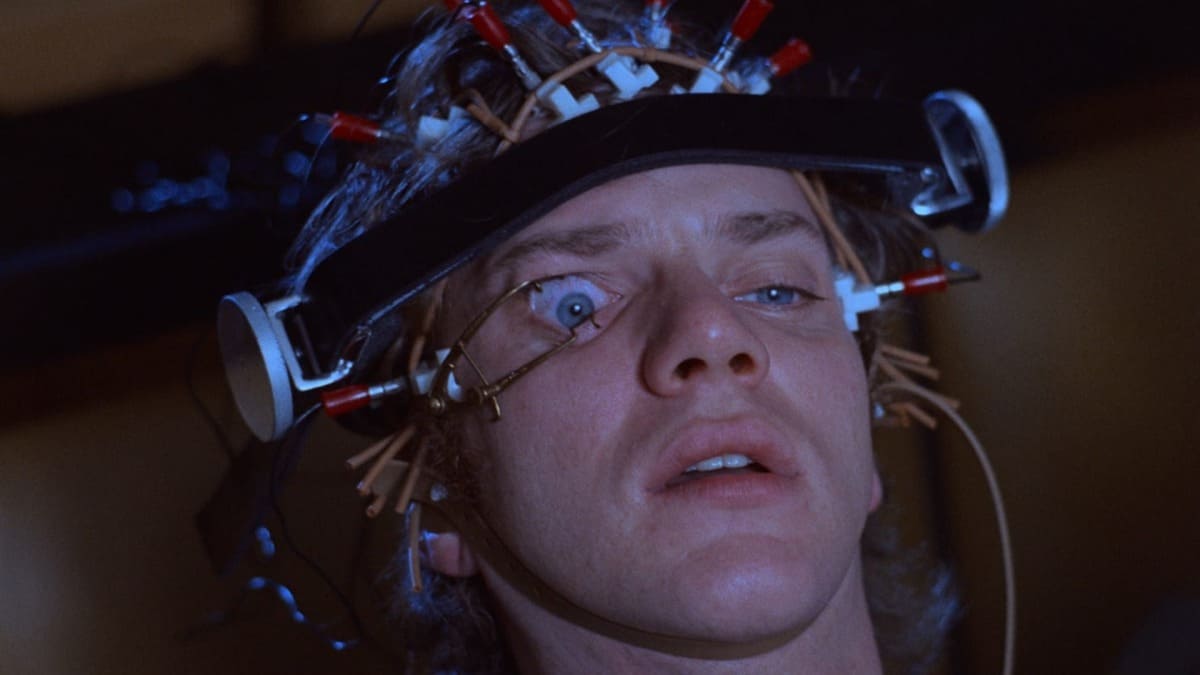
Kubrick’s other deeply sexualized film, A Clockwork Orange, directly connects the old in-and-out to ultra-violence. Kubrick’s take on Anthony Burgess’ dystopian novel attempts to restrain the animalistic evils of Alex (Malcolm McDowell) with the wonders of modern psychology, but the “Ludovico Technique” conditioning him in the opposite direction isn’t much more civilized.
Kubrick’s dark joke is that there isn’t much civilization left to compare it all to. Sure, a totalitarian government is cracking down on free will, but what are young people doing with their free will? Raping and pillaging, like nihilist barbarians who’ve crashed through the gate. Despite lingering remnants of art, like the all-important Beethoven who catches unintended strays during Alex’s aversion therapy, A Clockwork Orange takes place in a garish world just a few steps away from the id-driven hellscape of Idiocracy. Of course it would take something just as garish to critique it all.
Similarly, Kubrick’s two full-on war movies—Full Metal Jacket and Paths Of Glory—address their shared subject with visible contempt. The brutal, debasing boot camp lorded over by R. Lee Ermey in a role that would define his career quickly establishes what war, even the preparation to go to war, does to men from the very beginning of Full Metal Jacket. The torture and subsequent death of Private Leonard Lawrence (Vincent D’Onofrio) is among Kubrick’s most nauseating work, so potent that it often overwhelms audience’s memories of the entire film. Anyone saying that they prefer the back half of Full Metal Jacket is lying, but even that section of the film is abrasive in its self-destructive pointlessness. War is hell, but something in soldiers is killed before they even ship out.
If that’s a specifically Vietnam-era critique of war, Paths Of Glory displays its disdain by deconstructing the oversimplified heroism of the World Wars. Kirk Douglas stands alone as a WWI colonel with uncommon moral backbone, who turns lawyer when three of his soldiers are scapegoated after a disastrously botched attack. After some staggering battlefield scenes, which harken back to the newsreels of the actual wars thanks to their black-and-white cinematography, the film shifts to a human-scale power struggle between higher-ups covering their asses and peons paying the price. In the middle is the upright and impotent Douglas, who tries and fails to stand up for what’s right.
Advanced Studies: Journeyman jobs and early experiments
That experience was affecting enough that Douglas called Kubrick in a few years later when the actor fired Anthony Mann from Spartacus, the only film Kubrick ever exhibited less-than-perfect control over. Taking over after a single week of shooting, the director stepped into the big leagues almost by accident, the traditional remnants of which are still present in the sword-and-sandals behemoth’s stiff romance, plodding plot, and blocky leading man.
Yet, there’s plenty of Kubrick remaining in this unwieldy project, which threatens to sprawl off the edges of its ultra-wide screen and bleed Dalton Trumbo’s blending of Roman and American histories into modernity. Laurence Olivier, Charles Laughton, and Peter Ustinov all play ritzy Romans both pathetic and powerful, ready to be defeated in the colosseum of ideas by rebelling everymen. Crowdpleasing Hollywood simplicity is complicated by visual meticulousness and a HUAC-skewering thematic undercurrent, making for an unlikely hit and a film that never feels quite like Kubrick despite its powerful and entertaining subversions.
The only other film Kubrick made that doesn’t quite feel like his is his first experimental feature, Fear And Desire, which is even less of a kind with his oeuvre than his trio of short documentaries (all of which have been restored for The Complete Kubrick and are worth checking out). A meandering and tepid critique of the “police action” in Korea, filled with purple prose in both dialogue and voiceover, Kubrick’s debut is immature and out of control compared even to his first-ever work, the boxing short Day Of The Fight.
Frank Silvera, who would appear in Kubrick’s much better follow-up Killer’s Kiss, finds the most humanity in the quartet of soldiers crash-landed behind enemy lines by going grimier and gruffer than his cohorts. This grounds some of Fear And Desire‘s strained metaphors and abstract intellectualizing, both tells of a young twentysomething behind the camera, especially when Kubrick relents to his pull towards faces. A mid-movie freakout is both the film’s most striking scene and the director’s first example of that disconcerting straight-at-the-camera stare that pops up in so many of his future films.
The two directly following Fear And Desire, Killer’s Kiss and The Killing, make up the pupal phase of Kubrick’s career, which itself ends with Kubrick joyously breaking free from the chrysalis of cheap, bankable thrills. The pair of noirs aren’t masterpieces (though the latter might be close), but their pacing is tight, their framings evocative, and their camera moves exciting. Like any film genre whose beats and conventions can be recited from memory, noirs gave artists industry-approved brushes and paints with which to work. Kubrick made the most of these store-bought supplies, first in the independently-shot and visibly scrappy Killer’s Kiss (which is a lot more like his on-the-streets docs than Fear And Desire), then with The Killing, a more assured heist film with studio financing.
The Killing is the bridge film that lays out the game plan for an entire career: A ridiculously complicated and thoughtfully assembled plan blows up in everyone’s faces due to human error. Swagger and sweat meet on the same tense faces, crime looks like it’s going to pay until the last possible second, and hardened criminals collapse like so many perfectionist filmmakers confronted by the failures of those around them. Tough, lean, mean, and shot with a fluid control that its hapless characters wish they had, it’s the film Kubrick would consider his first mature work; now it stands as the film with one foot in his past and one in his future.


 Keep scrolling for more great stories.