Punch “Golden Sands” into your map app of choice, and you’ll get a handful of results in the contiguous United States: A few beachside destinations up and down the East Coast; a public golf course and events space in the middle of what Midwesterners earnestly call Michigan’s West Coast. But the Golden Sands that serves as the point of origin for Programme 4 is nowhere to be seen—it exists only in the imagination of Los Angeles-based multi-hyphenate Rachel Lichtman. Though there is a now-defunct motel by that name in Michigan City, IN, within signal range of the childhood home where the seeds for Lichtman’s “feature-length ‘broadcast’ from the Botany 500 age of television” were planted by regionally specific sights and sounds like Son Of Svengoolie and the low-pitched calling card of Bouchelle, The Cleaning People. (“Hudson 3-2-700!”).
“Growing up in the ’70s and ’80s as a child, you’ve existed in a world where typography, design, interiors, architecture, jingles, logos—they were done with a certain type of intention, and there was an aspirational quality to so much of it,” Lichtman tells The A.V. Club of her inspirations for Programme 4. “We’re the shittiest steakhouse in town, but our logo tells you otherwise.”
Courtesy of Rachel Lichtman
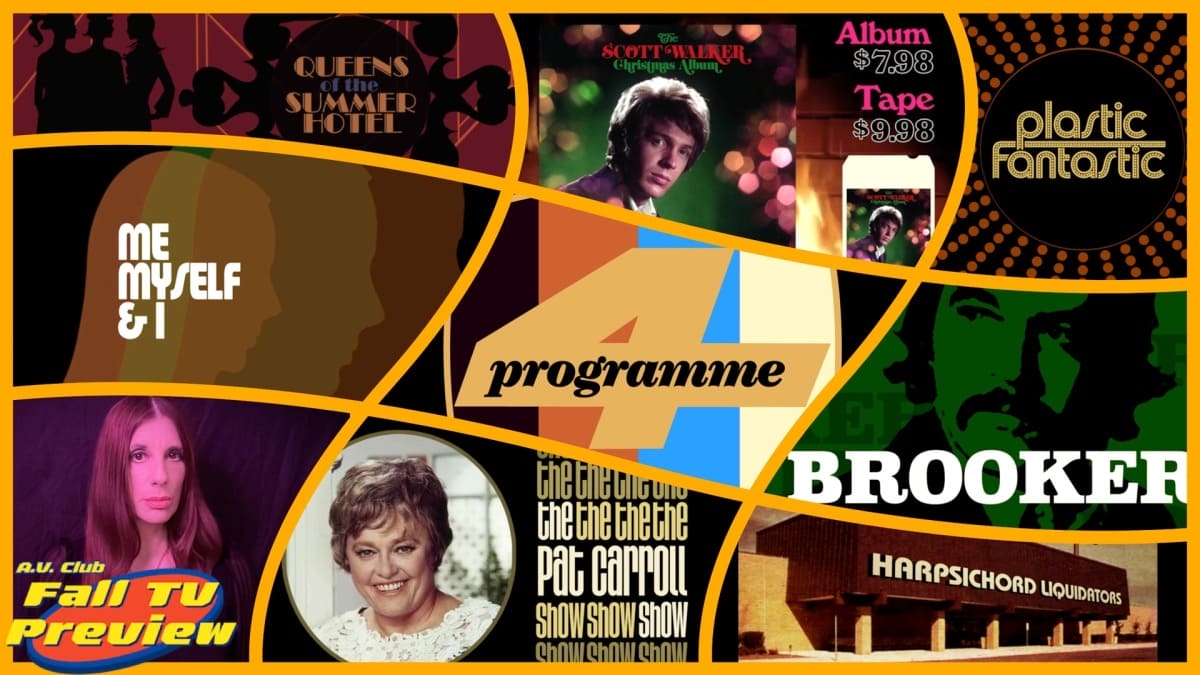
That disparity—the gulf between, say, how poorly the food at Buddy Rich’s Fucking Clams photographs and the care Lichtman took in crafting the branding for a fictional business whose name alludes to actual audio of drumming legend Rich blowing his top—is where you’ll find much of the comedy in Golden Sands’ alternate reality of browns and oranges, shag carpeting, and indoor smoking. But like any broadcaster worth its salt, Programme 4 is more than comedy. It’s music, in videos for the likes of Aimee Mann and Joe Pernice bearing Lichtman’s signature retro-cool flair. It’s variety, be it the brassy chorus of voices in the supporting cast of The Pat Carroll Show (“Close your eyes and guess which one’s talking! Ha HAAAA!”) or the quick-cut, Laugh-In-on-European-vacation stylings of Plastic Fantastic. It’s something that its creator can sum up in all honesty as “spiritual.”
And while the location of Rich’s restaurant and neighboring establishments like Panozzo-Wenneker Harpsichord Liquidators (“Act now and receive a complimentary ruffled shirt with every purchase!”) may only be a state of mind, the city limits of Golden Sands are expanding all the time. In the coming weeks, they’ll encompass Toronto, Philadelphia, and Lichtman’s old Chicagoland stomping grounds, via the latest round of Programme 4 tour dates. Given the timing of these live shows, and the entire enterprise’s echoes of the days when fall meant refreshed primetime lineups and an extra thick issue of a daily newspaper’s weekly TV supplement, The A.V. Club figured it was a good time to phone Lichtman up and have her walk us through what her “local station for a certain vibration” has on tap for this season and beyond.
9 a.m.: Me Myself & I
Educational: Center yourself and your morning before asking that all important question: “Do I really want to leave the house?”
Among the newer additions to the version of Programme 4 that Lichtman has shown in clubs and cinemas throughout 2026 is a segment fashioned after public-TV “self-actualization shows for children” from the ’70s.
“The one we see is for something called ‘Better Stay In,’” she says of Me Myself & I, “about a young girl who would prefer to stay indoors versus go outside where it’s scary. And that is how I think most people feel right now.”
Such feelings were a major motivating factor for taking Programme 4 on the road. The contours of Golden Sands filled in during the COVID-19 pandemic, as Lichtman assembled the pieces of Programme 4 and its audio counterpart, Easy AM 66, as a method of both self-soothing and self-humoring. “It was such a terrible time,” she says. “And that continues apace, where I’m like, ‘I’m just going to stay in Golden Sands. And I’m just going to bring everybody with me.”
Hence the immersive, transportive atmosphere of the Programme 4 experience. A prelude of period-appropriate hits played on that most mellow of instruments, the Rhodes piano. Emcees clad in all manner of synthetic fibers. The idea, as Lichtman puts it, is to cultivate an environment that’s comfortable, inviting, and convenient enough to coax people out into the real world.
“What would prevent me from going to a thing?” Lichtman asks, hypothetically. “Let’s eliminate that thing: Is it too loud? Is it hard to park? Is it too late? Does it run too long? Is it crowded?”
In a way, television (or a simulation thereof) could come across as an odd medium for this message. After all, what pre-smartphone device did more to keep people at home and from interacting with one another? But that’s ignoring some of the nobler, noncommercial aims of any broadcast venture: to enrich the lives of their audiences, and forge connections between individuals watching the same thing despite being separated by distances as vast as a continent and as short as an apartment-building hallway. The traveling edition of Programme 4 is achieving those same goals—it’s just that there’s only one screen, and it’s bigger than anything that might fit in the average living room.
“People give over to the sort of feeling of ‘I’m home sick from school and I’m just going to sit and watch whatever’s on,” Lichtman says. “You’re not really a participant in what’s happening to you. And that is part of the experience. The most analog thing of all is paying attention to something for a while and not having the ability to participate in it.”
3 p.m.: Now O’ Clock Movie: The Queens Of The Summer Hotel
Drama: Edythe Isaacson’s “The Complicated Women Of Pendleton Place” come to complicated life in the guises of Lee Kramer, Louise Sands, and promising newcomer Aimee Mann. (120 minutes, ★★ 1/2)
Partway through Programme 4’s first act, the mood shifts. After “about 23 minutes of nonstop jokes” (by Lichtman’s count) comes the Now O’Clock’spresentation of The Queens Of The Summer Hotel. The name ought to ring a bell for Aimee Mann fans (or observers of delayed Broadway productions) well before the first note of sorrowful brass hits: We’re hearing the final track from the 2021 album that gives this fake movie its title, a collection of Mann’s compositions for a musical adaptation of Girl, Interrupted that finally made it to the stage this year. In Lichtman’s hands, “I See You” is the theme song to a feature that suggests what it would look like if Susanna Keysen’s chronicle of her time in psychiatric care were adapted during the age of Valley Of The Dolls.
“It’s the opening titles for something that could not be more emotionally vulnerable,” Lichtman says. “You can hear a pin drop in the theater when that thing is running.”
The segment is a swerve in tone, but not necessarily content. Up to and following the Now O’Clock Movie, even in some of its funniest material, there’s a thread of loneliness and melancholy running through Programme 4. Where else but Golden Sands could you pick up The Scott Walker Christmas Album, the baroque-pop crooner’s musical tribute to “the most introspective time of the year”?
The make-believe viewers at home and the advertisers and producers pitching them carpeted garages and blowout sales on paintings of “Chances Are” singer Johnny Mathis are trying to fill a perceived hole in their lives. The real world where Lichtman and other Gen Xers were raised saw all sorts of unorthodox remedies for these maladies come into vogue: genuine psychotherapy, but also woo-woo nonsense like EST and Esalen. It’s one of the big “What if?”s Programme 4 poses: Picture a mid-century world where getting in touch with yourself and your feelings were activities as valid and mainstream as the “adult drag” (to borrow a phrase from Lichtman) of spending a Saturday night in the neighbor’s rumpus room drinking, smoking, and playing cards.
“You’re talking about an era pretty much defined by a postwar idea of family, masculinity, and feminism, where basically kids in their early 20s were expected to have children and get married, and there was a lot of trauma under the surface of all of that,” Lichtman says. “They didn’t know what they were doing, so they did what their parents did.”
“I think it’s part of the reason why so many Boomers grew up to have real midlife crisis situations. They weren’t really provided an environment to sort of figure out who they were as people before they started procreating.”
Make no mistake: Golden Sands, while a nice retreat from the noise of 2026, isn’t perfect. Its problems are our problems, too—that’s why a riff on Secret deodorant’s long-running “strong enough for a man, but made for a woman” campaign has proven to be one of the biggest laughs of the live show.
Courtesy of Rachel Lichtman
“It’s certainly not something where we’re looking back and saying, ‘Oh, things were so much better then,” Lichtman says. “That’s not what we’re doing here. The thing about Programme 4 is ‘What if there was a world where we just never stopped using this style?’”
“It was just different,” she continues. “It wasn’t better. It was better looking. But it had its own issues.”
8 p.m.: Brooker
Drama: Procol Harum’s Gary Brooker and Keith Reid investigate crimes in a world where the line between justice and injustice is thin, but not blue—it’s a whiter shade of pale.
There are layers upon layers to Programme 4. Sometimes that means getting hit by the unexpected emotional undercurrent of a segment, or connecting the onscreen title of Sean Wolcott’s instrumental “The Shield That Holds The Sun” to the footage of solar-panel installation it’s paired with. And sometimes it’s simply the quick recognition of “Yeah, the mustachioed guy from Procol Harum does look like a salt-of-the-earth detective in the mold of Cannon or Columbo.”
“I literally was like, I don’t even know why I’m doing this,” Lichtman says of the theme sequence, a companion of sorts to one earlier in Programme 4 that places the members of sunshine-pop quintet The 5th Dimension at the center of a Quinn Martin production titled Take The Fifth. “And I sent it to one person when it was done and I’m like, ‘Well, there you have it. This is for me and you, sir.’ And he said to me, ‘You might be surprised.’ And you know what? More often than not, people love Brooker.”
I mention to Lichtman that this reminds me of Joel Hodgson’s credo for Mystery Science Theater 3000—“the right people will get it”—and she sparks to the comparison. The influence of MST3K on Programme 4 and Easy AM 66 is as readily apparent in the volume of their jokes and the depth and breadth of their reference points as it is the direct contributions MST alumni Trace Beaulieu and Frank Conniff have made to the projects. Lichtman says she finds additional inspiration in the way the show was able to thrive and find its audience outside of traditional showbiz channels.
“I look at the Mystery Science Theater path, of like, ‘Here comes cable television,’” she says. “It’s kind of the Wild West. And nobody is really making a lot of TV specific to these channels, which are brand new [at the time]. And things were given a chance and they were given room to breathe in a way that normally would not happen. And so that is how I keep myself looking forward—it’s like jumping and having a net appear. I am able to do whatever I want with this.”
And with that comes a certain confidence in her decision-making: about the art she makes, who she makes it with, and the types of jokes it contains. (For the latter: “the dumber the better.”)
“The whole process has taught me to really trust myself,” she says. “This is just how I want to be.”
10 p.m.: Plastic Fantastic
Variety: Far-out musical and comedy transmissions from outside of Golden Sands’ orbit. Featuring: Percy & Sheridan, The George LaMontelle Affair, The Dick Gautier Singers, The Larry Finger Sound, and more!
So what does the future hold for Rachel Lichtman and the Golden Sands universe? She has no shortage of ideas she’d like to execute given the time and resources. “One of my dreams is to have the money to be able to produce a new Grey Whistle Test,” she says, alluding to the BBC show that provided a key source of TV exposure for rock acts of the ’70s and ’80s. Lichtman pitches her version as taking the form of Plastic Fantastic, the variety show parody that closes out the first half of Programme 4.
“I thought like, God, it would be so amazing to do like a full version of that—a real half hour. Fake commercials, some fake artists, some real artists, set design, promo films, et cetera. There’s so many shows like that from all over the world that are just gorgeous. And we’re really missing one of those—I’m sort of the guy to do that, you know?”
As the real-world counterparts of Programme 4 continue to be gobbled up by media conglomerates that then either gobble up or merge with other media conglomerates, the need for art and entertainment produced independently and without corporate interference will only grow more urgent. It’s not like either of the two companies that were just smooshed together to make Skydance were ever going to bankroll a sorta-TV, sorta-film product that simultaneously echoes Free To Be… You And Me and SCTV, but hundreds, if not thousands of talented people get squeezed out of a chance to express themselves for a living every time one of these abominations emerges unscathed from FTC review. Lichtman is happy to provide safe harbor to her friends and like-minded artists whose options for getting their work out into the world are shrinking by the day. Speaking of the “I See You” video, she likens Programme 4 to a gallery where projects can be discovered and rediscovered long after their initial promotional cycle ends.
The tricky part, as Mann, Wolcott, Beaulieu, Conniff, or any other honorary citizen of Golden Sands can tell you, is in keeping these personal, cultishly beloved projects financially viable. By Lichtman’s own admission, these live dates aren’t cheap, but they’re the best method she’s found for getting Programme 4 out into the world. The bespoke live supplements—movie-theater policy trailers cut together for a screening at L.A.’s Vidiots, R.E.M.’s Mike Mills showing up at an Athens show to sing Neil Sedaka’s “Laughter In The Rain”—are now part and parcel with an onscreen main attraction that’s been significantly expanded from the cut that once streamed for free online. It helps maintain the shared fantasy that every tour stop is just one “affiliate” in the Programme 4 network, with their own quirks and qualities like the ones local TV stations had prior to our current epoch of media consolidation.
And besides, “money’s money,” Lichtman tells me. As long as it doesn’t completely max her out financially, she’ll keep bringing her “traveling circus” to town and adding more members to its ranks—even if it means investing in an action news van and driving from venue to venue like the Programme 4’s version of the Wienermobile.
“I’ve been doing this for a long time and my reasons for doing it and for starting it had so much more to do with my own sanity than any end game or any metric or any external validation,” she says. “It was so that I could stay in a place that I enjoyed being in and connect with my work. There’s a very spiritual aspect to that. That is the thing that I think is the most important to reconnect to: the collective joy and the reason why we’re all doing what we do. The love of the game, you know?”




 Keep scrolling for more great stories.