While it’s traditionally more common for video games to borrow from tabletop gaming, Dungeons & Dragons rulesets and all, the upcoming one-on-one board game Re;Match bucks this trend in some interesting ways. Much like Puzzle Fighter, it combines the visuals of fighting games and the logic of tile-matchers, but then mixes this with a strategically deep ruleset fit for its medium. It’s a jump that sounds strange until you’re several matches deep, completely engrossed in thinking through the little nuances of marble arrangements and attack sequences that will determine if your flashy fighter comes out on top.
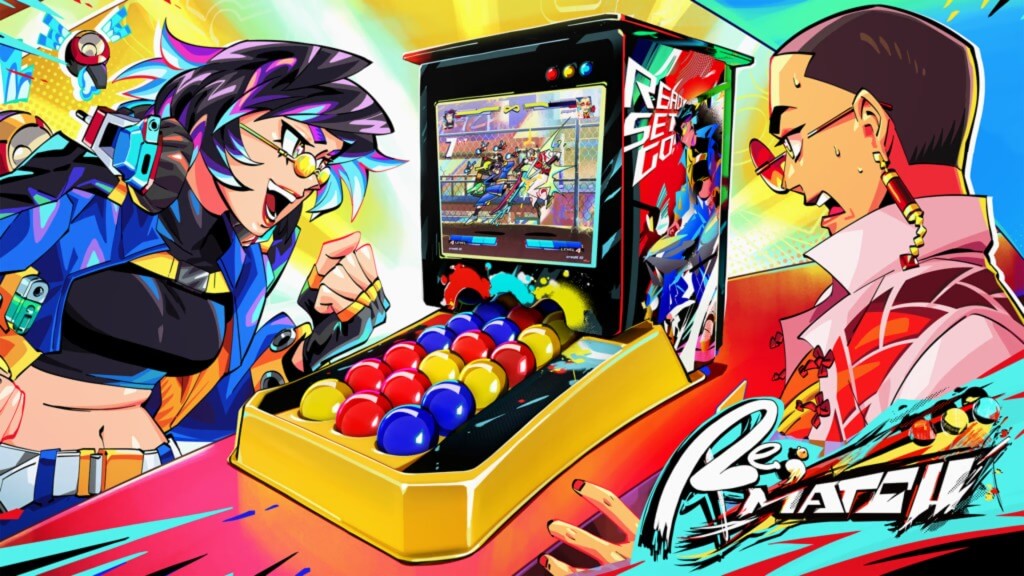
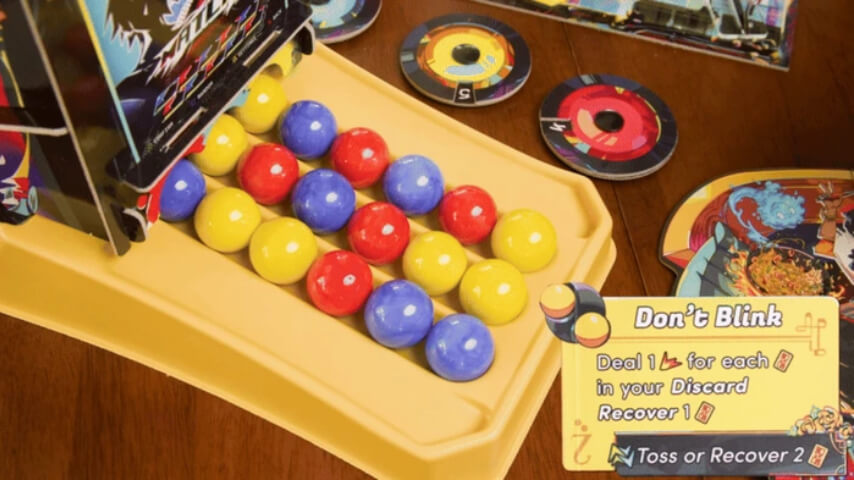
Re;Match translates the screen scrolling of match-three games to a physical medium through a sizable cardboard tower that dispenses yellow, red, and blue marbles into a three-column tray that fits five marbles per column (so 15 in total). Players take turns pulling connected marbles that match colors, with longer chains generally leading to more powerful attacks.
It may sound like there’s a lot of Puzzle Fighter in this setup, but the game quickly finds its own lane with its turn-based approach and distinct cast of six combatants to choose from. Each character has nine base attacks—three for each color—which can be activated by pulling one, two, or four marbles of the same color in sequence. The effects of these vary, but some basic themes are dealing damage (single target or area of effect), destroying marbles, or stealing “fans,” a resource that can give your moves an extra kick.
Despite their baseline similarities, these world warriors’ playstyles are defined by unique systems that give each of them individuality. For example, the Psychic can gain something called Focus after correctly guessing the color of their opponent’s attack. Once they’ve accumulated Focus by reading their foe’s intentions, they can deal big damage. Meanwhile, the Chef is all about control. They summon fire and ice spirits to manipulate the board, freezing lanes so their opponent can’t pull marbles. It also definitely helps that whoever you choose, the character designs by PsyOptima and machimile exude personality, capturing different cultures without the type of caricatures found in Street Fighter 2 and its peers—that’s one bit of fighting game history that they wisely ditched.
The distinct strategies and vibes of this cast smoothly mirror the asymmetrical weirdness of fighting games, a genre where ragebaiting zoners fill the screen with occult traps and projectiles as a sluggish, caveman-like grappler closes the gap to break their spine. Sometimes, fighting game characters are borderline playing a different game, something reflected in Re;Match’s many character-specific keywords and symbols.
These differences make matches all the more exciting because it’s not just about what you’re doing, but how you interact with your opponent’s decision-making. When pulling marbles to attack, you can grab from two out of the three columns: the closest one and the shared middle section. Because the middle column is used by both players, it lets you mess with your opponent’s upcoming combos by pulling or destroying what they want to use next. This creates room for compelling back-and-forths and ensures a match doesn’t turn into Solitaire as one player goes off on a crazy combo.
Beyond deciding which of your nine potential attacks to use and which specific marbles to pull, there’s also the choice of which of your opponent’s buttons you want to attack and how you want to protect your own. Both combatants have red, blue, and yellow buttons that start with 10 health points. To gloss over some of the specifics, there’s supposed to be an element of risk-reward here. If a button breaks, you get closer to ultimately losing, and can’t use attacks that match that button’s color. On top of this, if two buttons are broken at the same time, you have to pay more of your ultimate life force, arcade tokens, to repair them. If all three are broken, then you instantly lose.
However, as long as you choose to keep a button in a broken state instead of fixing it, you gain access to a game-changing ability that makes it easier to get off powerful attacks by connecting marbles you normally wouldn’t be able to. Basically, you can take the time to heal your broken buttons while gaining access to big attacks, but you risk another button breaking. Or you can hastily flip over a broken button to deny your opponent big points at risk of it almost immediately being broken again because you didn’t fully recover its health points yet.
If there’s an issue with the game, it seems the pseudo-comeback mechanic that kicks in once a button breaks is a bit too strong. So strong that going for a near-simultaneous three-button break (which again, is an instant win) almost always feels like a better choice for the attacker rather than destroying buttons individually and giving the other player the time and resources to stage an upset. It’s a shame, because the idea of juggling risk-reward around when to flip over your button seems quite interesting in theory, but both players seem incentivized to never let their opponent reach this state. It’s possible that going for a simultaneous three-button kill is just a beginner’s strategy with clear flaws, and that there’s more going on here that makes it worth focusing attacks on individual buttons, but only time will tell.
Aside from that nitpick, and some issues with the prototype tower not dispensing marbles as smoothly as it could (this is apparently being worked on for the final version), the game is surprisingly sleek despite its seemingly complicated ruleset. Matches can play out fairly quickly, while still offering more than enough time to build up a strategy and get off cool setups; each turn has a lot of weight because of this succinctness. The quick playtime also means there will definitely be many salty runbacks after a buddy narrowly pulls out a victory with a move you didn’t account for. It says a lot that even the toughest losses felt like they traced back to clear mistakes instead of randomness. Not only does Re;Match have an original concept and tactical nuances, but it does something that even many great board games fail to do: it very much respects the player’s time.
While the game’s $100 retail price is undeniably asking a lot, and it would be nice if there were smaller bundles that let players buy characters piecemeal instead of altogether, as a whole, this marble-based battler is extremely promising. With most of its design already done, the biggest final hurdle is likely its upcoming Kickstarter campaign in early March. Hopefully, the game hits its goals, because everything we’ve seen makes it seem like the kind of ingenious one-versus-one battler that will have friends duking it out until they understand every nuance of both their fighter and their opponent’s. It’s an arcade throwback in tabletop form, and that couldn’t be more of a compliment.


 Keep scrolling for more great stories.