In this installment of Staff Picks, editor-in-chief Danette Chavez stumps for Judd Apatow’s latest comedy documentary and senior TV editor Erik Adams recommends Alan Sepinwall’s newest TV tome.
Danette Chavez: Paralyzed By Hope: The Maria Bamford Story
I recently completed the “Judd Apatow comedian-focused documentary” hat trick, following up Mel Brooks: The 99 Year Old Man! and Norm: The Tale Of Norm Macdonaldwith Paralyzed By Hope: The Maria Bamford Story. Apatow and his co-directors Michael Bonfiglio (The 99 Year Old Man!) and Neil Berkeley (Paralyzed By Hope) have put their genial spin on these deep dives, showing as much curiosity as admiration for their subjects, trying in earnest to create as complete a picture as possible. But Paralyzed By Hope has more of a self-portrait feel—Bamford’s influence on the project is undeniable from the beginning, when, after ushering in Apatow and Berkeley, she cheerily accepts delivery of her meds. I don’t mean that Bamford, one of my favorite comedians and the star/creator of the short-lived Lady Dynamite, is controlling or gets in the directors’ way; it’s just clear that there’s no one else who can tell her story.
This is not to say that Apatow and Berkeley shirk their duties as directors—they bear witness to Bamford’s candor and occasional discomfort, and approach high-profile comedians like Stephen Colbert, Conan O’Brien, Tig Notaro, Ron Funches, Patton Oswalt, and Zach Galifianakis for their insights and anecdotes. (Bamford toured with the latter two as The Comedians Of Comedy in the early aughts; the subsequent stand-up special was one of the first films financed and distributed by Netflix.) They even sit down with Ted Sarandos, now co-CEO of Netflix, who says LadyDynamite, which he greenlit in a walk-and-talk with Mitch Hurwitz, is still his favorite Netflix original. (Note to Ted: You’ll find multiple critics who touted the second season of that showright here.) Paralyzed By Hope follows a linear timeline, starting with Bamford’s childhood, which should have been happy but, despite her picturesque home and outwardly perfect mom, was marked by a fear of listening too closely to her intrusive thoughts. College and adulthood yielded more agonizing self-discovery, including her eventual OCD and bipolar diagnoses, but those periods also led her to develop her voice(s) as a performer, putting her on the path to become your favorite comedian’s favorite comedian.
“Weakness is the brand,” Bamford jokes at the start. Throughout the documentary, in archival footage and present-day talking heads, Bamford effortlessly combines light and dark, using her chipper voice to relay some of the most difficult moments in her life. At one point, O’Brien describes Bamford as eschewing artifice and preferring to leave herself exposed, so much so that she can “[feel] every single molecule in the room.” If you’re familiar with Bamford’s stand-up or Lady Dynamite, this will not be new to you. But as Paralyzed By Hope traverses the different eras of Bamford’s life, you become aware of just how long she’s straddled these two sides, and how much fight and joy are left in her. Near the end, Apatow asks Bamford about her hopes for the future, in her career and life in general, and she responds: “I think just enjoying. Yeah, ’cause there’s a lot of good times” ahead. She’s found community—in her husband, at the Public Displays Of Altadena theater group, in the fans she recruits online to test her material on in person—and she’ll continue to write her own story.
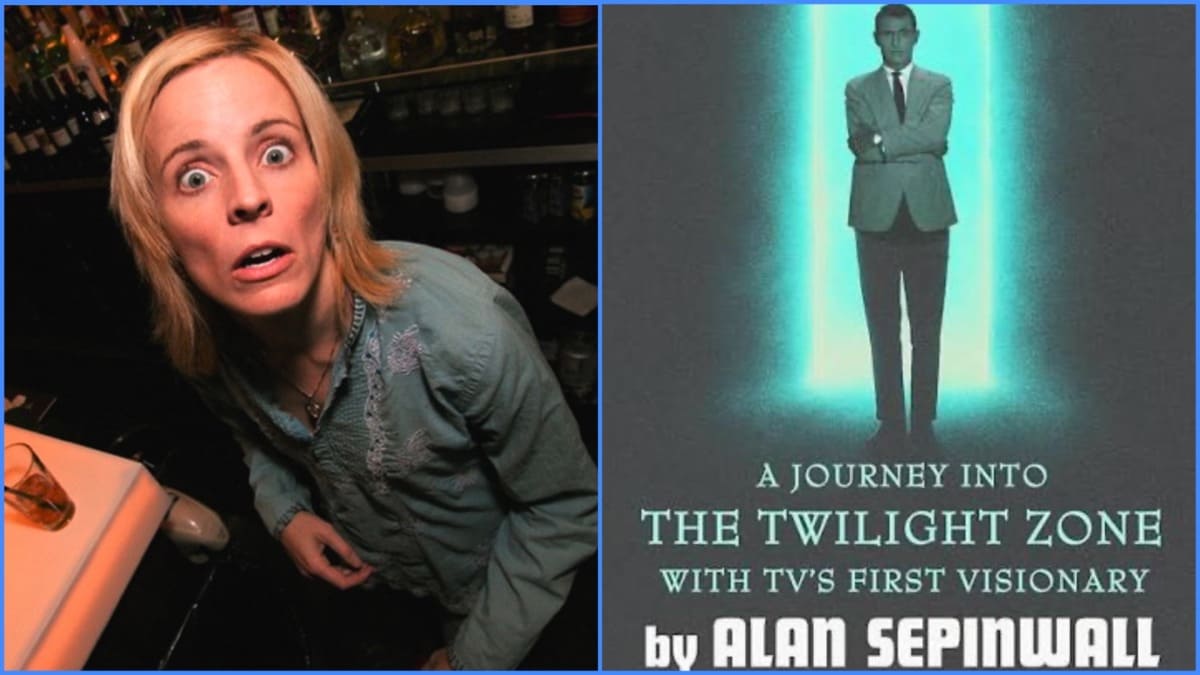
Erik Adams: Serling: A Journey Into The Twilight Zone With TV’s First Visionary by Alan Sepinwall
There is perhaps no subject of more TV scholarship and criticism than The Twilight Zone. And if the classic sci-fi series doesn’t hold that distinction, then its creator and host Rod Serling certainly might. A giant of early television, Serling’s live dramas like Patterns and Requiem For A Heavyweight inspired untold column inches in the newspapers and magazines of the day. On top of all the academic close-reads of his fantastical anthology’s Cold War parables, there’s also The Twilight ZoneCompanion, one of the earliest books to take an exhaustive survey of a single TV series’ entire run. Add to that list—and to the very upper ranks of its end-of-“Time Enough At Last”-sized heap—Serling: A Journey Into The Twilight Zone With TV’s First Visionary, the recently released biography by longtime friend of The A.V. Club Alan Sepinwall.
As Sepinwall makes clear, Serling lived a life worthy of being documented on so many pages. This is, after all, a guy who enlisted in the Army straight out of high school with his sights set on becoming a paratrooper—“with no other consideration,” he later wrote, “other than the knowledge that what I was doing was dramatic and different.” Serling frames this decision, and the three-year tour of duty that followed it, within an analysis of “First Squad, First Platoon,” an early Serling short story about a group of paratroopers that went unpublished until 2024. This is the book’s way of both drawing on and adding something new to the overflowing corpus of Serling studies: While constructing the conventional, chronological narrative, Sepinwall connects each new chapter to a different Serling project—some as obscure as “First Squad, First Platoon,” others among the most storied installments of The Twilight Zone, like the time-traveling homecoming in “Walking Distance.” Bolstering the straightforward biography material with the author’s top-of-the-line insights is a great idea, allowing Sepinwall to put his personal stamp on stories that have been told many times before.
Who’s telling those stories here is unique, too. With primary sources who actually knew Serling now limited to his daughters, their peers, and his former writing students at Anitoch and Ithaca Colleges, Sepinwall grabs his Rolodex and phones up an interesting array of current showbiz types to discuss the influence Serling had on them. There are expected testimonials, like Damon Lindelof attesting to the SerlingDNA in Lost and The Leftovers, but not across dozens of other dimensions of sight, sound, and mind could I have anticipated Rob Mac showing up midway through the book to relate how his dad used The Twilight Zone to show him thatthat “you can say things without actually saying them.” Serling fought tirelessly for his work and the work of other TV creators to be taken seriously, and to be able to explore hot-button issues like civil rights and nuclear war without interference from network executives and sponsors. There’s been a lot written about that legacy, but only in Serling will you find the quotes that trace the line from Serling’s struggles with the censors to a show as unfettered as It’s Always Sunny In Philadelphia.



 Keep scrolling for more great stories.