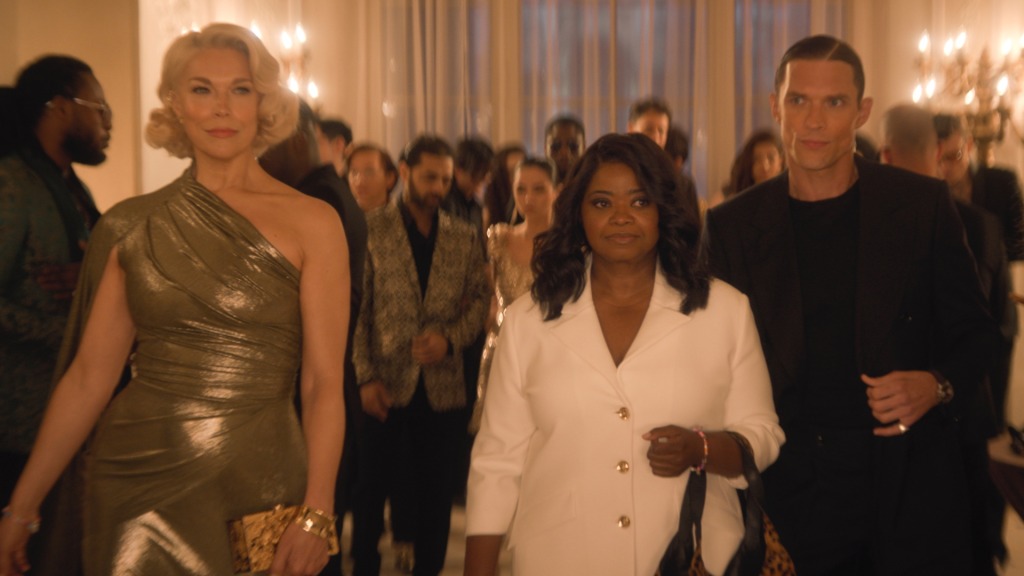
In a world too cowardly to give us Hannah Waddingham as 007, Prime Video’s Ride Or Die is the next best thing. Created by British multihyphenate Tessa Coates, the genre-bending miniseries casts Waddingham as a lady assassin who’s pushing 50 and remains in the game because she’s simply never known anything else. On paper, pairing that character with a best friend played by Octavia Spencer looks like the makings of yet another run-of-the-mill action-comedy about two people who think they know everything about each other—until one of them is forced to reveal that she’s an assassin. In execution, the team-up of Coates, Waddingham, and Spencer creates something far more interesting.
Ride Or Die has one foot planted in comedy while the other grounds its premise in the reality Waddingham’s character, Judith, has created for herself by having a civilian best friend like Spencer’s Debbie. But the show goes the extra mile to show why these two women work the way that they do. We see that Judith has never known real love outside of the friendship she has with Debbie. Debbie, meanwhile, is in a one-sided marriage with a useless would-be politician who can’t so much as tie his shoes without her. As a result, the two leads challenge each other constantly, especially—and perhaps most importantly—when they are not interested in being challenged.
A lot of credit for Ride Or Die’s success goes to the show’s ensemble. At first, it seems as if the focus will be solely on Judith and Debbie’s misadventures but, as the story unfolds, the duo learn they have more folks in their corner (and in the opposing one) than they think. Calam Lynch and Ed Skrein are both unexpected highlights despite their mostly tertiary roles, and their characters both add a level of depth to otherwise one-note spy-fiction archetypes.
Coates cut her teeth in stand-up and with the sketch comedy troupe Massive Dad, and Ride Or Die is her first outing as a solo creator. Fortunately, it doesn’t show: Ride Or Die has all the trappings of a conventional espionage story—charming and promiscuous spies, a lot of silly rules, some plot holes, shocking survivals, etc.—but it also never shies away from bending the genre or forming its own identity.
Better still, the show never once forgets that it’s about women. In one all-timer scene in the middle of season, Judith and Debbie—struggling without the former’s usual network of contacts—turn to a hostel full of party girls and their social-media sleuthing skills to hunt down a drug dealer. The scene may be rooted in stereotype (and the game of a recent Saturday Night Live sketch) but the way it’s executed is inspired in both its simplicity and its elevation of a concept frequently used to insult women. It’s just a taste of how shows about women shine the brightest when they’re told by women. There is absolutely no shyness to be had over girlhood here.
As Ride Or Die nears the end of its eight-episode run, it returns to the “sometimes besties fight” well one too many times, making for a rough transition between the penultimate episode and the finale. So much shock-and-awe hits in episode seven that there’s no time to process every emotional gut punch. Perhaps that’s true to the reality of being an assassin with enemies, but isn’t the best way to tell a story.
This quick transition doesn’t benefit the story’s pacing or character development, but those sacrifices are at least made in favor of more action. Ride Or Die goes hard in that department: Waddingham takes a licking more than once in the series, and there are plenty of mobster fights (and subsequent deaths) to keep your attention throughout the miniseries. The fights look authentic, as do the wounds they inflict, the latter depicted through the very welcome use of practical makeup.
Amid the series’ ongoing chaos, Waddingham comes across as both wickedly competent and extremely hot. She is and always has been a conventionally attractive actress; it’s more noteworthy (and uncommon) that Ride Or Die emphasizes her desirability given her age (she’ll turn 52 at the end of July) and that of her character. Equally important: The series treats Debbie the same way. Throughout Ride Or Die, she too is depicted as capable of desire and worthy of being desired.
Debbie, in fact, ends up being one of the more refreshing aspects of the series. Coates pulls a switcheroo with the character in the premiere: When we see her going out of her way to please everyone around her and lovingly doting on Judith despite the personal discomfort it may cause, it seems like her story will revolve entirely around her best friend’s. But it quickly becomes clear that there’s intention behind those scenes, with Ride Or Die constantly making an effort to paint Debbie—armed with merely her autonomy and vulnerability—as the most capable (albeit untrained) person in any room.
Such subverting of expectations is Ride Or Die in a nutshell. It establishes its identity immediately, and sticks to it—for better and worse, but mostly for better. This is a series that sizes up a challenge, squares its shoulders, and says “I am she,” offering an occasionally flawed, frequently fun, and always entertaining spy comedy.


 Keep scrolling for more great stories.