When considering all the roles and performances of Robert Duvall, the first thing that comes to mind is his sheer physical presence. Perhaps it stems from his first film, To Kill A Mockingbird, often shown in schools, a film partially dependent on Duvall’s frightening yet strangely tender appearance in the corner of a bedroom as Boo Radley. He’s a character Duvall makes implicitly threatening through his tall build and gaunt visage, while at the same time relaying a childlike fear behind his eyes. Similarly, as a performer, Duvall was something rock-solid yet ready to burst with emotion.
This was almost certainly on George Lucas’ mind when he adapted his experimental student film into his first feature, THX 1138. Set in a dystopian future where humans are stripped of identity, have completely repressed sexuality, and are forced to consume drugs and media to keep them complacent, the twinkle of life that Duvall can make shine through his totally stony face becomes essential to the film’s narrative. Even before Duvall’s titular THX 1138 stops taking drugs and begins to get his humanity back, we can still see some semblance of a soul hiding behind his eyes, just waiting to come out. THX 1138 pushed Duvall to the farthest reaches of his signature style of performance—concrete and restrained—but it was only a blip compared to what would come the following year.
The biggest film in the world in 1972 (and for a brief time, the highest-grossing film ever made), The Godfather propelled its primary ensemble to the forefront of New Hollywood. As the family lawyer whose position is tenuous by merely being an adoptive member of the family, Duvall presents Tom Hagen with a calculated demeanor that is always about to break as the Corleones’ empire begins to crumble. Duvall is meant to be the rock, the one that they can point to keeping calm during a crisis—he’s the exact person you don’t want to see getting emotional. Duvall’s Hagen acts as a foil to James Caan’s explosive Sonny, whose short fuse gets the family into further trouble.
Filmmaker Francis Ford Coppola was the best of his generation in extracting the full range from Duvall. Three years before The Godfather, he also had Duvall and Caan play opposites in his first passion-project film, The Rain People. In that film, Caan plays the Boo Radley-esque “Killer” Kilgannon (who is abandoned by his family because of severe football-related brain injuries), while Duvall acts as the cocksure cop, Gordon. Both find their ways into the life of runaway housewife Natalie (Shirley Knight) as she travels across the U.S., trying to find herself outside of her suffocating domestic life. Natalie is immediately struck by both for their stature, although the more she knows about Killer the more her role becomes motherly rather than erotic, and she keeps trying to leave him for something more libidinal. A smooth-talking bike cop is an easier choice, but Duvall underpins his swagger with a violence always ready to boil up. Where Caan gives Killer an innocence against his physical strength, Duvall portrays confidence as a kind of sociopathy.
“I love the smell of napalm in the morning,” from Coppola’s Apocalypse Now, practically transcends Duvall’s whole career with how it’s saturated cultural parlance. The line has become synonymous with the insanity of militarism. Duvall goes from standing heroically to squatting down in between a pile of huddling soldiers to deliver the famous line, like a schoolteacher talking to a class of kindergartners. Like the tone of the monologue itself, Duvall’s posture is intentionally mismatched with the destruction around him, heightening the terrifying absurdity of the war itself.
This crazed version of Duvall’s depths thankfully did not become the actor’s typecast. Another early breakout for Duvall was his villain opposite John Wayne in True Grit, and you see a lot of Lucky Ned Pepper coming back up in Lt. Col. Kilgore in Apocalypse Now. But just as True Grit solidified with an Oscar win John Wayne’s typical type—not the charming outlaw of his early films but the stern, old-fashioned, and mildly bumbling lawman of his later career—it would be Bruce Beresford’s Tender Mercies that would give Duvall his Academy Award and a general direction for the rest of his career. Tender Mercies sees Duvall as the washed-up, alcoholic country singer Mac Sledge, who finds himself at the start of the film at a motel in middle-of-nowhere Texas. The near dialogue-free opening scenes sees Sledge’s shameful past shoved away in favor of trying to pay his way at the motel by doing handiwork, which of course transforms into a romance with the widow who runs the place. Sledge takes on a paternal role with her son, preceding all the fathers and stand-ins that would sustain him for decades, from his fatherliness in Days Of Thunder or Secondhand Lions to literal dads in Sling Blade or his final Oscar-nominated role in The Judge.
While Duvall’s career fell into the familiar as the years churned along, it is a testament to just how good he was that he was still a welcome sight even in his most phoned-in roles. With Duvall, sometimes just having him sitting in a room was enough to feel his power. Indeed, this was a shorthand that Coppola used back in 1974, with The Conversation, having Duvall play “the Director” who commissions a surveillance operation from Gene Hackman’s Harry Caul, an operation that will drive Caul into a paranoid frenzy. All Duvall has to do in The Conversation is sit and calmly deliver some lines, yet he is able to convey something horrifying hiding behind his cool demeanor.
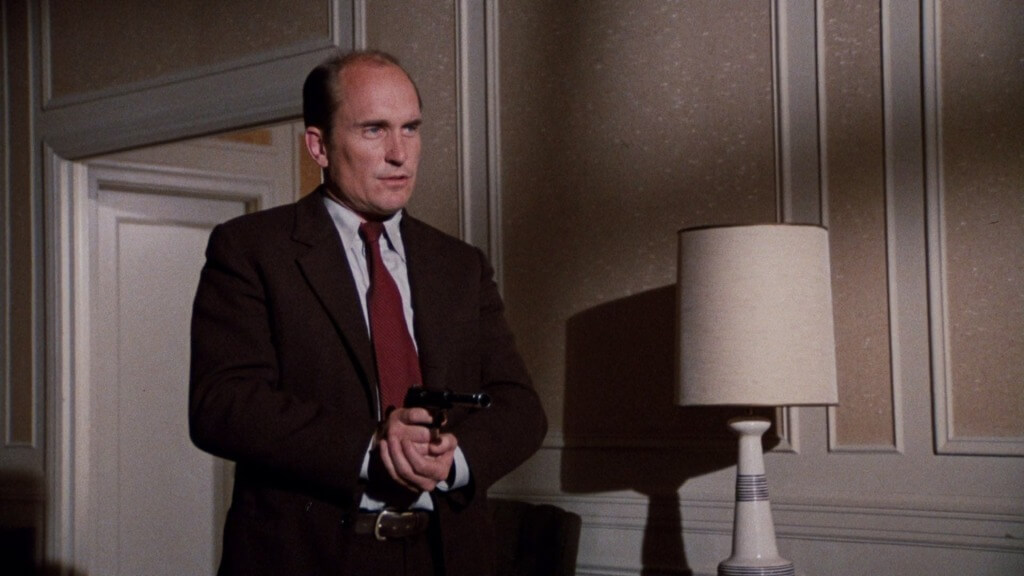
But Duvall’s greatest, most representative work isn’t from a canonized auteur. Instead it’s his role as Earl Macklin in John Flynn’s The Outfit that stands as the ultimate, iconic Duvall: strong statured, calm, professional, but belying something exuberantly emotional underneath. Following Macklin on a revenge tour against the crime syndicate that killed his brother, The Outfit is a quintessential “nihilistic” crime film from the ’70s, albeit not in the way one might assume (especially given that The Outfit, like John Boorman’s Point Blank, is also an adaptation of a novel by Donald E. Westlake’s pseudonym Richard Stark). The Outfit is a nihilistic film in that it presupposes there is no inherent meaning in our violent world, and so people have to go and make their own. Macklin can’t find that in ordinary life. Instead his joy is found in the heist.
Macklin’s cause (avenging his brother) is basically righteous, although it is completely muddled by the fact that his brother was killed because of him, and Macklin goes far beyond simple revenge, instead seeking to topple an entire criminal system. When Robert Duvall walks through the door into an illegal poker game or some low-level office, he immediately controls the room. People say they can best him, but Macklin is always ready to pull the trigger. Duvall is in sharp contrast to the film’s villain, portrayed by Robert Ryan, whose signature was tough-looking, tough-talking men who fall apart when actually pressed into action. What gives Duvall’s performances such strength is his ability to act on the prowess he projected, both tenderly, like in To Kill A Mockingbird, and horrifically, like in Apocalypse Now. And always, that rigid façade becomes the way Duvall’s characters navigate a world they don’t have a place in, hiding the human underneath. Then, suddenly, when that rocky posture washes away, something joyous in Duvall rushes to the surface.


 Keep scrolling for more great stories.