Like a good old-fashioned ghost story, Mark Jenkin’s Rose Of Nevada is a haunting tale of loss, mystery, and the unexplained. Instead of following the living as they tangle with shades of the past still lingering in the present day, the camera follows a small crew as they travel to another time, decades before their own. Although the waters and buildings once looked so familiar, they now feel like a distant planet. How the shipmates cope with this discovery becomes a lo-fi sci-fi tale of time travel, mistaken identity, and the everlasting odyssey to make it back home.
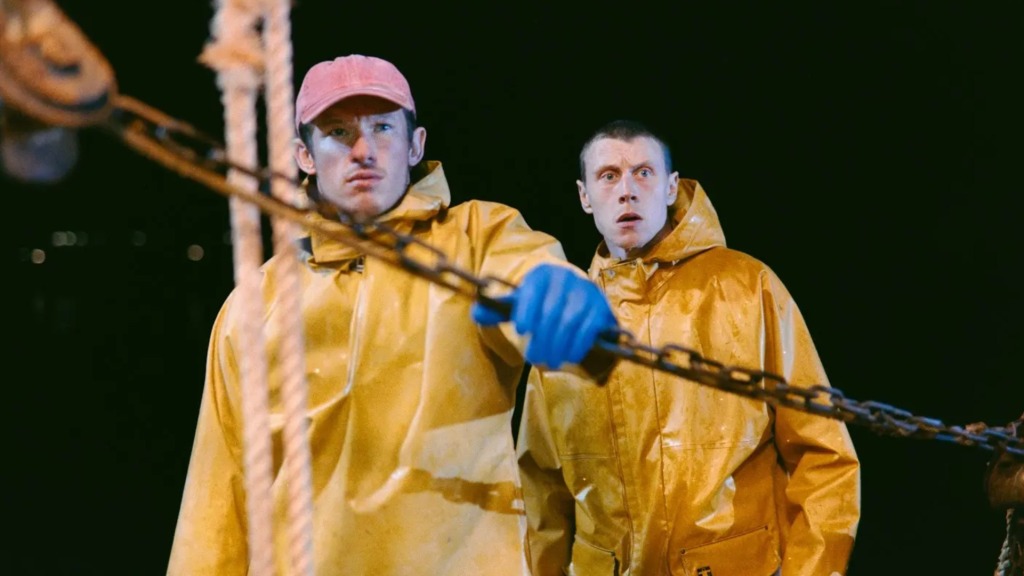
After being missing for 30 years, a boat named the Rose Of Nevada returns home to Cornwall, England. Its owner throws out the boat’s name and keeps its history a secret, choosing to simply send it back out to fish with a new crew including Liam (Callum Turner), a drifter, and Nick (George MacKay), a young father desperate for work. Unaware of its history, the pair take the job, and when the boat returns to shore after a short fishing expedition, Nick notices that the dock is busier than ever, the pub is bursting with life, and the fashion is more than a little out of date. Their longtime neighbors are now much younger, and they mistake the pair for two previously missing sailors. While Liam embraces the ethical murkiness of taking on someone else’s identity, Nick wants nothing more than to return to his wife and daughter, continuously getting back on the ship in the hope that the next port is his own timeline.
Written and directed by Jenkin (Enys Men), Rose Of Nevada is an immersive mystery with an otherworldly visual style from the very first frame. Like its characters who step into the past, the movie looks exquisitely vintage, shot on 16mm film with all of the grain and imperfections intact. No shot lasts more than 30 seconds, meaning the film is a carefully measured orchestration of composed images and scenes to immerse viewers in the area’s colorful landscape (from the bright red boat to the teal blue water below it), in details that convey a sense of place and people, and in the unspoken nuances of this seaside town that has lost its fishing business, and therefore a portion of its community. Jenkin, who also handled the film’s cinematography and music, gives Rose Of Nevada a sense of unease with a brooding score full of slow, slightly distorted chords and dialogue that drops in or fades out. Unseen voices haunt Nick’s guilty conscience, and he spaces out when trying to process just what has happened to him. With all of the film’s audio recorded in post-production, Jenkin and his team create a soundscape just as mesmerizing and hypnotic as the rest of the film.
Although Nick and Liam avoid getting too close to one another, there’s a quiet, almost cosmic bond between them. They’re undeniably united as men unmoored from their time. Although their performances are restrained, Jenkin writes each character as his own man, clearly struggling with the situation but unsure of what to say about it. Turner has the more easy-going role, willing to go wherever the next wave or date takes him. After some chiding from Nick about passing as another man and playing house with his family, conflict brews behind Turner’s eyes, but not enough to deny the lonely mother and child the presence of the dad they think is theirs. MacKay reacts much more strongly against settling into the past, initially rebuffing the parents of a young man who believes he’s returned home after a year at sea. Thanks to the dreamlike aesthetic of Rose Of Nevada, Nick readily drifts in and out of nightmares, haunted by the guilt of leaving his wife and daughter behind, barely holding back his desperation to return home to them. MacKay plays out the horrors and grief over what’s happened to him all on his face, rarely speaking it aloud, since Liam and their seadog captain (Francis Magee) have made their peace with living out of their time.
While Jenkin’s story is tightly controlled, with little explanation as to how this time jump happened and almost no room for big emotions, his visual storytelling is deeply expressive. He accumulates small details—like a hazy mist of rain coming through a hole in the roof; the ripples of water in a bucket; close-ups of rusty boats, working hands, and the straining of nets holding the weight of a daily catch—with a hypnotic precision, adding texture to the movie’s narrative. These images and the materiality of the film stock give Rose Of Nevada an out-of-this time feeling, while MacKay and Turner ground the movie in reality. In close-ups, Jenkin tells the part of their stories these men don’t have the words for, capturing them trying to hide their fears and uncertainty from each other. With only a few words shared between them, the men survive both the grim monotony of hard work and the ghostly fear that they may never see their home again.
Director: Mark Jenkin
Writer: Mark Jenkin
Starring: George MacKay, Callum Turner
Release Date: June 19, 2026


 Keep scrolling for more great stories.