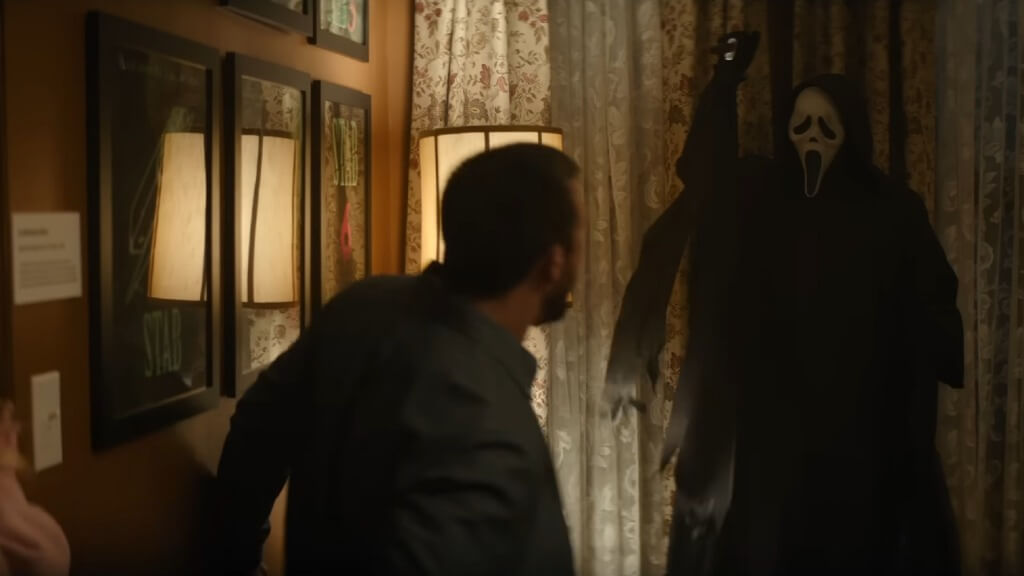
Scream 7 opens with Scott (Jimmy Tatro) and his over-it girlfriend Madison (Michelle Randolph) checking into an overnight experience at the Macher house, where the climax of both the 1996 and 2022 Scream takes place. For a “Stu-head” like Scott, a chance to spend the night amid all this Stab memorabilia and in the very house where Sidney Prescott (Neve Campbell) dropped a TV on Stu Macher’s (Matthew Lillard) head is a dream come true. Appropriately mixing the in-universe true-crime ur-text, Gale Weathers’ The Woodsboro Murders, with Stab, the set piece creates a nice interplay between the franchise’s relationship with reality and fiction. Of course, Ghostface shows up, kills them both, and burns the house down, taking whatever point Kevin Williamson, directing the characters he created for the first time, was trying to make with it.
Modern horror franchises struggle with making the topic anything but a buzz word, something to pay lip service to and then abandon. In 2018, director David Gordon Green also teased true-crime thematics via a pair of podcasters who hope to get an exclusive with Michael Myers. But they’re only a means to an end, helping free Michael so Green can return to Halloween‘s Final Girl, Laurie Strode (Jamie Lee Curtis). So began a trilogy-long excavation of PTSD, during which Curtis said the word “trauma” so many times, she basically forgot how to pronounce it.
Scream 7 is also more interested in trauma than anything else, once again running back the same themes that the series should’ve lampooned to death years ago. Now a cafe owner in the charming hamlet of Pine Grove, Indiana, Sidney is a self-help memoir author who’s afraid to discuss her past, despite the frequent interrogations from those around her. Sidney won’t even tell her daughter, Tatum (Isabel May), that she is named after her high school bestie, who was infamously murdered with the Machers’ garage door. At work, Pine Grove’s resident true crime-obsessive and aspiring podcaster, Lucas (Asa Germann), bugs Sidney about the Woodsboro episode of Dateline as an aside. But Lucas never develops into more than a possible suspect, whose interest in nonfiction makes him all the shadier.
One reason horror might struggle with true crime is that, by nature, these legacy sequels are nostalgia-ridden stories about survivors, and survivors really aren’t the focus of true crime. That is the realm of killers and victims, and of a different kind of looking back. Maybe the most successful modern film to address this phenomenon is Martin Scorsese’s Killers Of The Flower Moon, which tackles the true-crime industrial-complex head-on, showing how the genre venerates monsters, buries survivors, and comforts audiences. In that film’s coda, the action jumps to a staged radio play performance of The Osage Indian Murders for The Lucky Strike Radio Hour. After an announcer explains how all the perpetrators, more or less, shunted full responsibility for the killings, Scorsese himself reads the obituary of Mollie Burkhart, the film’s star survivor: “Mrs. Mollie Cobb, 50 years of age. She was buried in the old cemetery in Grey Horse beside her father. There was no mention of the murders.” The epilogue leaves audiences with the understanding that there is a long line of entertainment based on real pain, in which Jeffrey Dahmer is remembered and Tracy Edwards is forgotten.
Despite the presence of Lucas and the franchise-long obsession with Woodsboro, Scream 7 doesn’t even try to thread this needle. During the film’s obligatory unmasking, in which Sidney navigates an AI funhouse populated with cameos of Ghostfaces past, she meets the genuine article. It was Lucas’ mother, Jessica (Anna Camp), all along! For a second, it seems like Scream 7 might actually interrogate what we get out of these survivor stories, as Jessica explains that Sidney’s book inspired her to kill her husband. When murder didn’t heal her trauma, she turned to revenge, creating yet another remake for Sidney to deal with. Is the movie saying that true crime won’t heal trauma, and that an obsession with it can be harmful? Perhaps a version of the script did once upon a time, but in the final version, Jessica slashes away any subtext by confirming, “It’s about nostalgia this time!” Maybe next time, Scream can take a stab at something actually on the bleeding edge of culture.


 Keep scrolling for more great stories.