Spoiler Space offers thoughts on, and a place to discuss, the plot points we can’t disclose in our official review. Fair warning: This article features plot details of 28 Years Later: The Bone Temple.
The first line of 28 Years Later isn’t uttered by one of its main characters. Director Danny Boyle and writer Alex Garland gave the opening salvo of their legacy sequel trilogy to The Teletubbies. Tinky Winky, Dipsy, Laa-Laa, and Po’s jaunty toddler talk underscores the end of Jimmy Crystal’s childhood, when rampaging hordes killed his family. The scene of Jimmy and his sisters anxiously distracting themselves with television echoes the opening of 28 Days Later, when a shackled chimp, force-fed the world’s cruelty via TV, spreads Rage throughout Great Britain. Like that ape, Jimmy would infect the people around him with bastardized images he once saw on television. This thread continues in The Bone Temple, where an undercurrent of popular culture flows toward a heavy metal climax and contemplative, cameo-led coda.
28 Years Later and The Bone Temple are steeped in pop culture like a cuppa English Breakfast. The remaining vestiges of culture circa 2002, when 28 Days Later is set, are now artifacts of a forgotten time, helping the survivors dictate the world to come. “The whole film, and if we ever get to make the whole trilogy, is in some ways about looking back and looking forwards, and the relationship between looking forwards to better worlds or attempting to make better worlds or trying to construct the world that you’re in on the basis of old worlds,” Garland said of 28 Years Later. “The thing about looking back is how selective memory is, and that it cherry picks and it has amnesia, and crucially, it also misremembers. We are living in a time right now, which is absolutely dominated by a misremembered past.”
That’s the case in 28 Years Later, where an idealized re-creation of the Royal Crown reestablishes old habits and hierarchies. Boyle emphasizes the Lindisfarne perspective through the editing, soundtracking Spike’s (Alfie Williams) first hunt with a remix of Taylor Holmes’ reading Rudyard Kipling’s poem “Boots” and intercutting the moment with clips of Laurence Olivier’s Henry V—Britain’s idealized and misremembered past crashing against the hard-fought present. By that film’s end, Spike meets the embodiment of Garland’s cherry-picked past in Sir Lord Jimmy Crystal (Jack O’Connell), who quite literally drapes himself in the culture of his childhood. Decked out like Jimmy Savile and fitting his Fingers in pageboy wigs, Jimmy twists the cultural ephemera of his youth toward domination. As in A Clockwork Orange, Jimmy gives his droogs an identity through memories of Jimmy’s childhood, swapping “Singin’ In The Rain” for The Teletubbies‘ Dipsy Dance, recontextualizing the harmless entertainment of the past through sadistic violence.
Director Nia DaCosta digs deeper into The Bone Temple‘s record bin through Dr. Ian Kelson’s (Ralph Fiennes) relationship with music, which grounds him in the present as he reflects on the past. Duran Duran’s “Girls On Film” plays from Kelson’s record player as DaCosta’s camera lingers on a literal girl on film, a photograph of Kelson with an unnamed woman from the beforetimes. Simon Le Bon croons “Ordinary World” as Kelson and Samson (Chi Lewis-Parry) dance in the Bone Temple—music therapy for the post-apocalypse. (For all of Bone Temple‘s on-the-nose needledrops, it’s surprising DaCosta skipped the Rio album track “New Religion.”) Kelson doesn’t remember what it feels like to use a personal computer, but music from the past links him to humanity, and along with massive amounts of morphine, it does the same for Samson, however briefly.
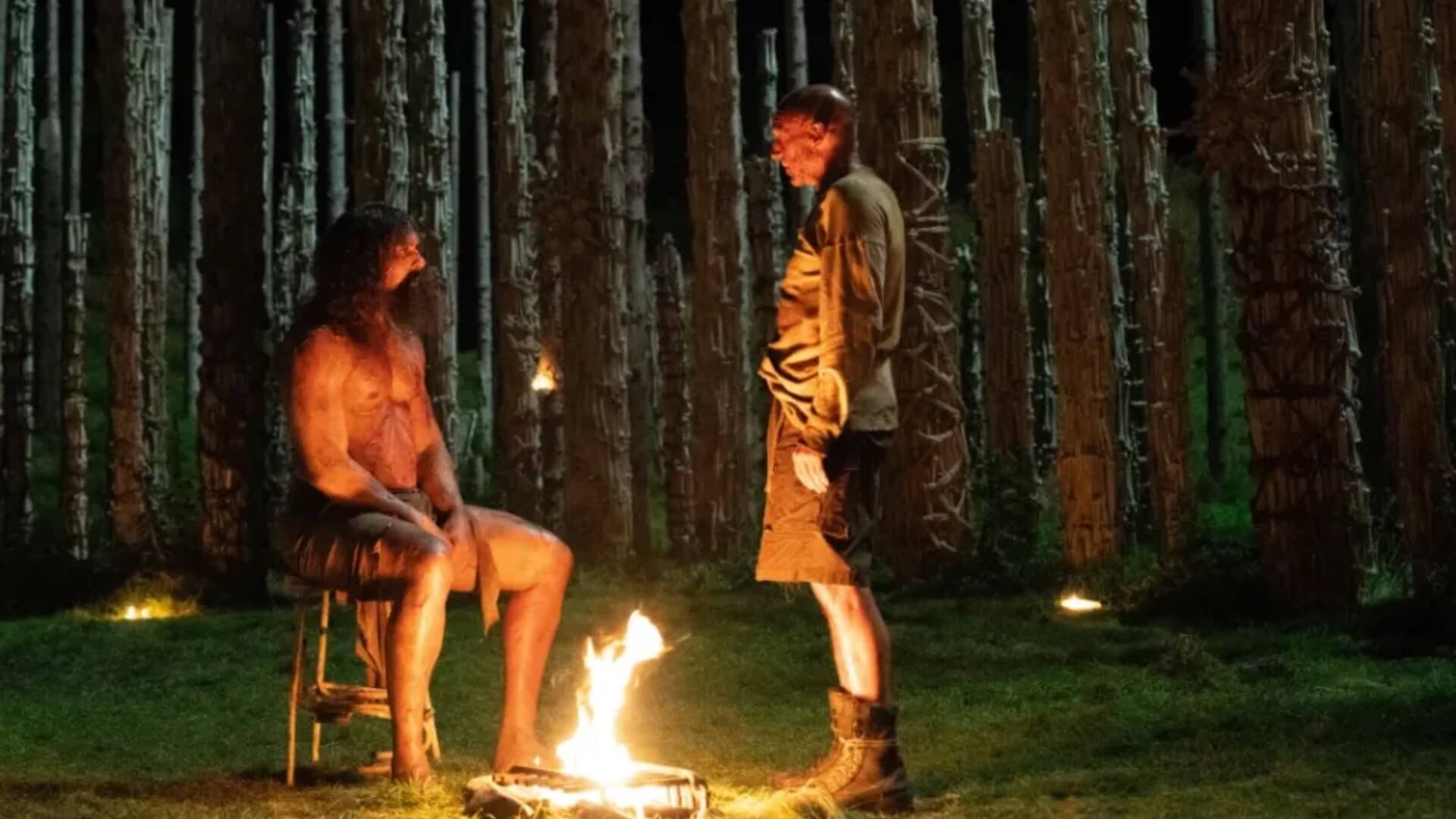
In the film’s rousing finale, Kelson stages a rock concert, a theatrical and soul-stirring exorcism to convince Jimmy’s gang that he’s “Old Nick.” It’s not violence, but the expression and performance of evil that allows the Jimmies to suspend disbelief, be entertained, and to mosh to Kelson’s rendition of Iron Maiden’s “Number Of The Beast.” “Let’s turn this one up to 11,” Kelson jokes, in the series’ first and only Spinal Tap reference. It’s enough to reawaken some humanity in Jimmy’s henchmen—though, to put a fine point on the ills of weaponizing art, Kelson’s last-minute decision to play up their inclination towards violence leads to his own death.
Yet, throughout, The Bone Temple argues that the humanities—history, music, literature, even Latin—help people find their own humanity. Thanks to Kelson’s treatment, which includes heavy dosages of Duran Duran, Samson remembers himself reading about the moon in a book as a child. “Memento mori,” are Kelson’s final words, a phrase about more than simply remembering that we die, but recognizing that we live. Instead of using bits of culture to demonize outsiders—as seen through Sir Jimmy (and increasingly in real life, as the U.S. government’s cursed social media pages scapegoat immigrants via a toxic stew of memes featuring Santa Claus, Lord Of The Rings, and George Washington)—the heroes of the film find connection through them.
This is something, in a more history-focused context, that Jim (Cillian Murphy) imparts to his daughter in The Bone Temple‘s final scene. “Those who don’t learn from history are doomed to repeat it” feels a bit ironic considering the lesson he’s teaching her: that the international community’s response to the end of World War II helped put an end to fascism and populism. Yet, this isn’t a lesson for our present, but for her future. The world will go on, and the survivors must shape it into the form they wish to see. It’s an idea that drives the final moment of this cliffhanger, when his daughter spots Spike and Jimmy Ink (Erin Kellyman) running from a horde and asks, “Should we help them?” Jim has a simple reply: “Of course we should.”


 Keep scrolling for more great stories.