Spoiler Space offers thoughts on, and a place to discuss, the plot points we can’t disclose in ourofficial review. Fair warning: This article features plot details of Digger.
In the lead-up to Digger‘s release, those curious about a “comedy of catastrophic proportions” from Tom Cruise and director Alejandro González Iñárritu had one question: So, what, was Digger a musical or something? The trailer’s massive, rotating sets, comically artificial makeup, and off-kilter camera angles were clearly hiding something, but what? Free from the fear of breaking embargo, we can safely say Digger isn’t a musical, but there is a twist: Digger is art from the future.
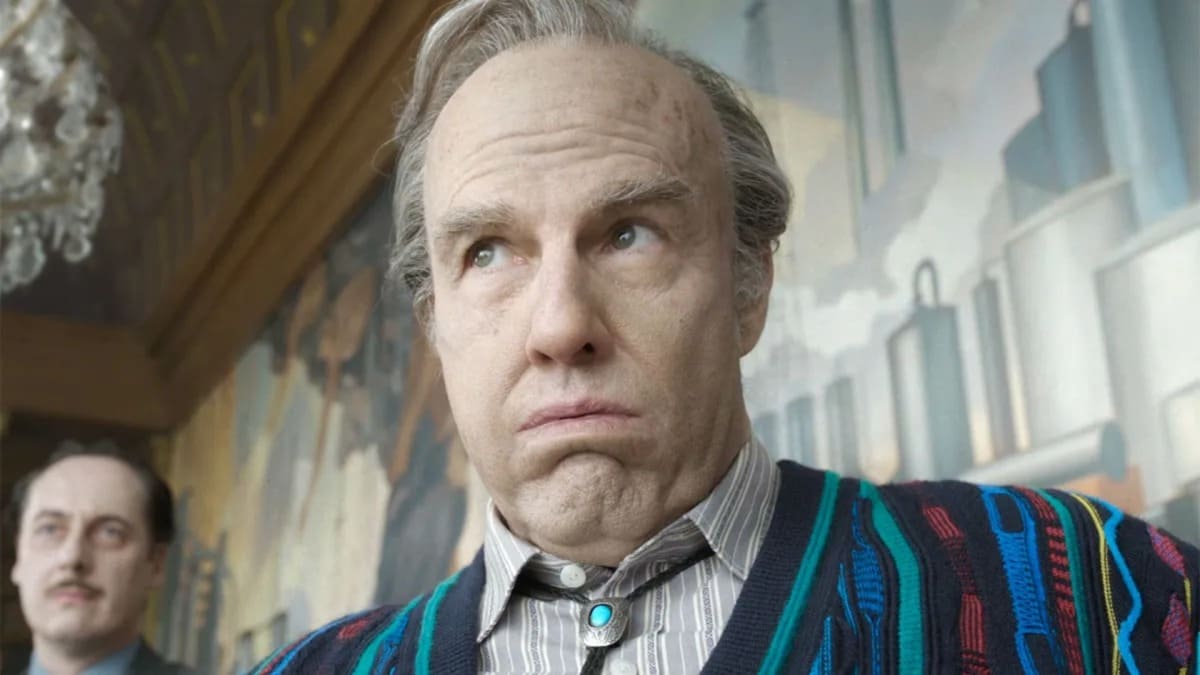
Half an hour into the film, as Digger Rockwell (Tom Cruise) comforts President Compson (John Goodman), who suffers from “cancer of the asshole,” a giant knocks over a tree. The Digger we’ve been watching is actually a technical rehearsal for the 20th anniversary of Fossil Fools, an elaborate stage show recounting the time the “real-life” oilman Digger and a cohort of bumbling government ghouls ignored climate scientists to their and our ruin. From here on out, Digger follows two tracks: The events of Fossil Fools, presented as a stylishly washed-out, mega-budgeted Dr. Strangelove, move forward while Iñárritu and four credited writers retread Birdman‘s unexpected virtue of ignorance in a water-logged backstage drama, set sometime after climate collapse in the near future. The two narratives constantly contradict each other, undermining the film’s comedy, drama, and heavy-handed message—telling the audience how it’s supposed to feel while also calling them idiots for doing so.
The dual role explains what Cruise saw in Digger. The death-defying, stunt-driven Oscar hopeful not only plays Rockwell, a corporeal version of The Simpsons‘ long-running oil tycoon Rich Texan, but also the hyper-fixated actor Curtis Marks, whose daughter’s flight disappears into a deadly storm on opening night of Fossil Fools. As Curtis lumbers unhappily backstage under a metric ton of Kazu Hiro’s prosthetics, he complains about the movie we theoretically paid $15 to see as personal drama plagues him just below the surface. The two sides of the coin ostensibly allow Cruise and Iñárritu to have their cake and eat it: Iñárritu can direct Cruise in a big, showy comedy, while also acknowledging Fossil Fools isn’t meant to be funny.
Except that isn’t the only perspective Iñárritu offers. Backstage, Curtis points out what the moviegoing audience already knows: Fossil Fools stinks. It’s not even historically accurate, he claims, insisting that he pored over the research and Fossil Fools makes a mockery of Rockwell’s and our reality. “Why is this funny?” Curtis yells to the rafters. His director, Hannah (Sophie Wilde), answers, “They’re laughing at you.” Watching the buffoon gives the audience pleasure, some amount of comfort and catharsis, knowing that the guys who killed the world were the same idiots they imagined them to be.
Digger‘s satire is a mess, especially as Iñárritu layers on the reveals. The play’s financier turns out to be none other than Rockwell’s nephew Kenny (Jesse Plemons), who’s not only been waiting in the wings of the show he’s producing but who also appears in the show as Emma’s (Sandra Hüller) son. This man was there. He knows what happened, and he prefers to print the myth. “You really get him,” he tells Curtis. “It’s a lot of fun to watch.” Is it?
Later, as Curtis is tearing the production apart, Kenny reminds the cast and crew that Fossil Fools is funny, it’s stupid, and it’s how people want to remember the end of the world. He’s right, apparently. When Iñàrritu gives us a look at the opening-night audience, there isn’t a dry eye or an unsplit side in the packed house. The gap between their experience and that of Digger‘s moviegoing audience is the size of a floating ice shelf. The film therefore plods onward without entertaining or engaging its real-life audience, all the while cynically gesturing at the in-movie crowd to hint at how they’re supposed to be feeling and reading the film.
Digger ends with a standing ovation. Kenny has found Curtis’ daughter, the audience loved the show, and all of the actors’ hard work paid off. That is, until the Level 4 audience puts on their gas masks and wanders back out into the flooded city outside. Fossil Fools isn’t a comedy about how the end of the world happened, but a way for the rich to continue controlling the narrative. The Rockwell family can write Digger’s myth, and Kenny can get some absolution for his uncle’s crimes.
Meanwhile, in reality, Digger‘s studio, Warner Bros., will soon be owned by Paramount, a sale partially financed by Paramount CEO David Ellison’s father, Larry, a Trump buddy who produces “profoundly scary technology” for wars all around the world, just like Kenny. Ellison, too, can locate any plane in a few hours, while producing abysmal works of fiction that moronic audiences gobble up without much thought. Iñàrritu’s message is that art, even art that seemingly challenges the powerful, is nothing more than cover for the powerful. Even at the end of the world, the people who ruined that world will continue to use their power to keep the masses calm and in check, giving them only brief relief from the horrors they created. Only, in Digger, they do so anonymously and earnestly, and ultimately ironically. Art—even bad art—is the opiate of the masses, says the awful $200 million Tom Cruise movie.


 Keep scrolling for more great stories.