Staff Picks makes its 2026 return courtesy of News Editor Drew Gillis, who found a Broadway show that has its cake and eats it too, and Games Editor Garrett Martin, who recently got reacquainted with one of DC Comic’s oldest superheroes.
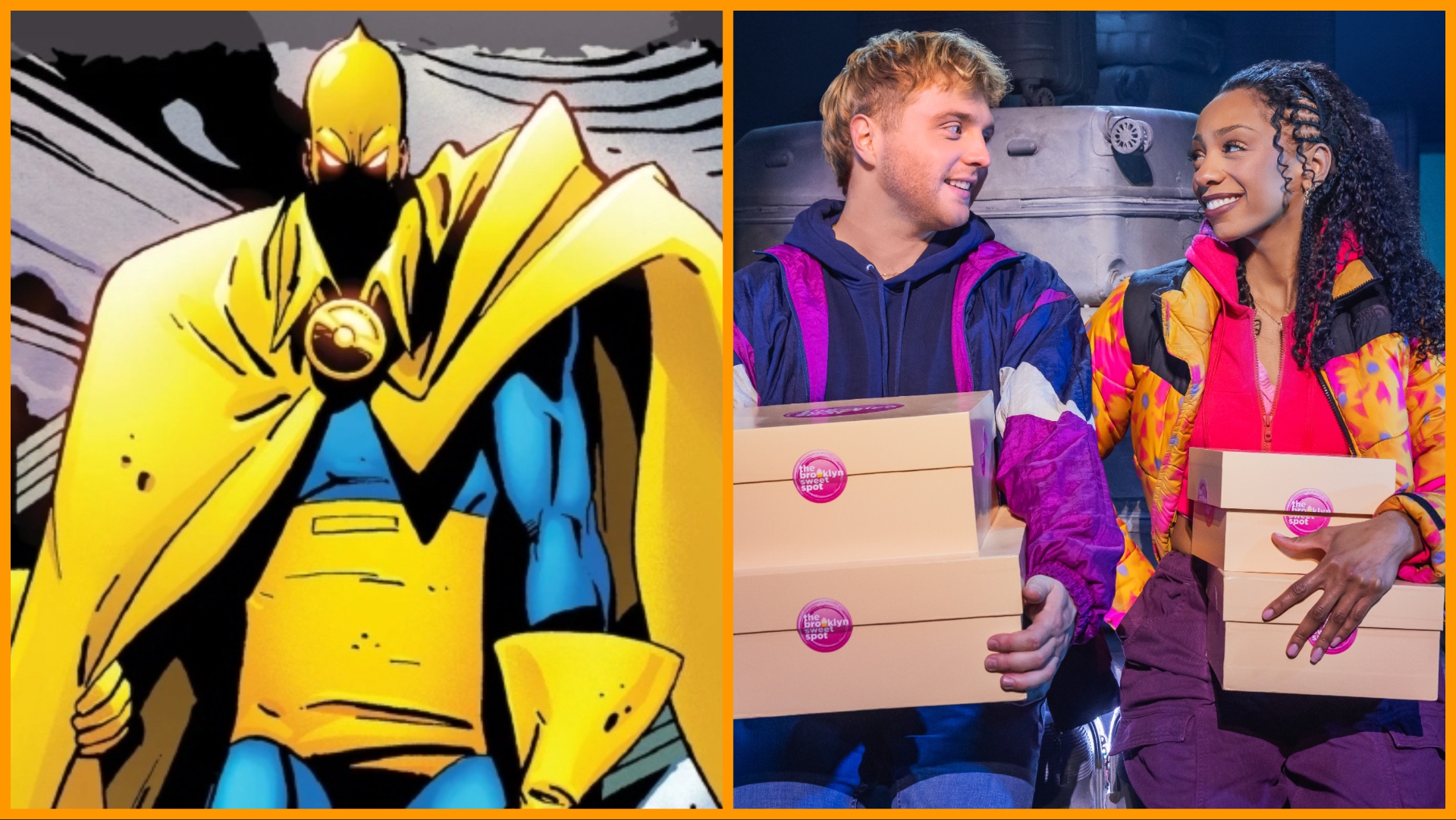
Two Strangers has the kind of title that seems to share the basic premise of the show. In truth, there’s a little bit more to it. Dougal is in New York for the first time for the wedding of his father, whom he’s never really met before. His father is marrying Robin’s sister which, despite being more or less the same age, will legally make Robin Dougal’s aunt. Dougal doesn’t know anyone in New York, and begs Robin to show him around the city; she is reluctant but ends up letting him come with her to pick up the cake for the wedding. If you’ve ever seen any romantic comedy, you can probably tell where this is going.
Fortunately, Two Strangers is legitimately quite funny, and having a fairly predictable plot is not a bad thing for a Broadway musical comedy. Though the score and the set and even the two-person cast feel like distinctly modern musical theater elements, there’s something fundamental about the type of show that Two Strangers is. It’s an original show, not based on some recognizable piece of IP, with songs that don’t come from the radio and actors that aren’t already famous. Seeing something like that on such a major stage feels increasingly rare. Two Strangers is the kind of throwback that makes me feel the slightest bit more optimistic about the future of this art form.
Garrett Martin: Doctor Fate by J.M. DeMatteis and Shawn McManus

Doctor Fate (Image: DC Comics)
So you don’t believe that there’s a love in this world pure and powerful enough to bring a smile to the face of Darkseid, the cosmic despot devoted to enslaving the universe in a state of antilife? Well, Doctor Fate’s love is higher than your assessment of what love could be—at least in J.M. DeMatteis and Shawn McManus’ fairly obscure late ’80s epic starring the DC Comics superhero. The full 24-issue run was collected into a single paperback edition last year, along with an annual and the Keith Giffen-drawn miniseries that preceded it; it’s a curious and fascinating echo of a comics industry that bears little resemblance to today’s.
Doctor Fate is one of DC’s oldest characters, debuting in early 1940, but was never one of its most popular. That made him ripe for modernization in the second half of the ’80s, during a company-wide period of reinvention after the Crisis On Infinite Earths miniseries. J.M. DeMatteis and his frequent collaborator Keith Giffen rebuilt the Golden Age sorcerer in a 1988 miniseries, introducing two new characters who shared Fate’s bright yellow helmet: Eric Strauss, a 10-year-boy instantly aged into adulthood by the mystic Lord of Order known as Nabu, and his stepmom Linda, the young widow of Eric’s rich, abusive father. Soulmates, the two unite to form Doctor Fate, with Nabu mentoring them from inside the reanimated corpse of the original 1940s Doctor Fate. Shawn McManus took over the art duties when a monthly ongoing series was launched a year after the limited series; with the addition of a talking demon dog sidekick, Doctor Fate was set with the specific characterization and supporting cast typically found in a standard superhero comic.
DeMatteis wasn’t interested in the standard superhero comic, though. He used Doctor Fate as a vehicle for expounding on his own spiritual views, inspired heavily by the 20th-century spiritual leader Meher Baba—the same self-proclaimed “Avatar” that The Who’s “Baba O’Riley” is named after. Baba even appears, unnamed, as a recurring character in the collection’s second half, an ineffably wise, always silent guide to the afterlife who makes the mystical warrior Doctor Fate cry tears of joy with a single kiss. Eric and Linda Strauss, whose deeply uncomfortable, incest-bordering love for each other is justified as a millennia-old synergy between two souls who lived thousands of lives together, aren’t characters so much as sounding boards for DeMatteis’ Baba-influenced ideas: That the path to a better world and personal enlightenment lies in a love for everyone, an overriding sense of selflessness, and being at peace with the universe—at peace with fate, essentially. The late ’80s and early ’90s probably weren’t the only times in history a creator could write a personal spiritual treatise in the guise of a legacy superhero who hung out with Superman and Batman and was owned by a massive corporation, but it’s almost definitely the only time he’d be able to do so for 29 straight issues.
Doctor Fate sheds whatever subtlety it might’ve started with by the halfway point, before Doctor Fate is able to escape (and win the respect of) Darkseid by showing him the power of love. It becomes a little too blunt and didactic, but that also just means that it’s the rare superhero comic with a strongly-held, personal point-of-view. Between that, the focus on Western spirituality, and McManus’ heavily stylized, frequently psychedelic art, Doctor Fate recalls a number of DC comics from that era that preshadowed the creation of the Vertigo label, books like Grant Morrison and Richard Case’s Doom Patrol, Morrison and Chas Trugo’s Animal Man, and Peter Milligan and Chris Bachalo’s Shade the Changing Man. It’s not a surprise that one of the editors of Doctor Fate was Karen Berger, the longtime DC editor who spearheaded the launch of Vertigo two years after DeMatteis and McManus’s time on the book came to an end.
Rarely mentioned since ending in 1990, the art’s probably the main reason to read Doctor Fate today (unless you’re a burgeoning Baba acolyte). McManus is as adept at expressing emotion in a character’s face (or helmet, even) as he is at creating hallucinatory imagery from the spiritual plane. Still, DeMatteis’ take on Doctor Fate gives modern comic fans a sense of just how weird DC was willing to get after Crisis. It wasn’t just a handful of books still revered today as laying the groundwork for Vertigo that gave creators more freedom than superhero comics ever had before, but Justice League-adjacent titles like Doctor Fate, as well, as this collection proves across its 775 pages.


 Keep scrolling for more great stories.