
Netflix's Strip Law argues its case loudly and unconvincingly
The busy adult-animated series stars Adam Scott, Janelle James, and Stephen Root.
Image: Netflix
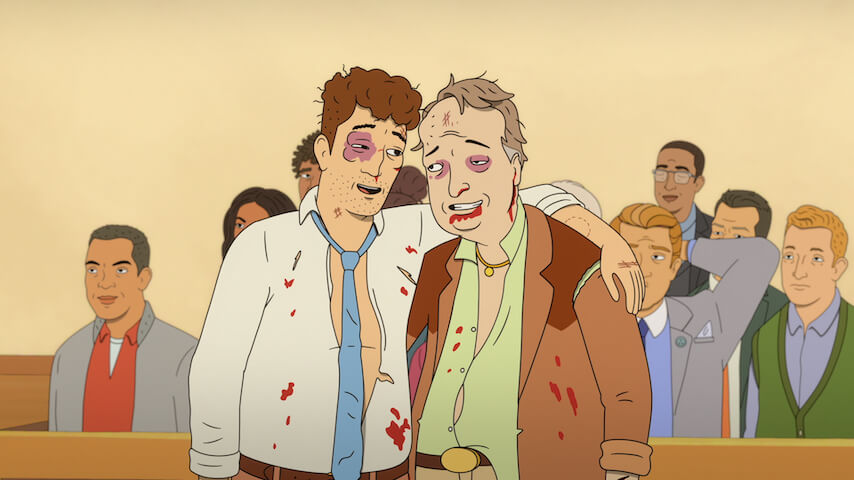
Strip Law saunters into a moment when adult animation still seems determined to prove its own uselessness. That’s a shame, because the form is truly capable of more than giving us a gorilla eating spaghetti, amusing as that absolutely is when one appears here. It’s just one of countless non-sequiturs you can expect from this series by Cullen Crawford (Star Trek: Lower Decks, the functionally similar cop cartoon Paradise PD), a mile-a-minute joke machine that seems designed to fear dead air. Its cadence is not dissimilar to one of those talk-radio shows from Grand Theft Auto, where characters disgorge profane inanities and scarcely let them land before the dial jerks violently to the next bit. (One lawyer calls for a “dia-recess” in court, for example.)
This is the latest slickly produced, low-calorie Netflix cartoon confection, boasting a roster of aggressively unlikeable characters—appropriate, given most are lawyers in a Rockstar-flavored version of Las Vegas—voiced by a stacked-deck cast. It’s too busy cracking wise to delve into Crawford’s law-and-order-in-no-man’s-land setup and even busier cramming in dusty pop-culture references (Austin Powers and “Cornholio” get several nods) to land a sharp satirical point or establish a distinctive personality. It does, if nothing else, bring millennial humor screaming into middle age, and the results are sometimes more depressing than hilarious.
The premise is very solid, though. Attorney Lincoln Gumb (Adam Scott), shit-canned from respectable Steve Nichols (Keith David) & Associates, opens a scrappy practice of his own called Gumblegal with his muscle-bound niece Irene (Aimee Garcia) and hapless, frequently license-less lawyer Glem Blorchman (Stephen Root). Set professionally and financially adrift in Las Vegas, Lincoln is temperamentally unsuited to practice law in the city. But with Gumblegal hemorrhaging cash, he’s forced to spice up his act. Salvation arrives in Sheila Flambé (Janelle James), a street magician and self-proclaimed “three-year all-county sex champion” who possesses the showmanship that Vegas courtrooms tend to favor over, say, law and precedent.
Lincoln’s issues go deeper than his lack of stage presence. He’s chronically depressed and cowers behind a superiority complex toward the very city that sustains him. It’s an intriguingly sour foundation for a comedy and opens up all sorts of character-rich possibilities, although Strip Law rarely takes the time to mine Lincoln’s problems beyond quick digs at his desperate mommy issues. (That said, “We Need To Talk About Heaven,” easily the best episode, flirts with his spiritual doubt and gives the series some desperately needed story oomph late in the season.) More often, Lincoln and his team force through jokes with relentless hyper-confidence to the point that some viewers may eventually grow numb to what’s really being said underneath the snark. Take the B-plot of the fourth episode, “Glemtastrophe: Anatomy Of A Glemsaster,” where a judge, nearing retirement, wants to set the world record for most cases presided over, compelling Lincoln and Sheila to power through twenty hearings in a matter of days. They hurtle over endless setups and punchlines with such agitation that most of their storyline is ultimately reduced to noise.
 Keep scrolling for more great stories.