It’s not unusual for a huge TV hit to draw a hefty number of haters, but there’s always been something a bit ridiculous about some of the vitriol aimed at The Big Bang Theory. As traditional three-camera sitcoms go, both BBT and its spinoff Georgie & Mandy’s First Marriage are snappy, likable, low-stakes shows, with characters who seem one-note at first but who deepen over time. The single-camera Young Sheldon—a true gem—adds thematic depth to the franchise, finding the humor and the pathos in the experience of growing up as an oddball in a small Texas town.
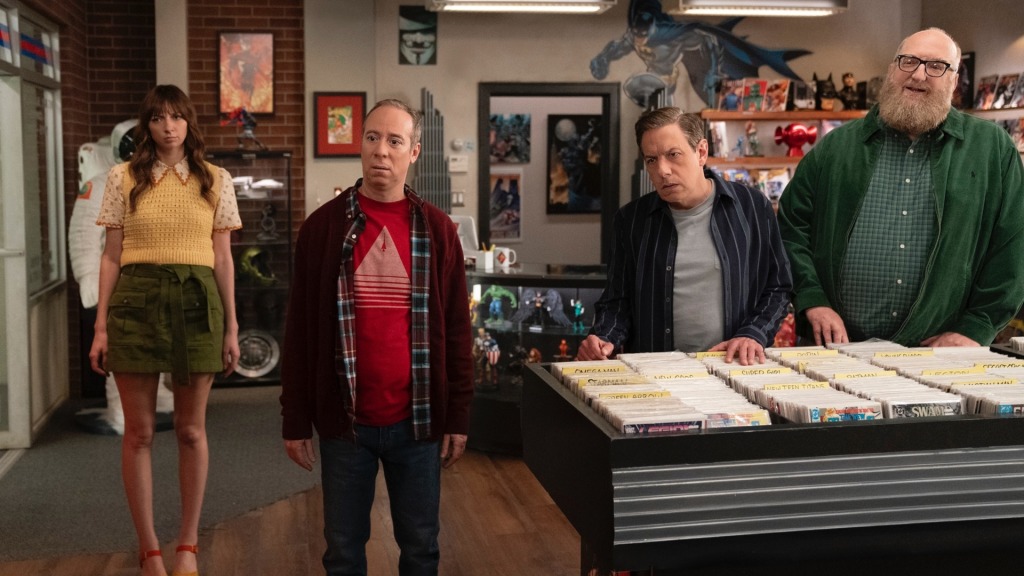
And now comes Stuart Fails To Save The Universe, an HBO Max series starring a few of The Big Bang Theory’s minor characters: the nebbishy comic shop proprietor Stuart Bloom (Kevin Sussman), his geeky off-and-on girlfriend Denise (Lauren Lapkus), the affable Caltech geology professor Bert Kibbler (Brian Posehn), and the devious Caltech physics professor Barry Kripke (John Ross Bowie). It’s a show with a lot of the strengths of its predecessors, including a deeply wonky sense of humor and an emotional core that reveals itself gradually.
It’s also sure to irritate anyone who can’t stand The Big Bang Theory. With Stuart, creators Chuck Lorre and Bill Prady lean harder than ever into the kind of nerd culture humor that makes one wonder whether they’re laughing at or with their cast of geeks and geniuses. The answer is, as always: Maybe both?
The series begins with a twist, opening in a post-apocalyptic version of The Big Bang Theory’s Pasadena, where Stuart and his friends are trying to spend as much time as possible inside the comic book store, away from the pillaging hordes and gigantic killer insects outside. Then Stuart gets a visit from an alternate timeline version of himself, who explains that his best customers Sheldon Cooper and Leonard Hofstadter have built a device that has spawned a multiverse, and that if Stuart doesn’t find this machine and travel to the correct reality, all of these increasingly unstable universes will cease to exist.
Each episode of Stuart Fails To Save The Universe takes place in a different one (or more) of these realities. Lorre and Prady’s co-creator on the series is Zak Penn—who, in addition to writing big-screen adventures for many of the BBT gang’s favorite superheroes, brings the metafictional and reality-bluring bona fides of his work on Last Action Hero and Ready Player One. One of the most entertaining parts of each episode is the big reveal of where Stuart and his pals land each week; it’d be too much of a spoiler to list all of the worlds these characters visit across the first season’s 10 episodes. Suffice to say that for the most part they’re riffs on classic science-fiction and fantasy premises: You’ve got your suspiciously placid utopias, your innocently primitive proto-societies, your nightmarishly militaristic realms, and so on. Within those expanded horizons, the writers take advantage of their single camera format and their TV-MA rating to make everything stranger and grosser than The Big Bang Theory.
More than once, Stuart ends up in a meta reality, framed around his life as a stereotypical comic book fan (who also happens to be a TV character). And it’s here where it’s worth noting that the “stereotypical” part is what has rubbed a lot of Big Bang Theory detractors the wrong way from that show’s beginning. When BBT debuted in 2007, it initially put forward a vision of “nerdery” that seemed stuck in a 1980s teen sex comedy. The characters dressed badly, were awkward around women, and were obsessed with science experiments and superheroes. For some viewers, one glance at how these people looked and how they talked was enough to turn them off for good. Sheldon and Leonard and their best friends Howard and Raj later became much more rounded characters; and BBT improved considerably once its stories started incorporating its three main women, Penny, Bernadette, and Amy. That said, it’d be a stretch to say that the show ever fully left behind its broader comic elements. It never stopped making jokes about nerds—or at least about the clichéd pop culture version of nerds.
It’s also true that the characters that Stuart Fails To Save The Universe ports over from The Big Bang Theory are some of that show’s most one-dimensional. Throughout the run of the original series, Stuart was portrayed as a sad sack, struggling both romantically and financially, compensating for his failures by tossing snippy put-downs at his customers. Bert, meanwhile, is perhaps the most prominent character in Posehn’s repertoire of gentle giants, speaking in a deep, growly voice that comically contrasts with whatever mundane topic he’s talking about. (Rocks, mostly.) And Kripke? Hoo boy. The big joke with Barry Kripke is that he has a speech impediment that turns his “L”s and “R”s into “W”s, Elmer Fudd-style. He’s also a creep with women, though he thinks of himself as a lothario. (Or, as Stuart would script it, “wothaweeo.”)
And yet, as was the case with The Big Bang Theory and its offshoots, there’s just enough depth to these characters to make them more than mere targets of mockery. Kripke’s weaselly nature isn’t just a comic bit; it’s also something he’s aware of and fleetingly regretful about. And as Stuart bounces from universe to universe, he’s motivated mainly by wanting to find a world where he and Denise are happy together, and where his self-doubt and timidity haven’t doomed their relationship.
The main problem with the comedy in Stuart Fails To Save The Universe isn’t that it’s occasionally mean-spirited, but that it’s only sporadically funny. The world-building in each episode is genuinely clever but just mildly amusing, with a couple of episodes setting up recurring gags that get old fast. The worst example of this comes in episode two, set in a reality where everyone has a device in the back of their necks that violently zaps them if they become too aggravated or unpleasant. The comedic value of Stuart writhing around in pain for several seconds, over and over, has been vastly overestimated.
Give Lorre, Prady, and Penn credit for one thing though: They don’t overstay their welcome. Each episode of Stuart Fails To Save The Universe runs around 20 minutes (sometimes less, rarely more), so that even when the schtick falls flat, the story moves on quickly. Each episode is packed with plenty of action—along with a lot of famous guest stars whose identities, like the episodes’ various setups, are best kept vague. (Expect a lot of Big Bang Theory alums, some of whom reprise their characters and some of whom—in the spirit of the multiverse—play somebody new.) Also, because Stuart is a production of Warner Bros. Television, it has free license to roam through the worlds of WB properties like Looney Tunes and The Matrix; the season’s best episode is a knowing spoof of the D.C. universe, which helps answer that big question hanging over everything Big Bang Theory related: Is it for geeks or against geeks? Watch more than a few episodes of BBT, Young Sheldon, and Stuart Fails To Save The Universe and it’s pretty obvious that the people in their writers’ rooms genuinely love science—both real and fictional. So even when the jokes are at nerds’ expense, the barbs are self-lacerating.
There’s a fundamental playfulness to Stuart too that earns a lot of goodwill. It’s there in the opening credits, with its campy Danny Elfman theme song and its self-referential messages, which change with every episode. It’s there in the sly throwaway jokes about the little differences in the universes Stuart visits. (In one, there’s no designated hitter rule in baseball and John Mellencamp still calls himself John Cougar.) It’s there in the arguments the characters have over whether people would speak English in a primitive universe where there was no England; and it’s there in a winking comment about the literal cosmic Big Bang, “which led to the creation of everything.”
More importantly though, there’s an ache underlying Stuart’s story, similar to the one that makes Young Sheldon so poignant. The larger arc to this season has a lot to do with Stuart’s deep belief—dating back to The Big Bang Theory—that nothing’s ever going to work out right for him, and that it’s more realistic to find a reality where his life isn’t totally terrible than one where his dreams could come true. The one constant in every universe in Stuart Fails To Save The Universe is his store, which remains a refuge even when the outside world is chaotic.
That’s not especially funny, no. But it’s not glib or cynical. The creators of this series set themselves a challenge, to build fresh and meaningful comedy around some of the more simplistic characters from a sitcom with a reputation for crudeness. What they produced is not a resounding triumph. But it’s not bad. The Big Bang Theory shows never are.


 Keep scrolling for more great stories.