Swingers influenced a wave of bad 1990s boyfriends. Released 30 years ago today, the Jon Favreau film is an entertaining bit of macho posturing that became a cult film for the boys who needed to grow up. It’s another Clinton-era tale of Gen-X slackerdom, featuring pop-culture-obsessed twentysomethings trying to hold on to their hipness as they head into adulthood kicking and screaming. (See Slacker, Singles, Reality Bites, any ’90s movie starring Eric Stoltz, and—of course—Kicking And Screaming.) But instead of photogenic boys and girls living and loving, set to a wall-to-wall soundtrack of alt-rock and grunge tunes, Swingers is a bonafide man show.
Swingers starts with an opening credits montage set to Dean Martin’s “You’re Nobody Till Somebody Loves You,” one of several swinging tracks that appear on the soundtrack. The characters are dudes in the most definitive sense: Single, predominantly white guys (there’s a token Black guy wearing a fedora, the official hipster helmet) rocking retro clothing, smoking stogies, drinking Scotch, and playing video games that eventually descends into roughhousing. When they’re not debating the filmographies of Martin Scorsese and Quentin Tarantino, they’re hitting the clubs and parties in Los Angeles looking for “honeys” and “babies.” They swing-dance the night away (Take it away, Big Bad Voodoo Daddy!) and hype up their fellow brothers by repeating three simple words: “You’re so money.”
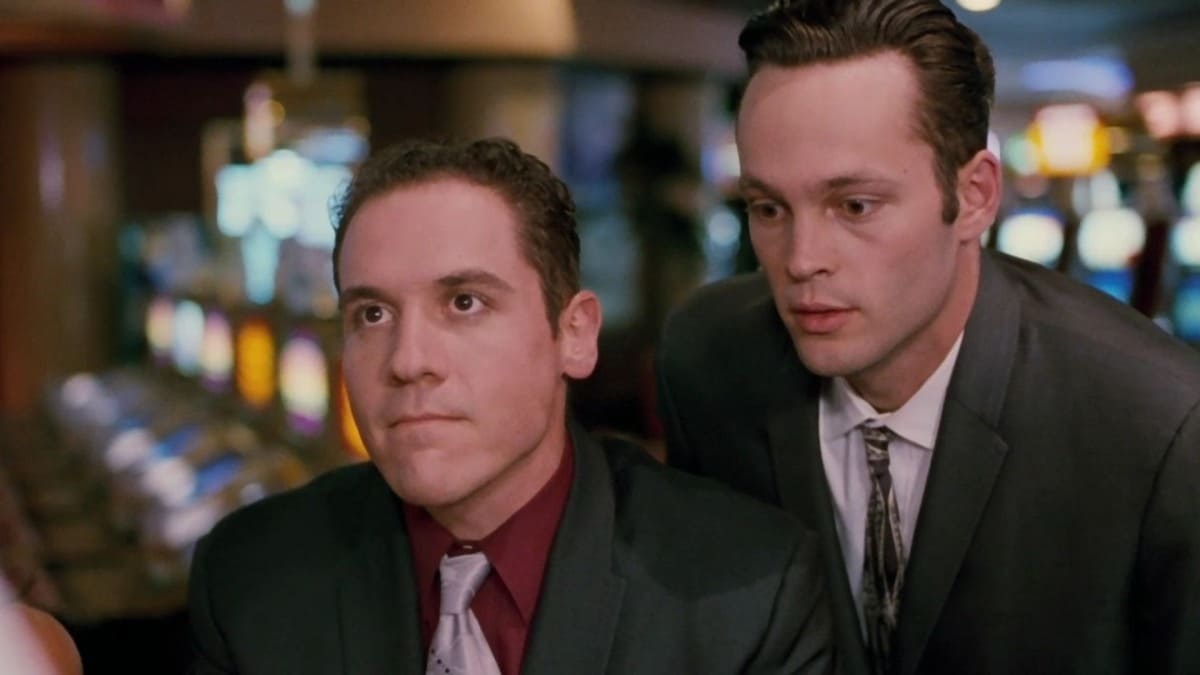
Swingers was the brainchild of writer-star Jon Favreau, who penned a script about being a heartbroken, luckless actor in Hollywood after years of actually being one. His character Mike is a struggling stand-up comedian and East Coast transplant who’s still smarting from a breakup, unable to curb his neurotic tendencies as he gets back in the dating game. He leans on his crew of actor buddies, especially his motormouthed bestie Trent (Vince Vaughn), who pressures Mike into taking a late-night trip to Vegas. It’s here where we see how these so-called hepcats are really just awkward poseurs, acting like sharp-dressed high-rollers in a casino mostly populated by senior citizens, trying to score with cocktail waitresses when they’re not getting wiped out at the card tables. As much as they want to be like Frank and Dino, their incessant bickering has them looking more like Felix and Oscar. (Favreau has admitted a scene where he ruins a meetup with two ladies was inspired by a similar scene from The Odd Couple.)
Made for under $300,000 and shot guerilla-style by future Bourne Identity director Doug Liman, Swingers was picked up by Miramax, which at the time was becoming a haven for buzzy, low-budget, men-behaving-badly cult pics like Clerks, Trainspotting, and Reservoir Dogs (which Swingers gives a visual nod to). Released into that perfect mid-’90s storm when cocktail culture, lounge and swing music, and Rat Pack romanticism were all making comebacks, Swingers is a nostalgic, kitschy artifact. It’s a film where aimless Gen-Xers find purpose by emulating a postwar cool, living out the Playboy philosophy in a world of angsty grunge guys, guitar-strumming Lilith Fair ladies, and other sensitive buzz-killers.
Although it made $4 million at the box office, that still wasn’t enough for Miramax (which bought it for $5 million) to keep it in theaters. Nevertheless, its popularity predictably escalated when it hit video. Liman, who’d go on to win Best New Filmmaker at the 1997 MTV Movie Awards, recalled in a 2014 oral history how some folks at Disney—which owned Miramax back in the day—were fans who wanted to make it a hot rental item. “Suddenly if you went into a video store there’d be 20 copies of Swingers,” said Liman, “like it was a big movie, everywhere in the country.” Miramax also joined in on the post-theatrical buzz; its books division released Favreau’s screenplay on paperback, which also included “The Swingers Rules,” a collection of rudimentary tips for bopping bachelors, conceived by Favreau and Vaughn.
Swingers received modest reviews, with many men loving it (Entertainment Weekly‘s Owen Gleiberman put it on his year-end, ten-best list) and some women baffled by it (Chicago Reader’s Barbara Scharres ended her brief pan with “Bring a barf bag.”). But if you go to the Swingers Letterboxd page, you’ll find wistful reviews that are actually fond memories from male fans who clearly saw themselves and their friend circles onscreen. “Swingers is one of these experiences you had to have when it first came out,” one reviewer wrote. “As a late teenager at the time (closer to my twenties), what Vince and Jon do [sic] in this movie was pretty much what I was doing (except the whole Vegas thing and saying ‘beautiful babies’ a lot).”
But even hardcore fans know the mild misogyny these loudmouthed lotharios spew (even the sympathetic Mike occasionally refers to women as “skanks”) wouldn’t fly in today’s arthouses. From its dated lingo, to its throwback sexism, to its willingness to present men as obnoxious tools and fools who need to grow up, Swingers may be too cringe-inducing or just too annoying for younger audiences. One blunt-but-brief reviewer put it best when he called it “Husbands for guys that can’t get girlfriends.” (Favreau and Vaughn would actually make that movie years later, when they teamed up to star in the Mikey And Nicky-like Made, Favreau’s 2001 directorial debut.)
Nevertheless, Swingers proved that there was an audience for bromantic comedies, which would later flood theaters—usually helmed by improv-friendly filmmakers like Judd Apatow or Todd Phillips—in the following decade. Vaughn would become an integral part of the Frat Pack, that gang of cool-cat movie stars (Jack Black, Ben Stiller, Will Ferrell, Luke and Owen Wilson) who spent most of the 2000s making sophomoric smash hits with each other. Favreau never became a part of that crew, opting instead to pivot into becoming one of Hollywood’s most successful blockbuster directors, setting off the Marvel Cinematic Universe with Iron Man in 2008. (Though he did help Ferrell reach A-list status when he directed him in the 2003 holiday hit Elf.)
Swingers memorably ends with Mike learning how to let go and move on (thanks to some nightclub rug-cutting with a pre-Boogie Nights Heather Graham) and an embarrassed Trent learning that his flirtatious ways don’t work on all women. As Favreau and a lot of its fans have learned, Swingers was a fun time in their youth, but that time has passed. Even they know you can’t hang with sex-crazed, wannabe-cool assholes for the rest of your life. It’s a Swingers rule that everyone—except Vaughn and, of course, Miramax co-founder Harvey Weinstein—seems to have learned over the last three decades.


 Keep scrolling for more great stories.