When it comes to deckbuilders, gameplay tends to be king. Sure, there are takes on the genre with a sense of style; Balatro’s interdimensional lounge music and swirling tie-dies are as memorable as its long list of game-modifying Jokers. But even when it comes to defining entries in the space like Slay the Spire, it’s far more common for these games to treat their stories and backdrops like flavor text.
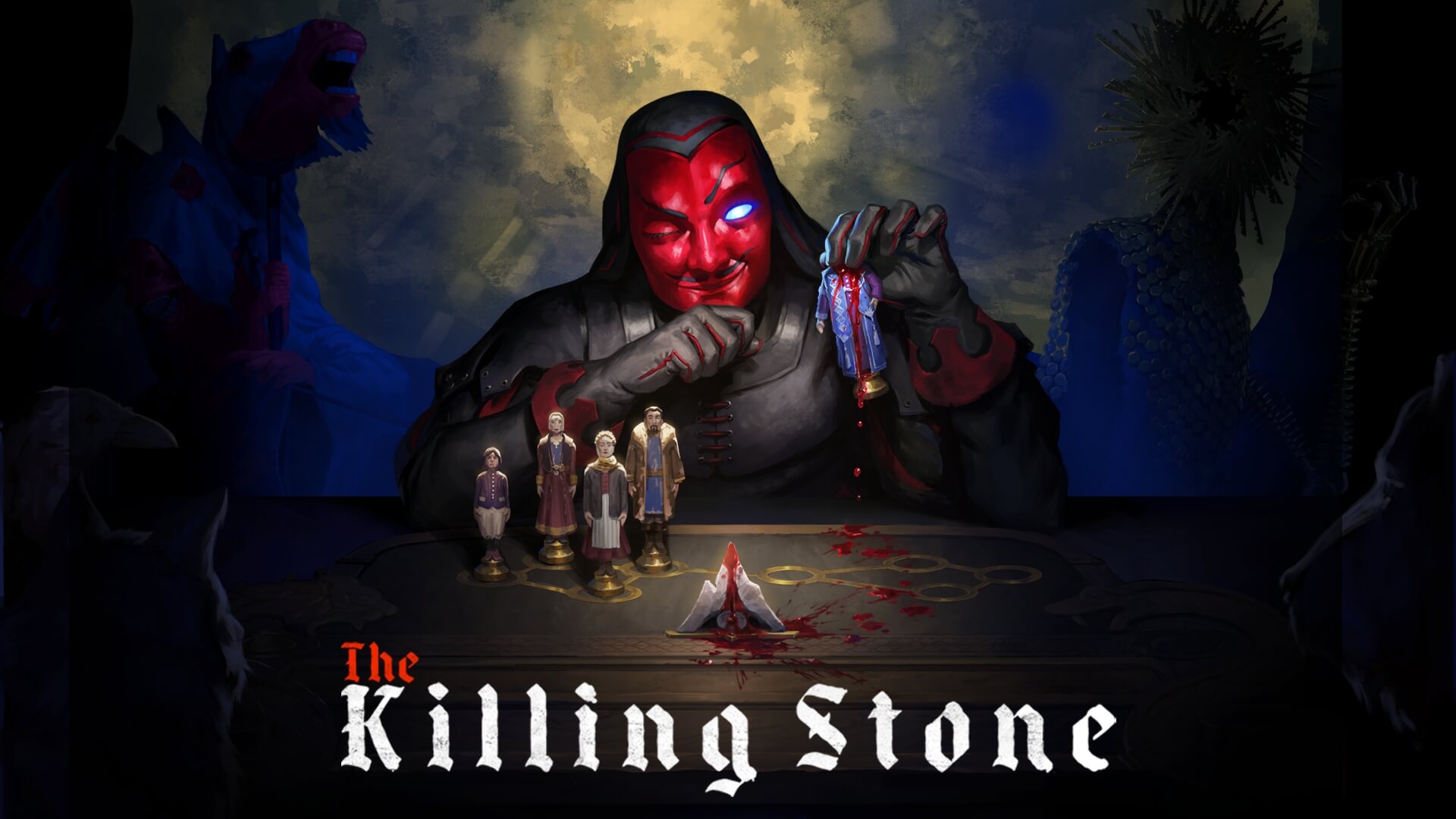
The Killing Stone, an upcoming title from Question (The Magic Circle, The Blackout Club), has very different priorities. Casting the player as a supernatural lawyer fighting for the souls of a cursed family, you’re tasked with outsmarting the Devil at his own game. This Faustian setup isn’t a surface-level aesthetic, but fundamental to the experience, something that manifests in the many bargains you’ll partake in along the way: on top of making tough choices around your deck, you’ll wager over boons and banes, setting bids that determine which of these attributes will activate. After a hands-off preview and a little over an hour with a demo (that’s on Steam), it’s clear that this card game takes its aesthetic and locale very seriously. This is best summed up by the wonderfully unhinged choice to have two scripts with separate voice-over tracks: one in regular Modern English and another in 17th-century Period English (thee, thous, thines, etc.).
As for the setup, you play as a Maven, a scholar versed in the “seven liberal arts,” who has just received the news that their teacher and close friend, Mariken Svangård, is dead. To sort out their will, the Maven journeys to the Svangård’s family home in the Arctic (where the group was exiled for Mariken’s witchcraft). Here, they get even worse news. It turns out that, on top of signing away her own soul, Mariken also signed away her family’s. In her final letter, she asks the Maven to parley with the Devil and defeat him in a battle of legalese—this is fitting because, in Goethe’s Faust, God hits the Devil with some semantic nonsense to bail out the German doctor.
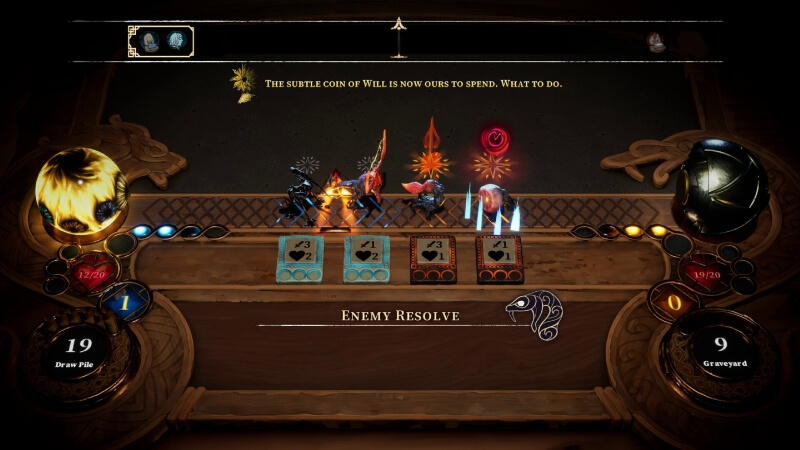
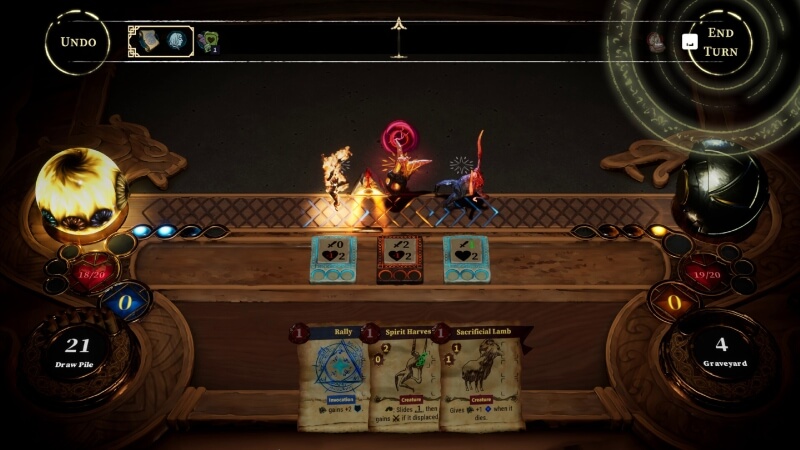
Here, these legal debates are visualized as a card game. You play cards to summon Bosch-like hell creatures, which are represented by little figurines, and wage a tabletop war against biblically accurate demons. At least from the limited hour we saw, there’s a mixture of elegance and complexity at work here. On the one hand, you can only summon a maximum of three creatures at a time, and while there are also other card types that let you cast spells and buffs, you won’t be orchestrating a horde of critters like in Monster Train. However, where things get interesting is with the “reserve” mechanic, which lets you stack cards behind a creature.
The most straightforward way this works is that if you place a creature behind another one, the background critter will come to the foreground when its ally is slain. However, there are other complexities at work. Although reserved units won’t attack or defend, their passive abilities can still activate even if they’re in the background: for example, the Flask of Thought creature has a skill that heals its Host (this is you) and neighboring units each turn, something it will do even when it’s behind an ally. There are other ways to manipulate the board, too, including methods to move units behind enemy lines and keywords to attack around or through adversaries. Similar to something like Into the Breach, the game pairs strategic depth with clarity. Easy-to-parse UI telegraphs how your actions will affect the board, and you’re given the option to undo actions during your turn.
As for the deckbuilding, a fairly unique element is that instead of drafting cards individually, they come bundled in pre-arranged sets of three or four. While it’s possible to remove individual cards, most of the time you will be trading bundles rather than adding or removing them piecemeal. It’s a choice that ties into the game’s underlying notion of trade-offs and bargains, and instead of building a lean engine after purging every bad card like you’re playing first edition Dominion with Chapel, you’re forced to navigate drawbacks. Similarly, depending on which family member you’re currently trying to save, you’ll have access to innate boons that overlap with their personality, as well as unique curse cards, which represent how Mariken has damned them, that need to be worked around.
All of these card game nuances are quite neat and show a lot of promise, but as mentioned, the area where The Killing Stone stands apart from nearly everything in the space (besides Inscryption) is in its emphasis on atmosphere and a sense of place. The voice work from Liam O’Brien (as the Devil) and Emma Gregory (Mariken Svangård) sells the Shakespearean theatricality of the setting, as dialogue trees and exploration of this mysterious manor mark the influence of games outside the deckbuilder genre. There are even several narrative decisions throughout the story that the developers teased could lead to different outcomes for this family; perhaps it will pan out a bit like the divergence between Marlowe’s Doctor Faustus and Goethe’s more optimistic reading of the character. Needless to say, The Killing Stone engages with this specific cultural and historical context in a way few games do.
Admittedly, it will be quite tricky for this deckbuilder to weave together its two halves; a looping, run-based card game doesn’t exactly fit the traditional structure of a narrative-focused experience. Still, given everything we’ve seen, there’s room to be quite optimistic, especially if you’re a classical theater nerd who also loves Thursday Night Magic. It may be an odd pairing, but what we’ve seen of The Killing Stone drives a hard bargain.


 Keep scrolling for more great stories.