How Star Wars sequel disappointment helped stoke the "fan-fiction to publishing" fire

The Love Hypothesis started with Rey and Kylo Ren, then it blew up.

How Star Wars sequel disappointment helped stoke the

It all started with the godawful ending of Star Wars: The Rise Of Skywalker. For a section of the fandom, namely those invested in the prophesied dyad connection between Rey (Daisy Ridley) and Kylo Ren/Ben Solo (Adam Driver), that chapter was an abomination. A waste of chemistry, mythology, and great actors, it led many to vent on social media, throwing shade specifically at director J.J. Abrams. Some of that number channeled their disappointment to the page by writing a more satisfying ending and then uploading it for others to read on sites like Archive Of Our Own. Of the 18.5 million works on that fandom-made, non-profit repository of fan-fiction, Reylos have written almost 32,000 fix-its and reimaginings. One of those writers, Ali Hazelwood, a neuroscience professor, wrote a contemporary story placing Kylo and Rey as post-docs at Stanford University who fake-date for individual reasons and end up falling in love. She then rewrote it with new character names—Dr. Adam Carlsen and Olive Smith—and, in 2021, it became a mainstream bestseller: The Love Hypothesis. 

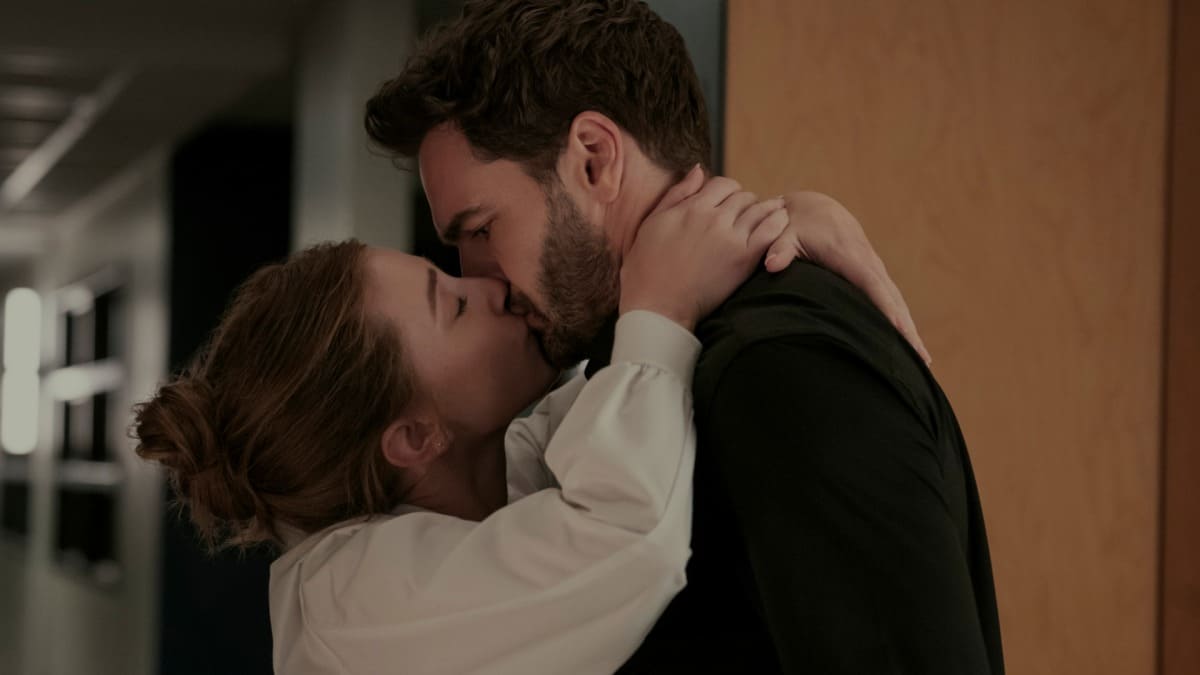
Hazelwood has plenty of company from the Reylo fandom who also turned their stories into bestselling novels, but not many get their book made into a buzzy movie. The September 23 release of Prime Video’s The Love Hypothesis—starring Lili Reinhart as Olive and Tom Bateman (married in real life to Ridley) as Adam, directed by Claire Scanlon (The People We Hate At The Wedding), and produced by veteran producer Elizabeth Cantillon (Galaxy Quest, Persuasion)—is a surreal moment, where years of inside jokes and fan-casting is now a reality.

The fan-fiction-to-publishing-to-film pipeline isn’t entirely new. E.L. James reworked her Twilight fan-fiction into Fifty Shades Of Grey. Heated Rivalry evolved from the invented relationship between Steve Rogers and Bucky Barnes. Then there’s SenLinYu’s Hermione Granger and Draco Malfoy fan-fiction Manacled, rewritten and published in 2025 as Alchemised, which is currently optioned by Legendary. While the creative path isn’t groundbreaking, it’s becoming increasingly mainstream, and the once-mighty romance film is pivoting to meet its evolving audience.

“Streaming has created a lane for this, because theatrical movies for romantic comedies and romances in general got put aside for different genres—superhero movies, horror movies, etc…,” Cantillon tells The A.V. Club. “But in that vacuum, created by nobody being able to see those stories in the movie theater, they were on streaming. And streaming really went hard. Some of those movies are great, and some of them are less great, but they’re definitely feeding the audience, and I think that’s wonderful.”

Cantillon admits that, when she helped option The Love Hypothesis in 2021, she was utterly naive to its fandom roots. “I came to it more purely from reading the text, then meeting with Ali, and being charmed by the setting and the characters and her,” Cantillon says. “What happened since then makes us all seem smart; that we were early to the party. [Ali’s] turned into such an icon in this space, and since Claire came on, and once we were making the movie, we were living in [the fan-fiction] world.”

Scanlon says she was also surprised. “After the fact, I found out how incredibly popular it was. Elizabeth mentioned it to me, and I heard her, but it didn’t really sink in,” she says. “I definitely know she said the words. It’s one thing that it’s a popular book. People Who We Hate At The Wedding was a popular book, but this was in the stratosphere of popularity. Once I started gathering how important it was, we wanted to make sure that the script maintained those true touchstones.”

That includes Easter eggs layered throughout, meant to speak directly to the original Reylo fandom, from composer Laura Karpman’s Dr. Carlsen motif that harkens back to John William’s Kylo Ren march, or opening the film with a Gracie Abrams “Mess It Up” needle drop. 

“Someone had put on Instagram or TikTok, ‘They better have a Gracie Abrams song in this movie!’ And I remember someone having to explain it to me,” Scanlon laughs. “Because I’m the Luddite in the room, I asked, ‘Why do they want a Gracie Abrams song, specifically?’ And it’s because J.J. created the characters of Kylo Ren and Rey, and [Gracie’s] his daughter. And then obviously, there’s the elephant in the room with Daisy Ridley being Tom’s wife. And he did not get that role because of his wife.”

More important than these sly references, The Love Hypothesis embraces why so many gravitate to the world of fan-fiction and the female perspective inherent in much of AO3’s fiction: sex and romance. While studios still figure out how a generation of filmgoers want to engage with intimacy onscreen, an avid audience of readers are quite clear about what they want. 

“I love how Laura Karpman described it when she was starting to compose the music for this film,” Scanlon says, “which was, ‘These are grown-ups. This isn’t a YA story. They are elite scientists at Stanford Biology Department. This isn’t kiddie time.’ The music reflects that. The sex scene reflects that.”

In fact, the portrayal of the book’s infamously steamy 16th chapter expanded as its importance to fandom sunk in for Scanlon: “Initially it was a smaller scene, and then as we realized, it evolved. We didn’t want to short-shrift this scene that was so important to so many people.” She also made sure it was filmed with the female gaze in mind. “If you present something in a mature, adult way with real stakes and a point of view, that scene is earned throughout the film, so it pays off and then some. And moving forward, if you tell me that other movies now decide to do that because of this film, I’ll be thrilled.”

 
Join the discussion...
Keep scrolling for more great stories.