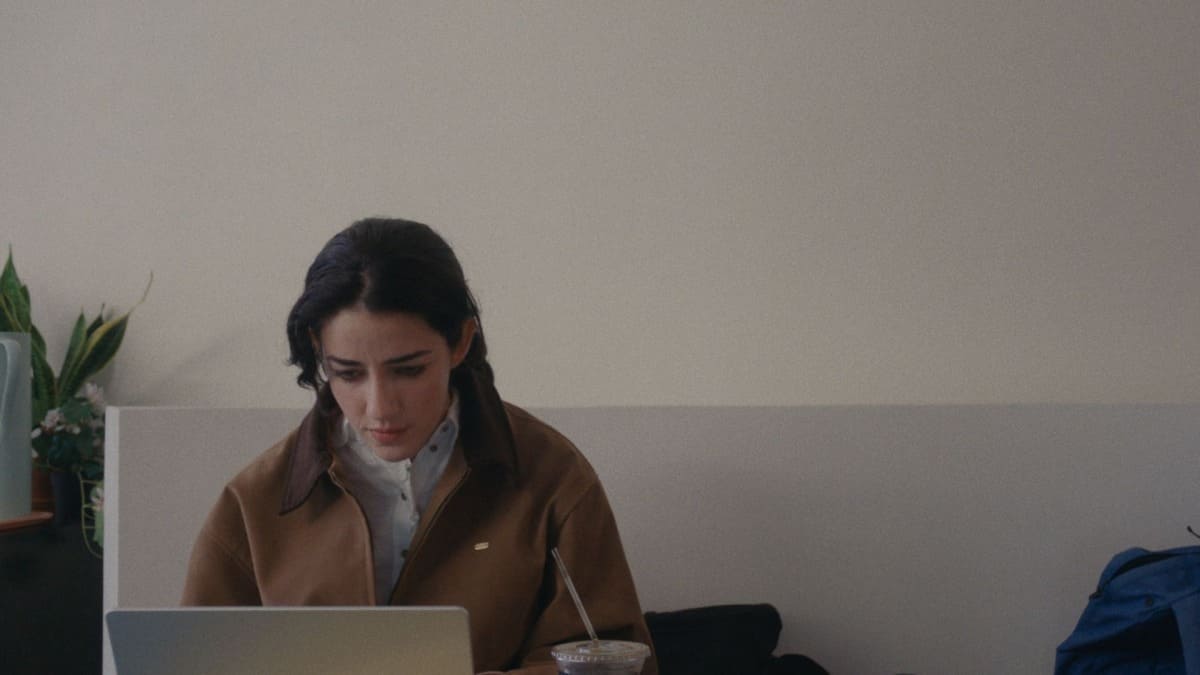
Through the minutiae of the job, González-Nasser carves something both highly specific yet deceptively simple in how relatable it is. Sofia drives from location to location, often listening to disgruntled voicemails from people she’s already canvassed—people who’ve had the spell of the first interaction wear off and now feel used. For something that is supposed to be business, it is all strikingly personal, both to the people Sofia effectively intrudes upon and to herself. To do her job, Sofia must approach reluctant homeowners and business proprietors with an affable and cautious curiosity. She also must use her personal phone, her personal car, and her literal, physical person; Sofia doesn’t so much have a work-life balance as her work seeps into every facet of her life.
The temporary relationships she forges also, inevitably, lead to some people wanting something more ongoing from Sofia. One of the people blowing up Sofia’s phone is a pet shop owner, Josh (played by Inspector Ike‘s Matt Barats in a more understated performance), who is insistent that Sofia get dinner with him. Herself running behind because of a series of compiling small problems, Josh’s advances seem necessary to entertain in order to hang onto the location he controls, lest she create another logistical problem to solve at work.
This creates a distinct loneliness to the world she lives in. Sofia’s job sees her form countless connections while never allowing them to grow—such a thing is necessary to keep going with the work she does. It’s another aspect which resonates deeply with anyone that works in many corners of the gig economy: Managing these transactional relationships, making people feel like they are having a genuine connection when the whole thing is business, is the emotional labor that makes up the hospitality and service industries. It’s not something as tangible on a set as lifting c-stands or tripods, it’s trying to get people to give you what you want. Whether that’s a tip, a sale, or the use of a building makes no difference.
The loneliness of the worker isn’t where it ends, either. Sofia’s location-hopping reveals a seriously lonely world at every one of her stops. Sometimes, this is quietly sad, like the old woman, Anna (Rutanya Alda), who lives alone in a beautifully curated brownstone. Other times, a broader societal anguish comes to the surface, like when Sofia is photographing the house of a work-from-home husband, Tyler (Max Rosen), who has lost any sense of social life since having a baby. Tyler stalks Sofia around the house, becoming a (perhaps menacing) voyeur to Sofia’s intrusions. While the scene never turns to violence, that implicit sexual threat quietly looms over everything. In this moment, whatever was once benign about the job suddenly gives way to an acute sense of danger—after all, this is a job about putting oneself alone in other people’s houses.
The unknown of what’s behind the door can also lead to chance encounters familiar to those working on the move. One of the apartments Sofia looks at turns out to be that of her old friend Becca (Otmara Marrero). The two make quick work of making up for lost time, losing themselves in conversation, although there still a sense of impossibility to their reconnection. As they stand on Becca’s rooftop, they look down through a skylight to the bar below, watching the customers and tenders in equal kind. A sadness sets over everything. Some people get to live their lives freely, others are trapped on the opposite side of the glass (or, the opposite side of the bar). It’s summed up by something González-Nasser told me, that so many struggling to make ends meet can understand: “Everyone’s having a great time and you’re working.”


 Keep scrolling for more great stories.