Few hit movies could resist the sequel siren song of the post-Jaws and Rocky 1970s, particularly in horror. Producers were happy to supply the built-in returning audience with follow-ups to The Exorcist, Halloween, and Friday The 13th, and by the mid-’80s, even horror’s elder statesmen were trying to compete with the Freddys, Michaels, and Jasons running amok. Psycho II and Return Of The Living Dead—to say nothing of Dawn and Day Of The Dead—proved that digging up the famous monsters of yesteryear didn’t have to be a brainless affair, but fans and critics didn’t know what to make of Tobe Hooper’s demented The Texas Chainsaw Massacre 2, which arrived in August 1986 with a single poster, spoofing The Breakfast Club. “I gave the general audience exactly what they did not want,” filmmaker Tobe Hooper told The A.V. Club in 2000. “I think they expected more of the same.” Yet, what Hooper gave them has lived on in countless other films.
Hooper, who changed the face of horror cinema with 1974’s The Texas Chain Saw Massacre, did not intend to direct its sequel. Had they not been stuck in litigation for a decade, the film’s producers would have loved to recreate Hooper’s low-budget, high-return hit movie much earlier. But by the time Cannon Films pulled the rip cord on Texas Chainsaw 2, Hooper already had risen to the top of Hollywood with Poltergeist and begun crashing back to Earth. His three-picture deal with Cannon began with a massive bomb: the 1985 sci-fi vampire epic Lifeforce. In June 1986, his remake of the flying-saucer B-movie Invaders From Mars flopped too. But before it did, Hooper and Paris, Texas screenwriter L.M. Kit Carson agreed to write the Chainsaw sequel to meet an August 1986 release date. In Hooper’s retelling, “I ended up running out of time and directing it myself.”
Though there is some dispute over how difficult working for Cannon was (star Caroline Williams says they were horrible to Hooper; Hooper called them a “really good company to work for”), time was always against the shoot, which began in May 1986, less than four months before the film would hit theaters. That airtight turnaround meant the film was in constant rewrite, reshaping itself around fluctuating budgets and studio demands. In the 2006 making-of documentary It Runs In The Family, Carson remembers someone graciously telling him to stop typing because filming had wrapped.
The filmmakers might not have always known exactly what they wanted, but Hooper knew he didn’t want to repeat himself. Carson and he were aligned on that front. “It had to be different from the first one,” Carson said in the making-of. “The key to the original was its outrageousness, so you have to be outrageous in the other way.” The result is just that: A restaging of the original for the sequel-heavy, financially deregulated Reagan ’80s, where horror-movie killers are beloved Texas royalty—and that’s even after Cannon recut the film and left many of its subplots and satirical moments on the slaughterhouse floor.
Before Gremlins 2: The New Batch mocked itself in 1990, Texas Chainsaw Massacre 2 blew up its predecessor with an anti-sequel the size of Texas. If Texas Chain Saw Massacre eulogized the ’60s through its depraved and decayed America, Texas Chainsaw 2 enjoys the excess of its era with pointed, satirical irony.
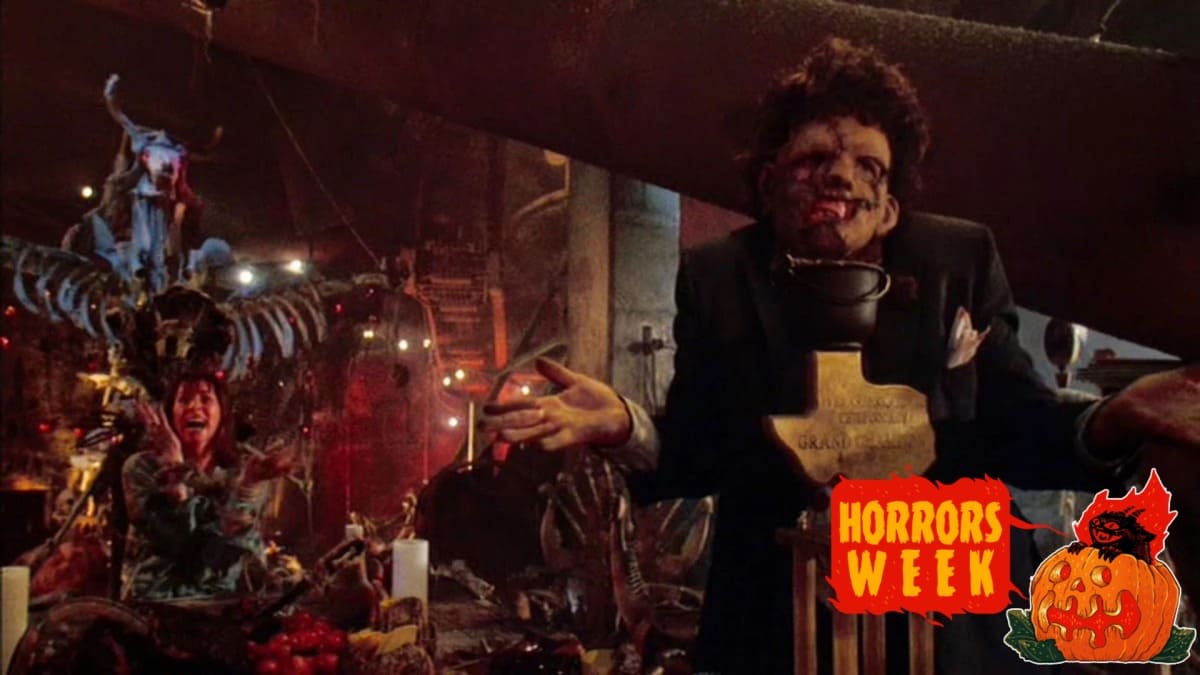
Texas Chainsaw Massacre 2 announces itself immediately as something different. We’re long past somberly road-tripping to check on Sally and Franklin’s grandpa’s ritualistically desecrated grave. Instead, two totally unsympathetic yuppies fire bullets into highway signs at high speeds. Like Hooper’s original hippies, they meet the Hitchhiker, so to speak: No longer satisfied with masks, Leatherface (Bill Johnson, replacing Gunnar Hansen) arrives wearing a human-flesh costume made of the Hitchhiker’s body. The suggested violence of the previous film is replaced with a gratuitously graphic haircut courtesy of makeup maestro Tom Savini.
Similarly, while the characters become bigger and more mythic, their day-to-day concerns are more mundane, as the business of being the Texas Chainsaw family of cannibals turns out to be quite lucrative. Their cravenness and brutality has permeated throughout society. Everyone’s part of the family, from the screaming yuppies who terrorize the Texas roads, to the chainsaw salesman brought to orgasmic nirvana from watching star Dennis Hopper wail into a tree trunk. “Oh my achin’ banana,” he moans. Everyone in the film loves and has opinions on chainsaw-based violence. One deleted scene even beats New Batch to the film critic punch by featuring horror movie critic Joe Bob Briggs positively reviewing Leatherface’s murders outside a movie theater.
This wasn’t a huge leap for Hooper, who never appreciated how seriously people took the first film. “No one got the ironic humor of the original,” he said in 2014. For example, “When the older brother, the Cook, screams, ‘Look at what your brother has done to the door!’ and all these hippies are dead.” The sequel underlines this. Now named Drayton Sawyer, the Cook (Jim Siedow, the only returning cast member) is a renowned, award-winning chili cook whose worries are mostly business-related. It’s not enough that he’s an insane people-eater—now he opines about slaughterhouse automation, artless factory farming, and, most importantly, the weekend’s croissant sandwich rush.
With the Hitchhiker dead, Hooper and Carson reformulate the character as Chop-Top (Bill Moseley), a proto-Beetlejuice ghoul whose hippie costume and peace signs do little to hide his skin-crawling menace. He’s more pointedly funny, which makes him even more deranged and monstrous. Even the chainsaws get gags, with Hopper, who stars as Lefty—an obsessed cop looking for his nephew Franklin’s killers—double-fisting mini-saws (complete with their own adorable holsters). For his part, Leatherface becomes infatuated with the female lead, Stretch (Williams), and humps a bucket of ice with a parodically phallic power tool. Everything is ratched up to the point of parody, turning the suspense and tension of the original into an explosion of gore and mayhem.
The film’s exaggerated characters, expansive and expressionistic sets, and ceaseless yelling do a lot to cover its nonsensical plot. The story mostly follows Stretch, an ambitious radio DJ, who recorded the yuppies’ murder. She and Lefty use the recording to lure the family out of hiding, leading to her imprisonment in the family’s sprawling H.H. Holmes-inspired subterranean funhouse underneath the Texas Battle Land theme park. The full details of Stretch and Lefty’s plan and their familial connection were left on the cutting room floor. Perhaps Lefty being Stretch’s illegitimate father would’ve made for a good Empire Strikes Back parody, but Hooper admitted the film was unfinished and features several “incomplete sequences.” The movie is better for it: Texas Chainsaw 2 is a vibes-first style piece, a self-parody that requires no further grounding. Carson’s belief that outrageousness is “key” to the original ignores its simplicity. The scant plot, character motivations, and backstory make TCM uniquely terrifying. But, in the years immediately after its release, the need to dig into family origins had already begun plaguing many major horror franchises. Texas Chainsaw 2 instead focuses more closely on the infamy of its killers, and how popular and influential they have become in the years since. It’s a meta-narrative where everyone loves these guys: Even their victims can’t help but play their hits on the radio.
Following the sequel’s box office failure, the Texas Chainsaw series made an immediate about-face. Aside from the conspiratorial fourth entry, the franchise mostly returned to recreating the gritty original to forgettable results. But horror fans are never ones to let a good sequel go unnoticed. Texas Chainsaw 2 found an audience on video, where kids too young to see the sequel in theaters could stare at its baffling cover art for minutes on end. It helped that the film was slightly ahead of the curve.
In the years that followed, spoof sequels became frequent staff picks on video store shelves. A year after Texas Chainsaw 2, Sam Raimi’s Evil Dead 2—an excessive, slapstick remake of his debut—would become one of the decade’s most influential horror movies. Other cult favorites, like Sleepaway Camp II: Unhappy Campers, parodied the popularity of horror celebrities with gory glee. Gremlins 2 (also rejected upon release by audiences and critics) willingly let success go to its head for a hilarious corporate satire, while Wes Craven explored slasher celebrities in New Nightmare and four Scream movies. Self-aware sequels that comment on their predecessor’s influence would eventually break Star Wars in half as The Last Jedi dared to play on the Skywalker legacy. Hooper’s vision was downright prophetic, especially considering something like Universal Studios’ Halloween Horror Nights, where the likenesses of horror’s most sadistic killers adorn toys and T-shirts for all ages. Texas Chainsaw Massacre 2‘s willingness to make a mockery of an instant classic took guts, on and off the screen.


 Keep scrolling for more great stories.