Paste Magazine is The A.V. Club‘s source for music news and lists, artist interviews, and album reviews.
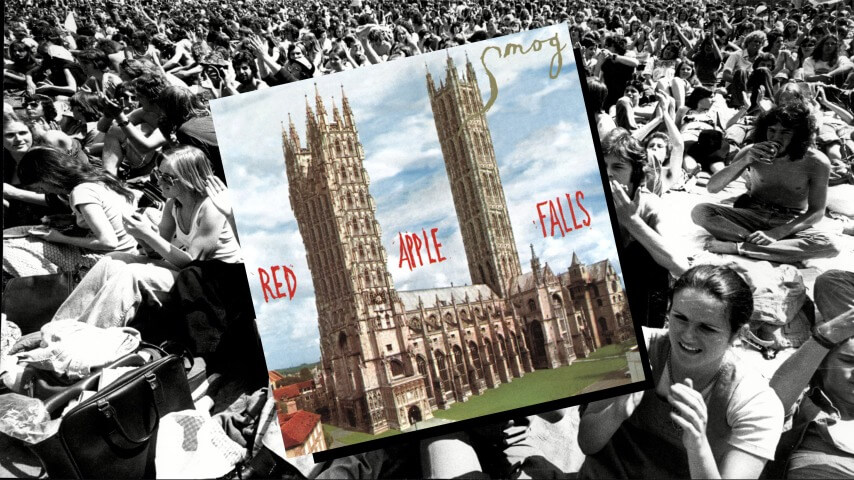
There’s a moment on 1997’s Red Apple Falls when Bill Callahan has an epiphany. You can hear it on the album’s penultimate track, the aptly titled “Inspirational.” The song is a soaring and ecstatic ode to positive change, and the sound of Callahan’s band (complete with lap steel guitar, tambourine, and propulsive piano) is in itself a positive embrace. And then there are the lyrics themselves, nestled in Callahan’s trademark warm baritone: “If you’re living the unlivable / By loving the unlovable / It’s time to start changing the unchangeable / By leaving the unleavable / Yes, it is now.”
“Inspirational” is an encapsulation of a new, reinvented Bill Callahan—under the nom de plume Smog. Before Red Apple Falls, Smog was known for a cold, brutal mythos. The songs were often riddled with existential dread and misplaced masculinity, Callahan delivering sparse lyrics over even sparser instrumentation—all of it drenched in metaphor, vocal distortion, and a 4-track hum. All five of his preceding records were never intended to be played live, allowing the production on each title to flirt with a very deliberate roughness, one that emerged from necessity: to record, Callahan thumbed through the yellow pages to find a producer and a studio, and just recorded the songs with whoever was there, as quickly as he could, then moved on to the next record.
But on Red Apple Falls, Callahan ditched the distortion. For once, his voice can actually be heard. He trades out the fizzy static of his earlier lo-fi works in favor of embracing cleaner, warmer production (courtesy of new producer Jim O’Rourke). The lyrics, too, are more straightforward and less mystical, the subject matter better accessible to the average listener. Callahan also honed in on a sense of thematic and symbolic cohesion, so that Red Apple Falls could be one collective work of art rather than an array of disconnected songs.
Red Apple Falls also marked the first time in Callahan’s career where he recorded with a full band, and the joy of that communal experience is audible. As he himself tells it, after the recording of “Inspirational,” O’Rourke asked him: “Were you smiling while you sang that?” He was. “You can hear it in the performance,” Callahan later said. “It was one of the first times I’d sung with a full band. It makes you feel high.” And it’s true; he does sound happier on the recording. Maybe not high, but happier. More in control. All that talk of “changing the unchangeable” and “leaving the unleavable” takes on the tenor of someone speaking directly to their younger self, advising them to cast aside their old ways of living to unearth something new, transformative, and intentional.
It was through Callahan’s label, Drag City, that he was finally granted access to a real recording studio and a rolodex of producers. The label suggested the then-27-year-old O’Rourke, who would go on to produce Wilco’s seminal Yankee Hotel Foxtrot and the Grammy-winning A Ghost is Born. O’Rourke and Callahan had met when the former played cello on two tracks from the Smog album Wild Love. As Callahan tells it, their working relationship was immediately different from his experiences with past producers. O’Rourke seemed to understand the aesthetic central to Callahan’s work—a unique pairing of acoustic prog, pseudo-country twang, evocative deadpan vocals, and a kind of softcore heavy metal—and O’Rourke helped Callahan harness that aesthetic to bring these new songs to life. “He was the first engineer that gave a shit about my music,” Callahan told Pitchfork in a career retrospective in 2013. “Having someone sitting behind the glass actually saying ‘Wow, that was good!,’ instead of just, ‘What’s next?’ was a big thing.” The pair worked quickly, recording and mixing the album in just five days. Although the process may have been quick, the finished product is lush, sophisticated, and clean: a testament to O’Rourke’s collaborative prowess and a far cry from Callahan’s earlier work.
The album has a tenderness absent from Callahan’s previous work. This comes through in a soft kind of poetry, with imagery that is rich and ubiquitous, and prescient symbols that would later appear in his later work: apples, birds, horses, rivers, and widows. These were surprisingly absent from his pre-Red Apple Falls catalogue, but here they found a permanent home. Considering the role the record plays in Callahan’s discography and musical evolution, it couldn’t feel more fitting that the record opens on a new dawn. “Morning Paper,” with its little French horn flourishes, stands with one foot in the future of Callahan’s artistry and one foot in his past. The lyrics themselves describe an impasse: wanting to wake up but desperately not wanting to face the way one’s world is unfolding: “The morning paper is on its way / And it’s all bad news on every page / So I roll right over and go to sleep / The evening sun will be so sweet.”
But where “Morning Paper” is about sleeping through life, about turning over to ignore the unlivable, unlovable, unchangeable, and unleavable, “Blood Red Bird” is about sleeplessness, about the tussle between two opposing forces—the livable and the unlivable, for one. A surface reading of “Blood Red Bird” reveals a dark and haunting impressionist painting of a dead relationship and its avian harbinger, but that would be too straightforward for a songwriter of Callahan’s caliber. Instead, the bird in question seems to represent the past—specifically, the past self—as a source of constant existential panic. “We can continually sink into each other / Just deep enough to rip out a bit more flesh when we move away / A scarf of skin trailing out behind / Like an arrow, I was only passing through,” he sings, letting his voice quaver across slowcore Americana.
“Red Apples” is a poetic dirge with a mix of hypnotic bass, snare drums, plaintive organ, and moody piano. One of the more abstract songs on the album, the track is a work of modern folklore, allowing the album’s symbolic tissue to breathe. “I went down to the river to meet the widow / She gave me an apple, it was red,” sings Callahan with haunting stillness. Mysteries emerge. What does the apple represent? And the river? Is the “widow” in the song Chan Marshall (a.k.a. Cat Power), who was his partner for some time in the ‘90s? And is Callahan “the ghost of her husband, beautiful as a horse”? “She wanted nothing in return, I gave her nothing in return.” The hollowness echoes. If the widow is indeed Marshall, then the track carries additional emotional resonance, because she presented an even more haunting version of the song on her 2000 album, The Covers Record.
After three tracks of minimalist prog, “I Was A Stranger” emerges in a shimmering, full-throated country twang, striking a perfect balance between pastoral folk and lonely grunge. The track dives deeper into Callahan’s penchant for writing menacing outsiders—these almost pre-incel characters—into his songs. “And why do you women in this town / Let me look at you so bold,” he asks, “when you should have seen what I was / In the last town.” Long before Alex Cameron made satirizing skeevy men cool, Callahan was doing it with a country bite.
On the songwriting triumph “To Be Of Use,” Callahan turns the gaze on himself once more, asking what it means to live a sexual and valuable life, and whether one can live the latter without the former. “Most of my fantasies are of making someone else come,” he sings over a gentle picking pattern and a lap steel slide. It’s a moving and honest portrait of a man adrift in a sea of misidentity, and shows Callahan at his most vulnerable and deliberate. Then, just as the listener thinks they have a grasp on the energy and pacing of the record, “Ex-Con” bursts through the tracklist and lands with a wry grin and dazzling synths. Herein lies Bill Callahan’s brilliance: he lulls us in with melancholic poetry, and then when we least expect it, he folds in wizened comedy. “Ex-Con” presages our modern media age, all lonely men alone in their rooms finding community online and turning into inhuman husks outside the safety of their homes. The closing line of “Ex-Con” hits harder now than it did in 1997: “Out on the streets / I feel like a robot by the river / Looking for a drink.”
On the album’s final track, “Finer Days,” Callahan sings of the isolation inherent in at last finding the beauty one seeks. It’s an elegant example of his control as a composer: it’s a remarkably still track, with a gentle guitar picking pattern and minimalist lyrics that sound ever so slightly like the old Callahan. But then, just as he sings, “And all of my old friends,” that French horn reappears and builds to a piano-led crescendo. This is the new Callahan—a Callahan that has seen a faint glint of light peeking through the darkness of the tunnel. There’s a bridge-like quality to the album’s conclusion, as well: the thumbed bass note (a B, played ad infinitum) almost connects to Knock Knock’s “Let’s Move to the Country,” with its similarly thumbed bass note (a B sharp, also played ad infinitum). And Knock Knock’s producer? Also Jim O’Rourke. In a sense, the album not only looks toward Callahan’s future, but grasps toward it—even making contact.
Nearly 28 years after its release, Red Apple Falls feels more exceptional and profound than ever. The songwriting alone lifted Callahan to new levels—but fold in Jim O’Rourke and a full band, and it’s hard not to agree that this record might be one of Bill Callahan’s crowning achievements, artistic or otherwise. The songs submit moments of self-actualization worked out in real time, and that’s what makes them linger; after all, we are always in the process of becoming. And so long as there are selves to become and lives to live, Red Apple Falls will continue to find purchase.
Listen to Bill Callahan’s 2011 Daytrotter session below.


 Keep scrolling for more great stories.