
Wolf Parade’s Apologies to the Queen Mary keeps finding new people to haunt
Time Capsule: From blog‑rock touchstone to the soundtrack of my sophomore year to hockey romance fancam fodder, Wolf Parade’s 2005 debut proves old ghosts never belong to just one moment.
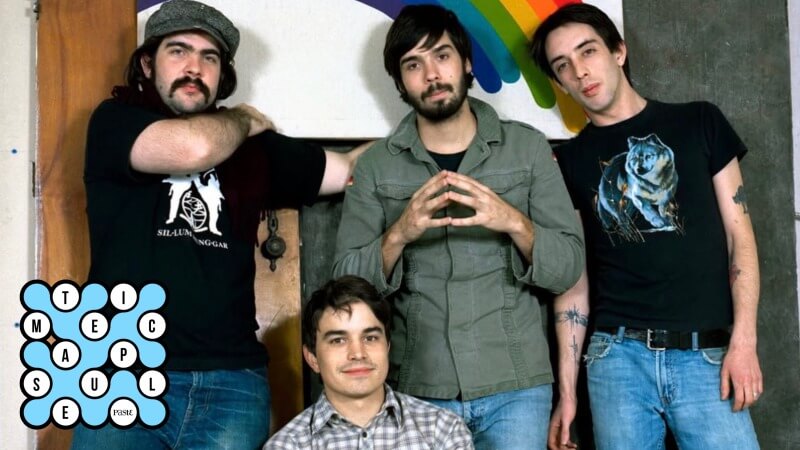
Image of Wolf Parade courtesy of Sub Pop
It’s always weird when a song you love goes viral. When I think of Wolf Parade’s anthemic “I’ll Believe in Anything,” I think of being 19 and clutching at the cheap green comforter of my dorm room bed, choking down furious sobs so my next-door neighbors wouldn’t hear me crying through the thin walls. I think of standing alone on Foss Hill at midnight, fingernails dug into the meat of my palms, my gaze cast up at the familiar sight of the Pleiades cluster and the line “Look at a place far away from here” ringing in my ears. I think of sitting at an old piano in an underground bunker-turned-practice-room, trying to suss out the song’s chords by ear as a last-ditch means of distraction from an increasingly unbearable year, always hitting the keys with unnecessary force whenever the “I’d take you where nobody knows you / And nobody gives a damn” refrain came back around. (Look, I know it’s ostensibly a love song, but it’s always been an outlet for sheer desperation for me—a soundtrack for that visceral, painful yearning for a life that is anything other than the one you’ve been living.) So it’s weird to hear that song as the accompaniment to triumphant, love-is-love TikTok edits of fictional gay hockey players, inexplicably reposted on the Instagram stories of the very people I’ve always associated that song with crying over. Funny, how life works.
I was three when Apologies to the Queen Mary came out, which means everyone else’s history with it technically predates my ability to read (sorry). I know the point of retrospectives is to, you know, retrospect, but if I reminisced on the music that made me in 2005, this would be an essay about The Wiggles. So when I first heard “I’ll Believe in Anything” in early college—at my dad’s recommendation, naturally—it wasn’t striking because I clocked it as a cornerstone of mid-2000s blog rock. It was striking because, when that scrambled little synth pattern came skittering in and Spencer Krug’s voice started howling its way up from the bottom of his lungs, it felt as if the meat of my chest had been carved out and filled with hot air, some desolate kind of hope clogging up my throat and making it hard to speak. In other words, I didn’t inherit Apologies as a reference point but as a working object, a tool that still functioned in 2020 just as well as it did 15 years prior. The trick of the album, I think, is that it’s just about as pinned to 2005 as anything possibly could be (Stereogum’s Ian Cohen called it “absolutely the most 2005 album” conceivable), but somehow, it refuses to stay there.
Over and over, these songs reflect and refract the same state of mind: restless, unsatisfied, slightly out of phase with your own life, pacing a room that doesn’t feel like it was built for you—but wanting it to be built for you so very badly. Wanting to make yourself someone it was built for, but not knowing how. When Krug yelps in that idiosyncratic voice of his about “sons and daughters of hungry ghosts,” he’s talking about his peers; I heard it and felt he was talking about mine. Sure, the scaffolding is different for my generation—less “refreshing music blogs between college classes,” more “refreshing five apps at once while the president legalizes hate crimes”—but the feeling at the album’s core hasn’t gone anywhere: You are here. You don’t want to be here. You’re not entirely sure where “there” is, only that it’s somewhere you might finally be able to breathe. And Christ, you’d do anything—believe in anything—to find it.
IN 2005, THOUGH, NOBODY KNEW this record as a retroactive lifeline for kids born after 9/11, let alone a TikTok sound. They knew it as the debut from a weird new band out of Montreal, that city every music writer suddenly decided was the center of the universe for about 18 months. Wolf Parade had technically only been a band for a couple of years by then—Spencer Krug and Dan Boeckner writing songs together in Krug’s apartment over a grimy bar called Barfly, enlisting drummer Arlen Thompson eight days before the band was set to play an opening gig for Arcade Fire, eventually adding electronics guy Hadji Bakara once things got serious enough to require someone whose job was “make it sound stranger.” It didn’t take long—at all, really—for the band to start making waves in the indie scene. (Oh, the things an Arcade Fire tie-in could do for you in the mid-2000s. Damn you, Win Butler, for being terrible.) The legendary label Sub Pop rapidly signed them; TIME’s Canadian edition called their debut one of the country’s “most anticipated indie albums”; Modest Mouse’s own Isaac Brock offered to produce and hauled them to Portland to record at Audible Alchemy. On paper, it’s the kind of origin story that makes publicists salivate: two gifted songwriters, one buzzy city, one famous adjacent act, one famous patron saint, one very hungry label. Then they finally released their debut—largely cobbled together from various re-recorded songs off their four already-released EPs—and the rest, of course, was history. Well, maybe not history; maybe just some good reviews (including a remarkable 9.2 from Pitchfork), modest sales, year‑end‑list appearances, and a long, quiet residency in the heads of people susceptible to its particular strain of beautiful agitation.
Apologies didn’t exactly blow up the culture on impact, in part because it didn’t launch a movement so much as arrive in the middle of one. In a moment when other Canadian bands like Broken Social Scene and Arcade Fire were making orchestral indie that sounded like it was meant for stadiums but was still technically being played in churches and bars and VFW halls, Wolf Parade showed up with something scrappier, more jagged, more likely to blow a gasket. Even then, people struggled to describe it without resorting to comparisons: “like a Ritalin‑deprived power‑Bowie,” “Springsteen filtered through a busted PA,” “Pixies rhythms and Frog Eyes vocals in a Canadian contraption,” and, inevitably, Modest Mouse (“Grounds for Divorce” always reminds me, for some reason, of “Gravity Rides Everything”). None of that really captures how the record feels when you’re alone with it, but it does get at the central fact that from the beginning, this was a band slightly outside whatever neat box you tried to put them in.
So maybe it’s fitting that when it came time to name their debut, they reached back not to some grand metaphor or announcement of their identity, but to the night they got thrown off a potentially haunted ship: the “Queen Mary” in the title is not Queen Mary I of England, but the the RMS Queen Mary, a retired British ocean liner that, in the mid‑2000s, doubled as a hotel, tourist attraction, and venue for the All Tomorrow’s Parties festival. Wolf Parade got invited to play, did the sensible thing—drank a heroic amount of free booze—and at some point in the night the group kicked down the locked door to the Winston Churchill Ballroom. Inside, they found an opulent, empty room just begging to be desecrated. Because the ship already had a reputation for being haunted, Bakara decided they should hold a séance to “manifest this era of Winston Churchill,” which somehow escalated into turning an oak table into a Ouija board with the help of a buck knife and some stolen décor. The conjured “spirits,” as he tells it, quickly became “pretty immature,” started “breaking stuff” and “throwing things overboard.” When the ship’s management finally intervened, the spectral perpetrators were nowhere to be seen, so despite the band’s protests that “it was just the spirits” (likely story), they were kicked off the boat. But whether or not the band actually summoned anything in that ballroom almost doesn’t matter—the album they named after the ship came back full of ghosts anyway.
GHOSTS ARE EVERYWHERE on Apologies to the Queen Mary, both explicitly and implicitly. “Dear Sons and Daughters of Hungry Ghosts” sees Krug name his whole generation after a Buddhist legend that posits that the “hypocrites and liars go” to a level of hell that turns them “into hungry ghosts…like Tantalus in Greek mythology: he can’t eat or drink, but he’s always hungry or thirsty.” That, Krug insists, is us—always starving and never satisfied—atop la‑la‑las and handclaps trying to pass that spiritual malnourishment off as something you can dance through. “Same Ghost Every Night,” with its “strange, constant blue” and walks taken just to hear your own breath, is Boeckner writing about a rural outpost that felt like it wanted to swallow him whole—family tragedy humming in the background, the woods pressing in on all sides, the sense that you are a tiny, doomed colony of humanity surrounded by something vast and indifferent. “Shine a Light” turns a hellish routine—insomnia, night shifts, “boring hours in the office tower,” that bus back home when you’re “barely alive”—into a hymn for people who keep going anyway, hearts “waiting for something that’ll never arrive.” “There is an awful sound, this haunted town / Some ghosts sink, some will get called to the light.” Right on the heels of “Shine a Light,” “Dear Sons and Daughters” follows with its pub‑chant stomp and talk of hungry ghosts, and then, without so much as a pause, “I’ll Believe in Anything” detonates the whole thing into a love song about wanting to be carried somewhere—anywhere—else. Sheer exhaustion, spiritual or otherwise, can turn into a kind of wild, reckless grace if you push it hard enough. That three‑song run is the record’s spine: work, hunger, escape, in quick succession. (It is also, not unrelatedly, one of the greatest three-song runs of the century.)
Even the relationship songs feel haunted by absence more than presence. “Grounds for Divorce,” which Krug insists is “just about breaking up,” hangs everything on trivial preferences—bus brakes versus imaginary whales, cloud‑watching versus radio static—and then keeps returning to that dead darling, that wedding cake of a relationship that crumbled upon contact. “We Built Another World” is ostensibly about getting drunk at a party and thrown out for breakdancing and fighting, but by the time Boeckner’s singing about lights pinning “the ghost to the street” and a world built by “hanging ghosts from the trees,” it feels like a vision of all the possible lives that might have been built out of nights like that and weren’t; a dream of escape from our “Modern World” that we struggle daily to actualize. “Dinner Bells” stretches that feeling out until it starts to blur, seven‑plus minutes of fall‑afternoon corniness and end‑times imagery that Krug kept precisely because it felt a little embarrassing instead of safely cool. Closer “This Heart’s on Fire,” which Boeckner calls completely autobiographical, can’t quite decide if it’s a love song or a grief song: “I am my mother’s hen / And left the body in the bed all day” sits right next to “you’re my favorite thing, tell it everywhere I go,” all of it attached to a hopelessly hopeful refrain of “It’s getting better all the time.”
There’s an interesting divide between body and soul throughout the record—“their hearts are dead but the body don’t mind”—yet, curiously, there’s less of one between body and body. “We Built Another World” begins with two people literally chained at the wrist; “I’ll Believe in Anything” is a love song of frenzied unification: give me your eyes, your blood, your bones, your voice, your ghost. “Fancy Claps” promises “When I die, I’m leaving you my feet / When you die, you can stand up for me.” Two spirits, one mouth—and wouldn’t you know it, Apologies itself functions the exact same way: two songwriters with different obsessions trying to cram their mid‑twenties crises into a single 47‑minute body.
 Keep scrolling for more great stories.