With Together Again, Jesse Hassenger looks at actors and directors who have worked together on at least three films, analyzing the nature of their collaborations.
Given his close working relationship with his creative and life partner Emma Thomas, Christopher Nolan seems like a Wife Guy. Given the results of that collaboration, though, Nolan has become better-known as a Dead Wife Guy. While his unofficial company of favored actors does have a few women, many of his narratives feature male-driven ensembles where at least one of the heroes must grapple with a dead spouse (or spouse figure): Bruce Wayne nurses his grief over Rachel in the second Dark Knight movie; Inception‘s Dom is haunted by the dream-world figure of his dead wife Mal; Leonard searches for his wife’s killer in Memento. It’s all over Nolan’s filmography, sometimes twice in a single film; The Prestige eventually curses each of its dueling magicians with a dead wife as collateral damage in their obsessive careers. It’s in this context that Nolan’s recently three-peated work with Anne Hathaway stands out.
True to her pre-Nolan sorta-rom-com history, Hathaway has played the love interest under his direction, and, yes, the faithful wife, as she does in The Odyssey. But even more so than the other women in Nolan’s rolodex, she brings a much-needed feminine energy to his sensitive large-scale bro-downs—which have in turn provided her with a triptych of films surprisingly well-suited to her strengths as an actor.
Hathaway arrived at her first Nolan movie already an Oscar nominee and a substantial star, having briskly cycled through Disney-machine introductions (the Princess Diaries movies) and I’m-an-adult-now displays of sexuality (Havoc, Brokeback Mountain) before landing at the happy medium of old-fashioned star vehicles like The Devil Wears Prada. The latter was a film emblematic of her greater career, especially in the 2000s: Many of her movies might be casually, carelessly shelved with other romantic comedies, but her love interests tend to be kind of a nothing presence, both as a performer and in the story at hand. So why did Anne Hathaway get the reputation as a rom-com mainstay? It’s probably because her persona, especially early on, was compatible with the kind of striving character lazily written into 2000s romances. Hathaway’s screen presence for much of that era felt similarly steered by someone who prizes that type-A orderliness—a rom-com heroine in a succession of mostly unfunny, non-romantic movies.
Yet when it comes to The Dark Knight Rises, it’s precisely that impression of romance that allows her to dominate the movie despite lacking the showiness of Heath Ledger’s Joker or Tom Hardy’s Bane. Praising Hathaway’s ability to coax heart-eyes from Christian Bale might sound regressive; after all, Marvel has proudly evolved the superhero subgenre beyond the need for such concerns as falling in or out of love, drawing a succession of female characters whose love lives are largely sequestered tastefully offscreen. Luckily, Nolan ignored the then-growing consensus against superhero smooching. (In contrast to, say, Ant-Man and the Wasp, who have an entire relationship and breakup while barely seeming to touch each other, Selina first plants one on Bruce without ceremony, in order to steal his car.)
To be fair, The Dark Knight Rises does not feature a grown-up relationship. Nolan’s baseline seriousness has sometimes obscured how pulpy and even silly his movies can get, yet Hathaway seems to intuitively understand his tone and its leeway. Selina Kyle—she’s never officially dubbed Catwoman—enters the movie breaking into a safe belonging to Bruce Wayne (and taking advantage of his gamy knee to knock him on his ass!), and almost immediately performs a very Anne Hathaway trick. Having disguised herself as a catering worker for an event at Wayne’s home, Selina is caught just after opening his safe. When she realizes Wayne has figured out what she’s up to, she immediately shifts her tone. Trembling, girlish eagerness to please drops as quickly and disposably as a mask, with an ostentatious “oops” in response to Bruce musing that he was told his safe was uncrackable. “No one told me it was uncrackable,” Selina continues in a mock pout.
It’s a cheesy note that Hathaway hits hard, and it’s not the last time, either; later, Selina escapes from a shootout and Hathaway toggles between terrified, shell-shocked victim screaming for help and over-it aloofness as she disappears into the night once she’s out of cop earshot. These moments play great, though, as do Selina’s sometimes-middling quips, because Hathaway is rarely more charming than when she’s committing to a bit. Many of her best later-period roles hinge on exactly the striving, performative quality she demonstrates in her earlier films, with the self-consciousness reconfigured as a sly feature rather than an earnest bug. Even a movie like her artistic breakthrough Rachel Getting Married is partially about the image her character desperately projects—the fuck-up role in her family she both protests and fills with dyspeptic discomfort. That acting-on-acting thread continues all the way up to this year’s Mother Mary (the first of her five 2026 movies), where she’s a pop-star performer losing her sense of self. There’s a bit of cloak-and-dagger deception in The Odyssey, too, with Penelope forced to play the part of the elegant, even-tempered, loyal yet pragmatic queen.
In The Dark Knight Rises, Hathaway uses her performativeness to give Selina a duality that’s more quicksilver and less meticulous than her Bruce/Batman counterpart. It’s code-switching with a touch of 1940s fabulousness, half moll and half screwball. There’s a broader transformation at work, too: Selina starts off like Nolan’s favorite non-wife female role—the noirish femme fatale—and by the end of the movie, she’s the very personification of Bruce finding peace and love, away from the public eye as both a powerful billionaire and the Batman.
This threatens to reduce Hathaway to a love-interest accessory—and to some extent, she is, given that she’s joining the third movie in a trilogy about Batman. But while Hathaway and Nolan’s Selina isn’t as psychologically thorny or nervy as the tour-de-force performance Michelle Pfeiffer gives in Batman Returns, the movie makes the case for her being a similarly perfect match for this universe’s Bruce, especially as The Dark Knight Rises hurtles forward. After she first banters with Bruce, Selina turns up at a costume party with cat ears, and later wearing goofy headgear that conveniently pulls up into a similar-looking silhouette, both chic costumes accompanied by a tasteful little face mask. The brief mid-movie scenes of Batman and Catwoman kicking ass together—mere minutes of screentime—are the closest Nolan has ever come to a swoonworthy consummation.
So when it comes time to see Bruce and Selina happily ever after, it’s a surprisingly moving image, echoed from a moment described earlier by Alfred (Michael Caine), voicing his hope that he would one day encounter an incognito Bruce who has left his traumatic double life behind. Again, it’s easy to read some regression into that image: Here’s the former hellcat, domesticated. But while his subsequent movies would largely step further away from noir, Nolan and Hathaway give his love of that subgenre a touching send-off with a femme fatale redeemed, rather than punished the way a true noir might dictate (or successfully villainous, the way a neo-noir might end).
Bruce and Selina’s rarified domestic bliss is all but reprised in The Odyssey, when an early flashback shows Odysseus (Matt Damon) and Penelope (Hathaway) discussing what he might do instead of going off to fight in an open-ended Trojan War. Penelope suggests that they might sneak away together on a boat bound for the horizon, renouncing the royal responsibilities and burdens that threaten their family. Odysseus doesn’t agree to it, but snatches of that imagery return in the film’s finale, as he and Penelope reunite and agree to exile themselves from Ithaca, with mournful knowledge of the damage the war has wrought upon the world. It’s a more bittersweet ending than Dark Knight Rises, which essentially offers a happy one (with Nolan even cutting back to Gotham for an assurance that a Batman-like figure will continue to serve in Bruce Wayne’s absence), and Penelope is a much different figure than Selina Kyle—less dynamic but more emotionally textured.
Still, on the scale of Christopher Nolan’s wives, Penelope is notably not a martyr or a betrayer, and the most fully formed and human of the lot. The contrast is especially obvious in a movie where most of the other female roles are imbued with magic (Circe, Calypso, Athena) or cursed with a near-magical reputation (Helen Of Troy). While Nolan portrays these characters matter-of-factly, his presentation of Penelope is more stylized. She’s introduced from behind latticework, sectioning off her semi-private weaving quarters from a palace overrun with her suitors. Nolan does capture her unobstructed, particularly in her fraught conversations with her son (Tom Holland), but some of her big scenes take place with her obscured in some way.
In one of the most striking shots of the film, Penelope talks to the scheming Antinous (Robert Pattinson), and the camera views them through the weaving on Penelope’s loom. Penelope looks a little hazy through the fabric, while the camera angle makes Antinous look ghostly. Nolan often uses shallow focus, and in The Odyssey depicts several dialogue scenes with rack focus emphasizing the speaker, rather than cutting between one-shots. The weaving subtly keeps Pattinson less in focus, while also placing a sense of royal mystique around Hathaway. Despite that royal bearing—and Hathaway’s theatrical ability to force Nolan’s intentionally colloquial version of Homer to occasionally sound like roughly approximated Shakespeare—Penelope is the human anchor for The Odyssey, even when she’s suggesting locking the suitors in the palace and burning them alive. She’s both more grounded and more idealized than the literally magical women Odysseus encounters. For Nolan, humanity simply means expounding on or symbolizing love.
Hathaway’s role as an ambassador of love becomes more explicit in Interstellar, and points to the ways Nolan’s approach has shifted since welcoming Hathaway into his circle. His reputation as a chilly, Kubrickian control freak was always overblown and Interstellar, the movie that was supposed to lock in his next-gen Kubrick status, moves him further away from that, despite its superficial resemblances to Kubrick’s own odyssey from 1968.
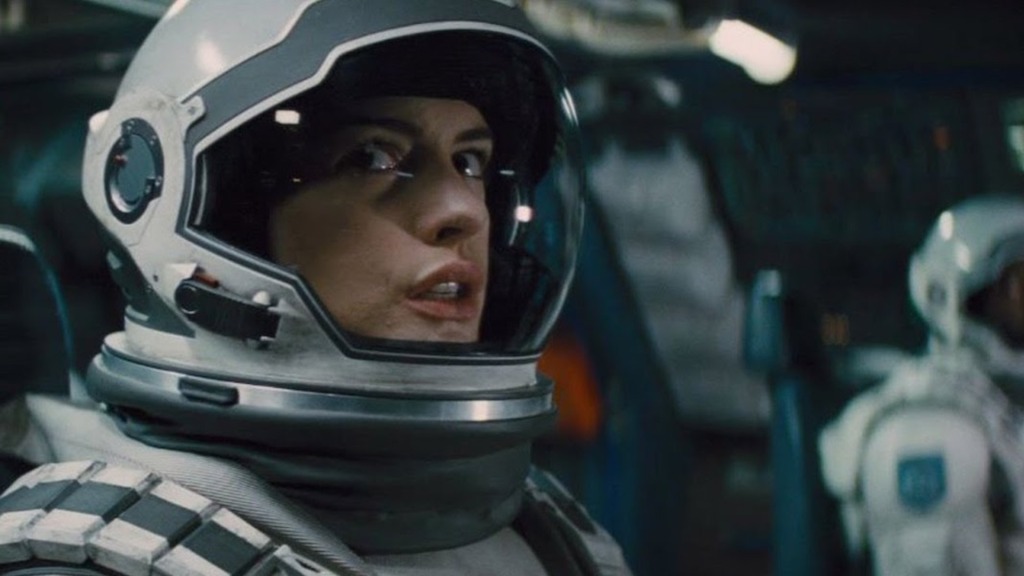
As in The Prestige, Nolan doubles down on the dead-spouse gambit—and for the first time, a woman plays one of his tortured Wife Guys. Hathaway’s Amelia Brand is a NASA scientist tasked to find an inhabitable planet as an alternative to a dying Earth, and argues passionately for focusing limited resources on reaching a planet where she may find the man she loves, who has gone ahead to explore that planet. Her colleague Cooper (Matthew McConaughey) argues that this is a bias she needs to overcome, while Amelia counters with a justification for following her heart, even though she knows there’s a good chance her lover is dead: “Love is the one thing we’re capable of perceiving that transcends dimensions of time and space.” Just before this line, Cooper tries to brush off the science of love as more of the social variety. Amelia has a comeback to this, too, speaking to the heart of a major Nolan preoccupation: “We love people who have died. Where’s the social utility in that?”
This scene is light-years away from the outlines of romance Hathaway was performing a decade earlier. It’s passionate, straight-faced, and endearingly corny—very Nolan, in other words, and Hathaway nails it. She plays against the most stereotypical reading of the role, the woman who prioritizes the heart over the brain, with a fervent exterior that barely masks her greater sadness. As easy as it is to pluck self-inserts from Nolan’s other movies, Amelia is a stealth candidate for one of his strongest on-screen analogues.
At the same time, it would be reductive to ascribe Hathaway’s increasingly complex performances to Nolan, whether they’re as unvarnished as Interstellar, playfully deceptive as The Dark Knight Rises, or theatrical as The Odyssey. For all of his narrative pretzels, Nolan’s way with actors tends to be pretty straightforward. With many of his female characters, that could probably be downgraded to simplistic. Yet Hathaway seems incapable of merely playing the wife or the girlfriend for him, even when those words fit a simplified description of her role. Her self-consciousness becomes, in this context, a great gift.
Perhaps, rather than Nolan’s direction adding to her performances’ complexity, it’s fairer to say that Nolan’s movies have opened up emotionally in Hathaway’s presence. There’s emotional impact in Memento, The Prestige, and more. But his three with Hathaway confirm that Kubrick-style detachment isn’t really his bag—that he can naturally wring some tears from an audience. Nolan’s movies aren’t the only ones that benefit from Hathaway’s later-career reinterpretation of her own poise, but there’s a courtly sense of gender equality, however illusionary it might be, in their collaboration. At times, they seem to be holding doors open for each other.


 Keep scrolling for more great stories.