With Together Again, Jesse Hassenger looks at actors and directors who have worked together on at least three films, analyzing the nature of their collaborations.
For years, Sam Rockwell seemed to dance through every role. Not literally, of course; combing through his back catalog reveals plenty of parts where he doesn’t shimmy, bop, or do that signature fast-foot shuffle he’s made a part of multiple roles and a number of talk-show entrances. And in terms of his later-period roles as a more famous performer, he certainly doesn’t cut a rug as George W. Bush in Vice, nor in Clint Eastwood’s Richard Jewell. In fact, he doesn’t even dance in Wild Horse Nine, despite working under the direction of Martin McDonagh, a playwright and filmmaker who seems otherwise prone to indulging Rockwell’s naturally raffish, riffy instincts.
Rockwell isn’t playing a weary old-guy version of his squirrely, smarmy persona in Wild Horse Nine. The designated old guy in McDonagh’s latest film is John Malkovich as Chris, a dying CIA man whose colleagues have indulged his final wish (or is it?) that he sees Rapa Nui, also known as Easter Island. Rockwell plays Lee, Chris’ partner and chaperone on the trip, which also functions as a brief break from their job of sowing discontent in 1973 Chile. But while Rockwell is recognizably himself in the role, he has, over three movies, used his status as McDonagh’s favorite American to subtly shift the tenor of his scene-stealing performances.
McDonagh has only made five feature films so far, with a new one arriving every four or five years. They could be classified as The Ones With Colin Farrell and The Ones With Sam Rockwell, a Venn diagram that overlaps with Seven Psychopaths, his second and probably least-regarded feature (though less divisive than at least one awards darling that followed). Though Farrell is the ostensible lead in Seven Psychopaths, it plays more as a Rockwell film because it’s set in Los Angeles, or at least a kind of post-Tarantino, Western-and-noir-influenced version of it, with some good old-fashioned American desert thrown in at the end. Naturally, then, Farrell plays a screenwriter—named Marty, no less, as if assuring viewers it’s understandable to conflate creator and creation—struggling with both his craft and his alcoholism, possibly having trouble differentiating between the two.
Little context is provided for Marty’s greater career; he has a nice house in L.A., and enough time to noodle on a movie where he only really has the title—Seven Psychopaths—but little in the way of obvious outside pressures, and no one really talks about his past accomplishments, if any. Regardless, he’s exhausted by the expectation of flashy cinematic violence, and having come up with his grabby title, he seems forever in search of a way to write his way out of it. His best friend Billy (Rockwell), a struggling actor, prefers to barrel straight through, and when Marty floats the idea of subverting audience expectations by setting up a violent revenge picture and then allowing the characters to walk away and relate to each other as humans instead, Billy demands to know if we’re “making French movies now.” In the same conversation, he also disputes the idea that taking an eye for an eye leaves the whole world blind; he insists that there would be a single one-eyed man left triumphant. McDonagh works with a lot of great actors, but Rockwell might be the only one who could so easily sell Billy as someone who puzzles this out in real time and feels genuinely vindicated by it.
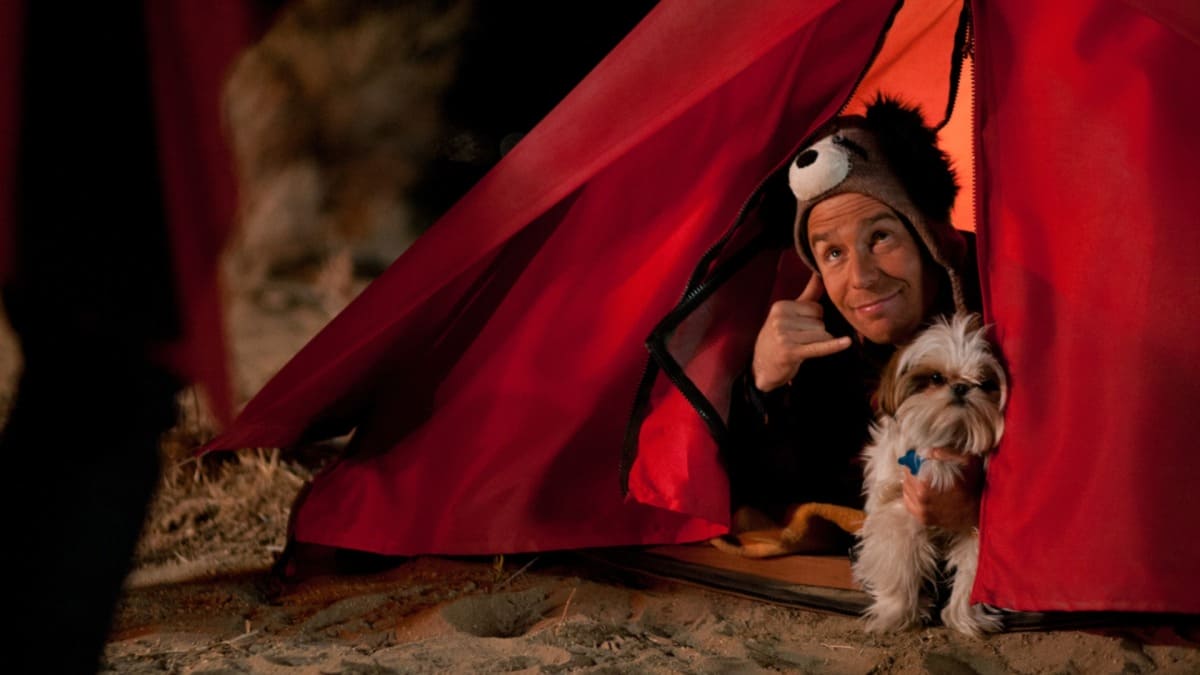
Billy, then, gives voice to an American id that might be outside the grasp of someone like Farrell: loud, exuberant, and antsy, he’s a go-getter with some dumb ideas about what to get. Though long conversations punctuated by violence are often associated with the films of Quentin Tarantino, Rockwell characters tend to be more akin to the self-consciously quirky figures populating the bumper crop of late-’90s post-Pulp Fiction rip-offs and wannabes. That’s particularly true of Billy, whose side hustle is kidnapping dogs, returning them to their owners, and reluctantly accepting their gracious cash rewards. His other side hustle is serial killing; it’s eventually revealed that he’s the masked first psychopath the movie introduces in its ongoing and fuzzy accounting of the seven.
McDonagh wasn’t trying to make a Tarantino knockoff, though. If anything, Seven Psychopaths is a belated commentary on a certain style of violent indie film, filtered through a playwright’s semi-dark night of the soul, attempting to figure out his role in an entertaining but potentially corrosive culture. His movie is filled with slurs as punchlines, violence as plot, and occasionally lacerating commentary on the kind of movie he seems to be making following the more contemplative (though also slur-and-violence-filled) In Bruges. “You can’t let the animals die—just the women,” Billy says while excitedly outlining his plan for a movie-ending shoot-out. He’s not being pointed, but McDonagh is, and again, Rockwell may be the only one in the movie who could deliver this line while sounding like his own freewheeling person rather than a wry authorial surrogate. That outside-yet-inside quality is what made Rockwell pop in his earlier roles, like the designated red-shirt extra in Galaxy Quest (where he’s both aware and in mortal fear of his metatextual disposability) and the possibly delusional host of game-show trash in Confessions Of A Dangerous Mind. In Seven Psychopaths, it’s Rockwell’s job to keep nudging the movie into sensational ridiculousness while serving as its fall guy.
Rockwell was able to approach this task with some unlikely experience under his belt: Of McDonagh’s small group of repeat movie performers (Rockwell, Farrell, Brendan Gleeson, Woody Harrelson, Tom Waits), he’s the only one who has also performed the writer’s work on stage. In fact, Rockwell’s performance as a hotel clerk in 2010’s A Behanding In Spokane predates his film collaborations with McDonagh. I was lucky enough to catch the show in its Broadway run, and though I can’t claim a perfect recollection of a play I saw 16 years ago, my dominant memory is of Rockwell slyly competing with his Psychopaths co-star Christopher Walken (playing a man who’s been searching for his severed hand for decades) for who can be the most off-kilter guy on stage. As in Psychopaths, Rockwell’s loopy, heel-rocking enthusiasm also has a way of highlighting a more soulful quality to Walken’s signature built-in weirdness.
A little experience with McDonagh’s theatrical work, particularly his first play set in the United States, means that Three Billboards Outside Ebbing, Missouri never strikes as especially loathsome, neither in its dimensionalized (and supposedly redemptive) portrait of a racist cop nor in its distortions about the U.S., a country McDonagh does not live in. Here Rockwell becomes the designated drinker as Officer Jason Dixon, a cop in small-town Missouri who has recently been reprimanded off-screen for abusing a Black suspect in custody. He often appears to be taking a hobbling victory lap over having a job at all, despite the fact that we later learn it took him an extra year to graduate from the police academy.
Dixon isn’t supposed to be a part of the film’s central conflict, which involves Mildred Hayes (Frances McDormand) putting up billboards publicly demanding to know why Chief Willoughby (Woody Harrelson) hasn’t made any progress in solving her daughter’s horrific rape and murder. But Dixon, loyal to Willoughby and emboldened by his own stupidity, inserts himself into the situation, more aggressively after Willoughby’s suicide (which is unrelated to the billboards, but timed in a way that adds fuel to some eventually-literal fires). Though Willoughby has a capacity for violence and bigotry, Rockwell physicalizes his instability in a slouchier, weight-shifting way than your typical powder keg. In both sadness and anger, he presses his head onto someone else’s body. Rockwell’s usual antsiness wobbles and threatens to collapse; even in a signature dance break, he’s less surefooted, making stupid little faces along with the music in his earbuds while at work, briefly oblivious to the spreading news of his boss’ death.
That Dixon, who loses his job after nearly killing a man and then attempts to make progress in the Hayes case, is ultimately viewed as more pitiable than evil, rankled some viewers, who felt as if McDonagh utilized the likable Rockwell to make a mistimed argument in favor of extending empathy to purveyors of police brutality. That Rockwell won an Oscar for his work seemed only to underline that point: Not only is he playing a racist cop, but one the Academy is allowed to explicitly love. Similarly, Harrelson’s reasonable, funny, self-aware, only lightly stern chief feels like an old-fashioned idealization of the good-sense lawman, bearing little resemblance to his real-life equivalents. Yet, it’s difficult to watch McDonagh’s films without bringing in the abstractions of his stage work, which make this movie’s Missouri and its cops feel more allegorical than purely sociological.
Granted, Three Billboards has a less stylized and movie-referential look than the color-saturated Seven Psychopaths and feels more “open” than McDonagh’s plays. The billboard location in particular would be difficult to mount on stage; the same is true for the island scenery of his subsequent movies The Banshees Of Inisherin and Wild Horse Nine, where there’s tension between wide-open spaces and their water-on-all-sides limits (not to mention their focus on exhausted duos). But the mere continued casting of Rockwell is a gesture toward theatricality—a tip-off that we’re not meant to be thinking primarily about how Dixon represents real police. For that matter, if he does, he’s ignorant, bumbling, and easily wounded, not exactly a recruitment ad or even much of an apology. He does, however, come up well short of pure evil, something Rockwell tends to embody only cartoonishly, if at all. It’s easy enough to root for him to lose even in his most villainous roles; it’s easier still to enjoy every minute he’s on screen, which can be part of these baddies’ deception.
Accordingly, Rockwell also rarely seems like the “real” version of what he’s playing, whether he’s a dad or a drug dealer or the president of the United States. This isn’t to suggest that he can’t be grounded or believable; more that he bends the reality of the movie around him. He’s perfect casting for a McDonagh version of America; a more realistic broadside at an American cop would probably focus on heft, an intransient nature, or a false but unshakable sense of authority. Dixon, on the other hand, can’t sit still despite a lack of physical grace, just as Billy in Seven Psychopaths can’t stop pitching and nudging his vision of a great screenplay.
As laid-back as he can sound, Rockwell characters often have an inner rapaciousness driving them, often in the wrong direction. That’s literalized when Three Billboards ends on Dixon making peace with Mildred and embarking on a drive to find the man who has just been cleared in the Hayes case. He likely committed a different rape, and the two agree to track him down and murder him. The glimmer of possible sidelong redemption comes from their mutually confessed uncertainty over whether they really want to kill this guy. “I guess we can find out along the way,” Mildred says, and Dixon seems to agree. Though he’s tried to reflect on his own wrongdoing, and now sits in the passenger seat, he can’t remain entirely motionless while he figures out how much grace or forgiveness he needs.
Wild Horse Nine calls out his character’s busying actions early on: “You’re always eating,” Malkovich’s Chris tells Rockwell’s Lee. It’s true in spirit if not literally; the movie does often show Lee eating, an actorly affectation that Rockwell also adapts in a series of Seven Psychopaths snacks. Lee retains plenty of recognizably Rockwellian moves in Wild Horse Nine, like the way he wraps his food-full mouth around a sticky admonishment of Chris’ nonexistent discretion talking about their work on an airplane. He doesn’t dance, though. For Rockwell, Lee is pretty restrained, channeling his mannerisms into the consumption of food, testy phone calls with his wife, and reining in Chris. He frames the latter in such businesslike terms that it’s a while before the movie makes it clear what Lee is actually there to do, and why.
Anyone galled by McDonagh’s portrait of a racist cop clawing his way out of his own anger in Three Billboards might feel similarly about his sympathetic view of a couple of murderous CIA guys with a checkered-at-best history and a current assignment to assist with the military overthrow of Chile’s new socialist president. The accumulation of his life’s shady work has begun to weigh on Chris, while Lee seems, if not content, at least accepting of the idea that he can keep busy, keep his head down, and keep doing his job. Rockwell slides back into McDonagh bob-and-weave banter with ease, but he’s channeling that restless energy into more socially acceptable forms. It’s Malkovich who now plays the live wire, as if trying to jolt himself out of the spy routine Lee dutifully enacts.
Malkovich is so good in the movie, and so beloved in general, that he steals focus from Rockwell’s uncharacteristically semi-restrained work, spent applying himself to covering for Chris’ flagging mental capacities. But Rockwell is crucial again because of his Americanness; Malkovich has long had a semi-European, semi-otherworldly aura about him, and while that doesn’t undermine Chris as a CIA lifer, that detail is easier to buy with Rockwell’s Californian drawl present. For some, McDonagh’s attempts to reach into the U.S. overshoot their mark. But McDonagh characters are often temporarily displaced, whether in location or in life, so why should that only apply to Irish guys? Wild Horse Nine often plays like an American mirror to In Bruges, where the guilt-ridden hit men instead become discomfited company guys. It lends Rockwell’s more buttoned-up approach to his own persona the poignancy of a man who’s nowhere near retired, but is forced to confront how little is waiting for him on the other side. If Farrell is the soul of McDonagh’s film work, Rockwell is the legs, slowing as they go but not yet able to hold still.


 Keep scrolling for more great stories.