Trinket Trove’s complexity sneaks up on you, what with all the cute woodland creature art showing the animals collecting seemingly worthless treasures like crayons and buttons. But the combination of its two-part bidding mechanic and the ways different sets score give the game more weight than the smiling mouse on the cover might imply
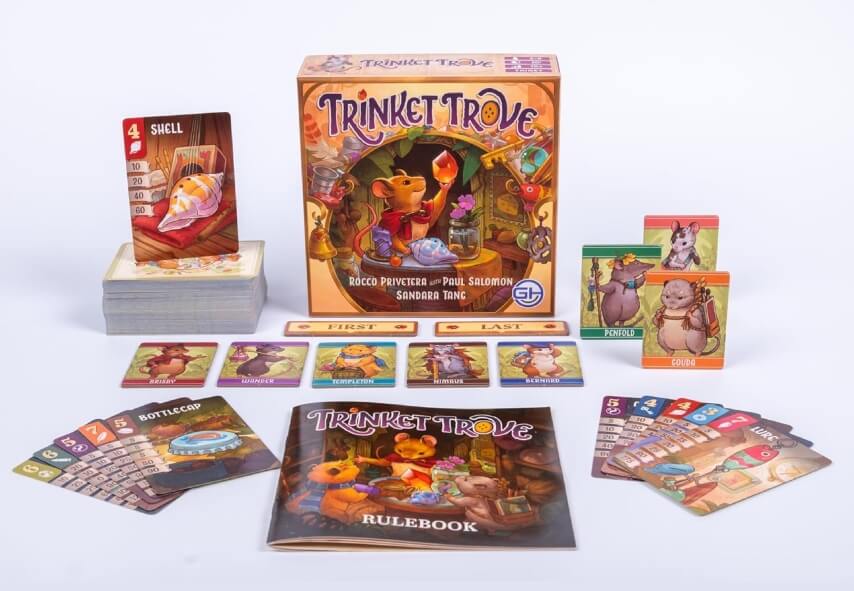
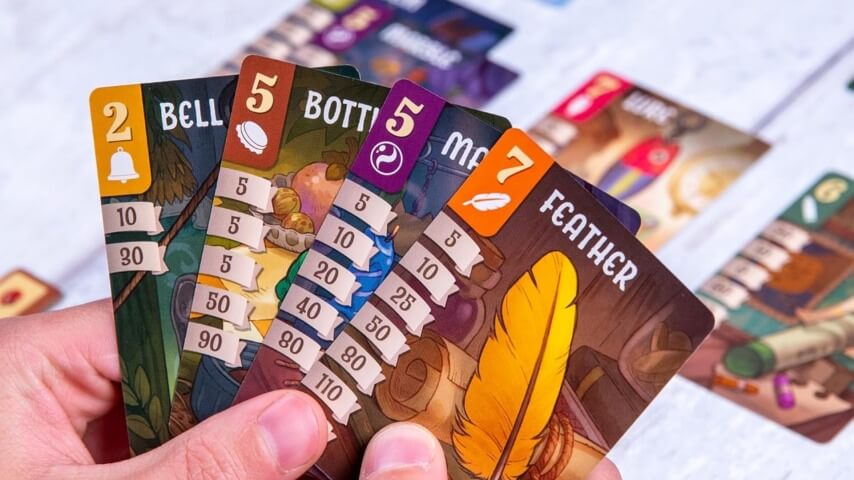
Trinket Trove is a set-collection game at heart, with the entire game comprising a deck of 112 cards along with player tokens and two cardboard pieces to mark the ends of the turn order row. There are 12 unique trinket types in the deck along with the wild mirror cards, and each trinket scores differently based on how many cards of that trinket you have in your hand at game end. Each trinket has a number in the upper left showing how many cards you need for a “full” set, scoring the maximum number of points, while that number also comes into play in the bidding process. The value-2 Thimble is worth five points if you have just one in your hand, and 35 if you have a pair; if you end up with a third one, it starts a new set. A full set of value-7 Lures (as in fishing), however, is worth 175 points. Most trinkets increase in value as you collect more in the set, but some break that rule—one Crayon is worth 20 points, but three Crayons are worth zero points, and then they jump back up to 80 points for a set of four.
Each player starts the game with four cards, discarding any Mirror cards in their initial draw. The dealer also sets up a “timer” deck that has six cards in a two-to-four player game or 10 cards in a five-to-six player game, with that deck used to mark the number of rounds. The dealer then draws one card per player, placing them individually in the bid row in the center of the table, and then takes the top card of the timer deck and places it on top of the leftmost card in the bid row (or does this with two cards in a five-to-six player game). Those cards are now up for bid in this round, with stacked cards only available together—you can’t just take one card from a pile or two or more (although you’d seldom want to do that anyway).
Players then go around the table and bid once by playing cards from their hand. Bids are valued first by the number of cards, regardless of face value, so three cards beat two no matter what numbers they show. If there’s a tie, the higher-valued bid by total face values wins; if there’s still a tie, the later bid takes precedence. The cards that the players use to bid go in a separate row and are then available for players to claim when the bidding is complete, with the one restriction that you can’t claim the bid cards you placed unless you’re forced to do so.
Each player will then claim two stacks of cards per round, following the order set in the bidding, until all stacks are taken and a new round begins. The turn order set in the previous round becomes the order in which players place their bids in the new round.
Because of the nature of the scoring, you want to collect more cards of fewer types to maximize your point total, rather than gain a more diverse set of cards. You’ll bid with cards where you might only have one, or where there aren’t matching cards in the offer row, but a card you think is expendable at the start of a round may become less so if other players bid similar cards. Early in the game, you’re more likely to have to choose which cards to give up as bids, since you can’t keep everything in your hand even if you’ve got some sets building up. You can also start to guess what opposing players are collecting and try to pivot; in any case, the cards you have in your hand at the end of the game often won’t be the ones you thought you were collecting when it started. That’s the real appeal of Trinket Trove, more than the cute critters on the cards: It demands that you stay agile and reassess your plans repeatedly throughout the game without ever requiring any heavy lifting or too much mental math.
I could also see this game expanding very easily just by adding different types of trinkets, where you set the deck at the start of each game by selecting two card types at each value level from two through seven. I’d love to see cards that are a little harder to score, such as one that only gives you points if you have an even number of cards in its set.
Trinket Trove plays two to six players and takes less than 45 minutes to play even at that max player count. I’ve played this with four and with six and found it worked well at both counts, but even if it technically works with two players, this is the type of game that’s always going to play better with more people so you’re cycling through more cards and more likely to be fighting someone else for a specific type. It’s a small gem—which, coincidentally, is one of the trinkets you can collect for your trove.


 Keep scrolling for more great stories.