When Unbeatable’s first trailer was released over a year ago, it made about as strong an impression as it could, a sharply directed music video that combined crackling lo-fi anime presentation with beat cops getting uppercutted. “A game where music is illegal and you do crimes,” the tagline read. For some, it likely popped up out of nowhere, but this journey was a long one; development started eight years ago (according to the ending credits), with the game receiving its first serious attention in a 2021 Kickstarter that coincided with the release of its free proof-of-concept on Steam, Unbeatable: [White Label]. For those tuned in, it has been a long time coming, and the promise of a punchy new rhythm game has left many eager to shred.
And shred Unbeatable does. After a wobbly introduction that threatens to derail this excitement, the game discovers its sound, eventually turning into a sensory overload that blares like a punk rock belter. It’s admittedly messy at times, with both writing and technical hiccups, but ultimately, toe-tapping rhythm game segments blend with powerful imagery that reminds us of something important: music isn’t all about perfect execution and polish, but about emotion. Unbeatable has emotion to spare.
As the previously mentioned tagline suggests, the story takes place in a world where music has been outlawed: the narrative is vague in setting this up, so let’s just say that singing and playing instruments can trigger a dangerous reaction that summons unwanted guests. Beat, a hot mess 20-year-old who has no clue what the hell is going on, stumbles into this locked-down community with little besides her kickstand and guitar. She’s a struggling musician who happens to run into Quaver, a kid whose mom was in a famous act, and, before long, they form a band with Clef and Treble, twins who’ve been in and out of prison for music-related “crimes.” From here, they try to find their way in a world where the thing they love doing more than anything is very illegal, at least according to H.A.R.M. (Harmonious Audio Reduction Maintenance), the fascistic para-military that cracks down on noise complaints with extreme prejudice.
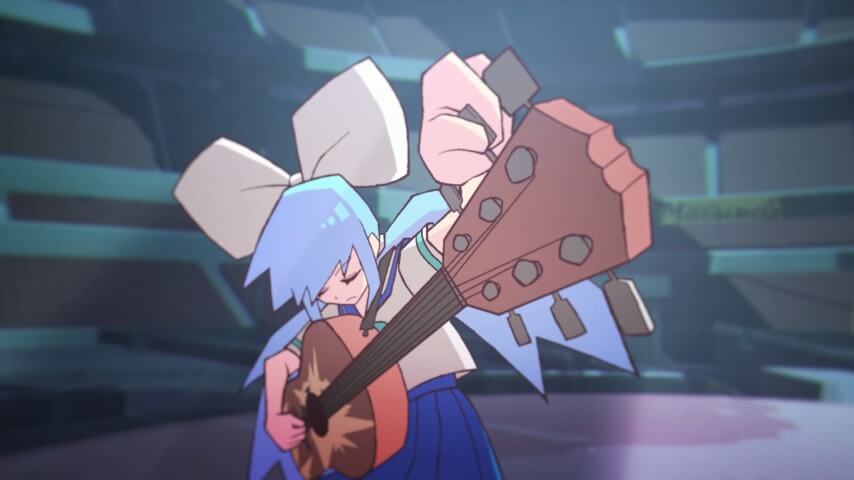
If there’s one part of this rock-and-roll journey that hums from the very beginning, it’s the game’s audio-visual charms. This band and the rest of the cast are realized in an anime-inspired aesthetic that pops, as the over-the-top designs and plentiful use of color convey each character’s personality. This clean, hand-drawn art is then paired with a grainy, VHS presentation that gets at the middle-finger-to-the-status-quo sensibilities of the work as a whole. Where it really sings, though, is in how these visuals meld with its soundtrack. Diagetic and non-diagetic bops thread us between animated cutscenes, musical monster bashing, and other set pieces, as Andrew Tsai and RJ Lake’s direction conveys the larger-than-life emotions of young adulthood. While not quite as off-the-wall or honed as something like FLCL, it similarly uses rock to tap into a particular brand of age-based ennui, as its animated sequences perfectly blend with each insert song.
One place where Unbeatable has a leg up on its coming-of-age anime peers is that it has more than just sight and sound at its disposal: it has play, too. As for how the game is structured, you play as Beat, exploring this metropolis as you scrap in foot-stomping battles and advance the story in what essentially amounts to a narrative-focused adventure game where fights play out in song. At first blush, Unbeatable’s rhythm game elements seem simplistic compared to the Guitar Heroes and Dance Dance Revolutions of the world, but with time, it all becomes downright frantic (in a good way). Here, your character faces off against incoming monsters, which act as notes that approach via two lanes (it should be noted that many games in this style use at least four lanes, if not more).
While the presence of only two lanes seems limiting, things very much get turned up to 11 on the harder difficulties: eventually, notes stream in from both the right and left side of the screen as you face obstacles that need to be jumped over instead of thwacked, big boys that require mashing, and monsters that pop up after being smacked, requiring a well-timed follow-up strike. Hold-and-release notes are combined with regular staccatos, requiring displays of finger gymnastics. It all results in simple but fun musical beatdowns that have a solid amount of variety in chart compositions and just enough variables to keep players on their toes, especially on the diabolical upper difficulties. Oh, and it certainly helps that the music is largely great, particularly the tracks used in the story’s most important moments.
These rhythm sequences can be played in the Arcade mode, which works like a more traditional rhythm game with scores and multiple difficulties per song and whatnot, and they’ll crop up throughout the Story mode, which is likely what most will flock to. In the latter, things are even more chaotic; sometimes the next “note” coming in horizontally isn’t a note at all, but an angry cop with their own vertically scrolling chart where pressing buttons on time represents you beating the tar out of them—basically, you’re eventually doing rhythm games within rhythm games as you jump between this central loop and other mini-challenges. Admittedly, some of these little divergences work better than others, like the unreasonably good baseball minigame, but when combined with the general sense of visual direction, there are stretches that steal the show.
In particular, each episode (the game was released all at once, but is divided into chapters) ends with a climax that throws everything at you. Virtually all of them make it worth the price of admission as you seamlessly fret-switch between animated sequences and playable ones, with the blaring soundtrack tying everything together; like a great musical, it captures what the characters are feeling in song (i.e., wanting to smash a Les Paul through a police cruiser’s windshield).
Still, while these moments soar, there are some rough patches to get there. When engaging in the previously mentioned rhythmic duels, there were rare stutters here and there that proved a bit distracting. Then, there were other technical hiccups, too, like hard locks and graphical bugs that appeared while exploring these cop-filled city streets and underground sewer mazes.
Much more fundamentally, the biggest initial barrier to becoming emotionally invested in this experience is that a lot of its dialogue can be clunky and dip into self-indulgence as its characters go on long asides about idioms, and so on. It’s not so much a Kojima-esque tendency to ramble about a random monster movie from 1932, but more that the characters can sometimes sound overwritten and ostentatious, as if they’re not talking to but past each other. In the opening hours, there are too many stiff exchanges to count, something not helped by the strange choice to sometimes overlap line-readings and dialogue boxes to emulate speakers interrupting each other, which proves much more distracting than naturalistic. In general, the script has a very monologue-heavy style that would have benefited from a more merciless editor. Luckily, it’s not all bad. Just like most elements of the game, the writing gets better as things go on, perhaps reflecting how its authors improved over the lengthy process of making the game. The cast becomes more interesting and complicated as events progress, eventually culminating in an explosive outro that positively rocks.
Similarly, while the story begins in an intentionally confusing spot, it eventually mixes seemingly unrelated subject matter into a harmonious blend that well and truly embodies the counterculture vibe it’s going for: prison, policing, and post-9/11 Patriot Act-style politics are blasted while authoritarians get slugged in the nose. In parallel with this rage against the machine, there are also more personal coming-of-age tribulations; the band faces internal tensions as the messy particulars of making music make their inner and interpersonal issues worse. We see how art can foster community, encourage self-reflection, and facilitate mourning, but also how the process of creating it can lead to obsession and heartbreak.
Fittingly, these ideas are best conveyed when it hands things over to its music, which booms during fights between protesters and rotten law enforcement, or thrums with melancholy as we see superimposed images of two family members who will never see each other again. Some of the plot specifics here are vague and only partially explained, but the soundtrack smooths over the edges by getting across the emotions that matter, like the cataclysmic grief and loss that beautifully undergirds the entire story. To put it simply, when its music does the talking, Unbeatable lives up to its name.
Unbeatable was developed by D-Cell Games and published by Playstack. Our review is based on the PC version. It is also available for the PlayStation 5 and Xbox Series X/S.


 Keep scrolling for more great stories.