“Immolation,” the penultimate episode of this final entry in the WandaVision trilogy, lands on an interesting thesis that colors our understanding of all artificial intelligences seen so far in the Marvel Cinematic Universe. We’ve already gotten indications that the AIs feel some kind of familial connections to those who came before and those who come after, specifically with Ultron thinking of Vision as his son and his thought of comparing his cyber-girlfriend/grandmother (or whatever) to Oedipus’ mother, but this episode really hits on the original sin of MCU AI: It’s all fathers and sons who hate each other, straight down the line.
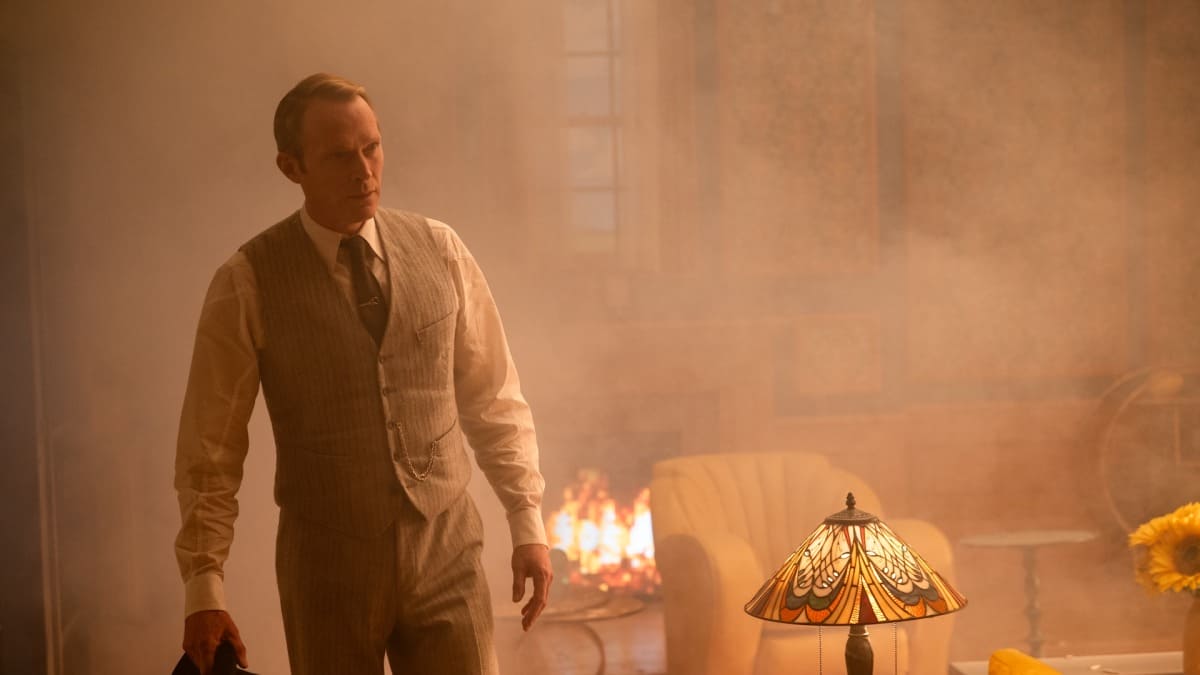
We get our first sense of that in the episode’s opening flashback, which takes place in a big, old house in 1939. An aging scientist, Dr. Phineas Horton (played by Paul Bettany with a big forehead), is preparing to sell off everything his family owns in order to fund his research into building a synthetic man. We learn from his distraught wife that he’s trying to build a robot-man to replace his son, despite the fact that he also has a daughter that he doesn’t care about, and he essentially admits to himself that he wants to build a robot-man—J.I.M.—who isn’t weighed down by troublesome nonsense like “emotions” and “love.”
An earlier episode teased J.I.M.’s story, with Vision telling Thomas that he was the first synthetic person and that he experienced emotions so powerfully that it made him explode. So, in other words, we know that Dr. Horton’s vision doesn’t exactly play out the way he wanted it to.
Back in the present day, Team Vision discovers that they can’t remove the nanobot from Lisa without killing her, so their only chose is to figure out how to reprogram it. Meanwhile, Ultron and Jocasta are unlocking the pod containing all of her nanobots, but they’re stopped by one final trick: A simple password, which Josephine has no knowledge of. Before they can look into that, both she and Vision are visited by The Client (who appears as a shadowy figure in a hat and with a heavily distorted voice).
In a pair of somewhat confusingly depicted intercut scenes, The Client offers Vision a chance to recover his heart and save Lisa, while also offering to give Jocasta what she needs in order to unlock her pod. The catch for Vision is that he will have to immediately hand himself over to The Client once he saves Lisa, and the catch for Jocasta is that she will have to become Josephine Carrington again and recover the sad memories that she’s not sure she wants to recover. Thankfully for the purposes of dramatic progression, they both agree (though there is a brief and interesting moment where Ultron speaks to The Client, who didn’t realize he was there, and he seems puzzled by Ultron’s involvement).
The Ultron/Jocasta side of things in this episode is weaker than the A-plot, but Ultron is up to a lot of shenanigans. Not only does he already know that F.R.I.D.A.Y. has snuck into Jocasta’s mind, but he claims that he’s been covering for her and implies that he’s still on Team Vision… or he is at least until he finds out who The Client is and what he’s planning. He believes that whoever is pulling Jocasta’s strings is the real threat, and we all know how much he hates strings and those who pull them.
With help from Paladin and a battery made out of Corvus Glaive’s famous spear (remember Corvus Glaive? From Avengers: Infinity War? Part of Thanos’ Black Order?), Vision supercharges himself and descends the mental elevator into the darkest and deepest levels of his code. This is depicted as a hallway from the big house was saw in the initial flashback, and Vision is periodically haunted by things he doesn’t want to see or doesn’t want to remember, including a—ahem—vision of the original/“real” Vision. He’s annoyed that our Vision has relegated him to nothing more than a memory, but our Vision insists that’s all he is and that he resents him anyway for being able to save people so eagerly and love people so confidently. Original Vision says that our Vision only thinks that because he’s a coward and is too afraid to try and be as good as the original Vision, having put him on a pedestal that is purposefully impossible to live up to.
The original Vision also reminds our Vision that the fake magic Vision from the WandaVision reality did give him all of his memories, so he does remember his time with Tommy and Billy as children even if he chooses to pretend that he doesn’t. Our Vision gets upset and zaps him with a laser, revealing the oft-glimpsed portrait of J.I.M. on fire from the main house. This is all a little been-there-done-that, but there is something powerful about seeing our superhero friend go through something that is so emotionally harrowing for him. It’s worth praising VisionQuest for the fact that this is about a guy who is scared of his emotions and not about a guy who is trying to just access more superpowers so he can kill an evil robot.
And it just gets worse from there for our friend, because (on advice from another vision, this one of Ultron) he realizes that the way you get through Hell is by just going through it. So he charges through the ominous hallways and finds himself in Dr. Phineas Horton’s library, as seen in the flashback, where he comes face-to-face with J.I.M. himself. It’s a striking scene, with J.I.M. standing in the middle of the room motionless, on fire, before he steps over to a fireplace, disperses his flame energy into it, and then reveals himself to be… yet another Paul Bettany, this one with slick dark hair. Vision was based on J.A.R.V.I.S., J.A.R.V.I.S. was based on Josephine’s tech, and Josephine’s tech was based on J.I.M., so it tracks that they all look like the same guy.
Dr. Horton himself then appears, and we get a sense of their messed-up relationship. J.I.M. recognizes that he was built as an excuse so Horton wouldn’t have to mourn his dead son, and Horton says J.I.M. was meant to be free from the horrors of emotions. However, J.I.M. wanted nothing more than to be able to feel and be exactly what his father didn’t want, which led to him falling in love and feeling such strong emotions that his inner-workings overheated and he burned up. Dr. Horton died when this happened, and in his guilt and his grief, J.I.M. allowed himself to die as well.
There are obvious parallels there between Vision and his relationship with Thomas, and J.I.M. says that he needs to basically admit that he’s the Vision in order to access the source code he needs. Vision breaks down, saying he can’t be the Vision because he’s afraid—something J.I.M. says is actually a gift—and it would mean admitting an “impossibly cruel” truth: If he’s the Vision, then it means his whole family died. And he would have to be the one to suffer that pain. Bettany is great in this scene, having an absolute breakdown over not just his sorrow but his sheer terror at having to face that sorrow, and as silly as it all is if you pick at it, it is genuinely impactful. This is the kind of thing that superhero stories and comic books are really, really good at, and it’s somewhat rare for the MCU to really pull off an emotional beat like this.
“Who are you now?” asks J.I.M. “I am the Vision,” he responds. “I have always been the Vision. There is only one, and I am he. And I am impossibly broken.” “No,” J.I.M. answers, “you are healed. And I envy you.”
Vision then looks over at a mirror and sees his White Vision appearance transform into the classic Vision, and J.I.M. presents him with a triangular circuit thing that goes in his forehead where the Mind Stone used to be (it’s even yellow!). This represents the source code, and Vision is able to pull himself back to the real world just in time to save Thomas from a robo-zombie Lisa. This was all done quite well, which makes the surprising amount of stuff left in the episode feel like a yadda yadda, if only because we don’t know what much of it means yet.
Vision surrenders himself to Paladin, who takes him to a dropoff site… which happens to be Dr. Horton’s house. At the same time, we find out that Josephine’s forgotten collaborator, who presumably set the passcode on her pod, is played by an unseen James Spader (he even says “peace in our time” while discussing selling her tech to Stark Industries). Then another James Spader—The Client himself?—comes sauntering out of Horton’s house, with a big mustache and crazy hexagonal glasses. What’s that all about? We’ll find out in next week’s finale.
Stray observations
- I wondered if we would ever see the person that Ultron’s human persona is based on in an earlier recap, and hey hey, here he is.
- If MCU AIs are born from fathers and sons not understanding each other, it’s interesting that two of Tony Stark’s AIs are female-coded. As you may recall, he was specifically mad at Bucky for killing his mom, not his dad.
- Dr. Horton says that J.I.M. was a hero who saved lives, but that’s never explained. Perhaps he fought in World War II like the comic book version of this character? That guy was friends with Captain America, but it would be weird if the MCU Cap knew a robot and never mentioned it.
- During his emotional breakdown, Vision insists that he has no son. Wait until he remembers that he has TWO! (He did mention Billy by name later, to be fair.)
- Last week, I noted that I was likely the only person in Wisconsin watching VisionQuest and not the Brewers game. This week, I just might be the only person in the whole country.


 Keep scrolling for more great stories.