Movie taglines are an underappreciated art. Most of them are forgettable and generic—a bit of lazy, focus-group-tested text that adds nothing of value to a movie poster. The best ones, however, are perfectly clever, managing to succinctly explain the premise of a film and invite a little mystery that makes would-be cinemagoers want to see the full feature play out. Jaws 2 has an iconic one in “Just when you thought it was safe to go back in the water…” Jurassic Park promised “An adventure 65 million years in the making.” And Alien Vs. Predator, though not an especially good film, has a killer tagline that’s lived on beyond the movie it was promoting: “Whoever wins, we lose.” This relatively dormant art has been revived thanks to Whalefall, which might have the single greatest tagline in motion-picture history.
“The odds of being swallowed alive by a whale are not zero.” Are you kidding me!? That’s incredible. Read it again: “The odds of being swallowed alive by a whale are not zero.”
Jason Eskin, senior vice president of digital marketing at Disney, tells The A.V. Club that the marketing team came up with the tagline organically after seeing some early cuts of the trailer. While wondering if getting swallowed alive by a whale could actually happen, somebody mused that the odds were not zero. “As soon as we said that, everybody latched on to it,” Eskin says, adding that the probability in the tagline had some personal implications for him. “I was thinking about my wife, who scuba dives, and thought ‘Oh no.'”
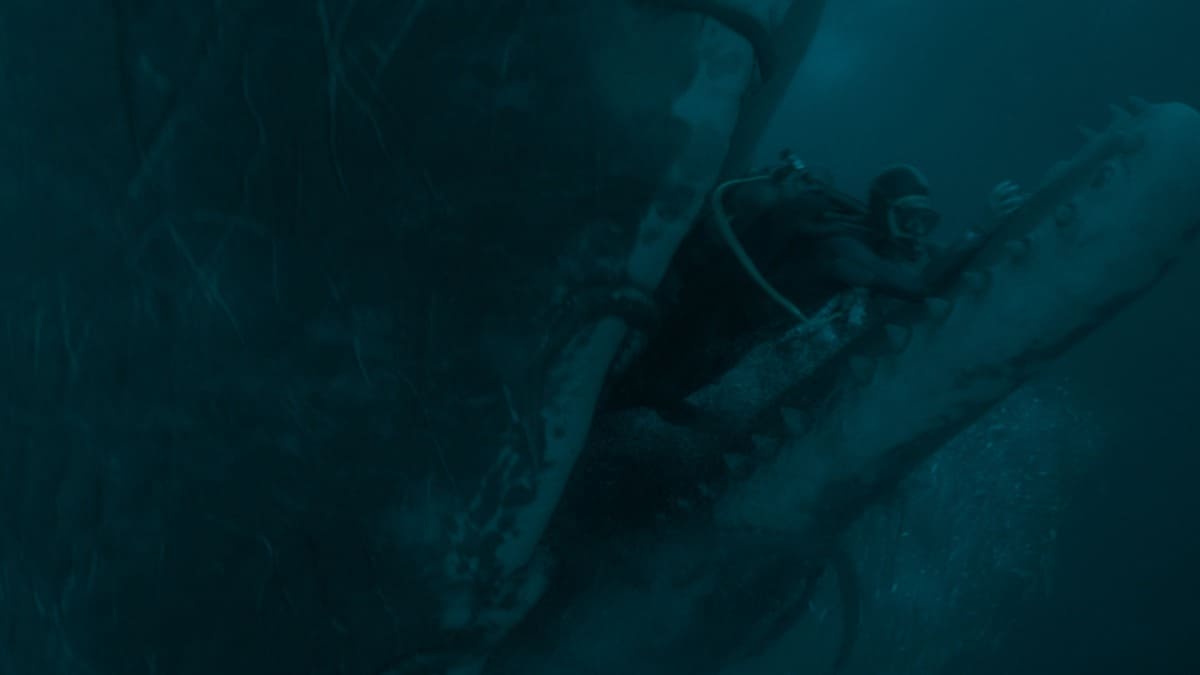
With the notable exceptions of Pinocchio and that one part of the Bible, it’s true that you don’t hear much about people getting swallowed alive by a whale, and those are just stories. In real life, people simply don’t get swallowed alive by whales at all. What are the chances? Well, they’re not zero. Right away, Whalefall is using this tagline to get ahead of the fact that what happens to Austin Abrams’ character is exceptionally unlikely, yet the fact that cetacean vore is possible—if not plausible, in Mythbusters terms—makes the premise that much juicier.
If the odds are not zero, that means that what happens to Abrams could happen. Follow that train of thought and the tagline nudges audiences towards a different conclusion. If the odds are not zero, that means it could happen to them. It almost certainly won’t, of course. But it might! Suddenly, moviegoers are putting themselves in Abrams’ scuba gear. This absurd premise doesn’t sound so absurd if the cold logic of mathematics forces you to imagine yourself inside a sperm whale’s squid-filled tummy.
The tagline is also scientifically accurate. Tom Mustill, a documentarian who has written a book about whales and had his own very statistically unlikely encounter with a whale when one landed on top of him while kayaking, tells The A.V. Club that it’s the specifics of Whalefall‘s scenario that make the odds greater than zero.
While plenty of people have been “mouthed alive” by lunge-feeding humpback whales, the creatures’ gullets are only the size of a grapefruit. A large sperm whale, however, does have a wide enough trough that a person could conceivably get swallowed whole. (The protagonist’s scuba gear probably makes the swallowing trickier; as Mustill notes, “a really nice slippery swimmer would be much easier.”)
Mustill also explains that while sperm whales are typically a deep-diving species, they do sometimes come near the surface in the area of the California coast where Whalefall is set. The nearby presence of a giant squid—the natural snack of the whale—makes the film’s accidental ingestion all the more possible, as a whale wouldn’t normally seek out human prey. And, sperm whales even have a “pre-stomachy zone,” in the scientific lingo of Mustill, where a swallowed swimmer could find some respite rather than immediately be dissolved by stomach acid.
“I kept trying to pick as many holes as I possibly could in it,” Mustill says. “However, there are loads of things that are right about it.” Stressing that the chances are infinitesimally low and noting that a person would almost certainly die soon after being swallowed alive, Mustill gives the tagline credence, saying he’d be “cautious to say it was impossible.”
“I would say the odds would have been substantially higher had we not killed so many of the whales,” Mustill adds. “In a better world, where humans behaved more responsibly, the odds of a person being swallowed alive by a whale would be better as well.”
That’s much too long to put on a poster, but we’ll always have “The odds of being swallowed alive by a whale are not zero.” Sadly, many posters for Whalefall have a different, far less evocative tagline: “Hold your breath.” That’s nothing. The marketers behind Whalefall have invented a truly incredible sentence, and the industry should lean in: Not only should the studio run with it on all promotions for the film, but all of Hollywood should adopt this construction for their sillier premises.
Instead of the humdrum tag of “Defy the gods,” The Odyssey could’ve let moviegoers know that “The odds of it taking 20 years to return home to your wife are not zero.” The End Of Oak Street could’ve touted that “The odds of a neighborhood getting sent back to dinosaur times are not zero,” because how many moviegoers know enough about wormholes to definitively state otherwise? Other Mommy could make audiences ponder the chilling implications of “The odds of there being another mommy are not zero,” while Avengers: Doomsday should’ve let superhero fans know that “The odds of Chris Evans and Robert Downey Jr. returning to the MCU are not zero” before any Comic-Con reveals.
These proposed taglines are all improvements, but they can’t match the special magic of the original. It paints such a complete picture that you almost don’t need to see Whalefall, but you will. You’ve got to see this probability play out. If Whalefall is a fraction as good as its tagline, it should win Best Picture at the Academy Awards. The odds of it winning an Oscar are, after all, not zero.


 Keep scrolling for more great stories.