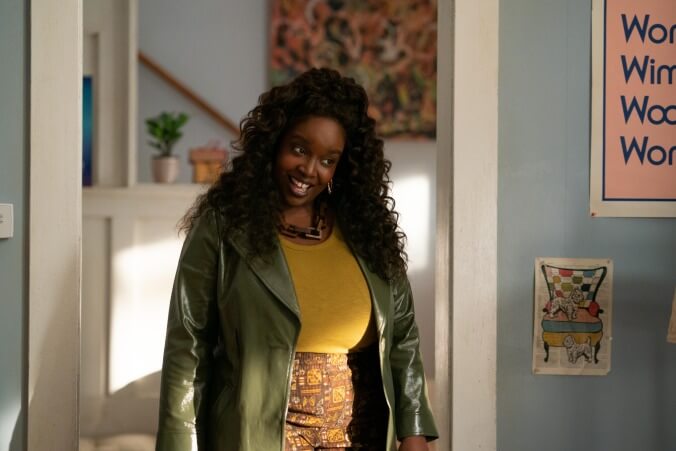
Lolly Adefope Photo: Allyson Riggs/Hulu
In season one of Shrill, the Aidy Bryant vehicle based on the Lindy West memoir of the same name, Annie Eaton’s (Bryant) newly discovered confidence turns her into a flaky friend. Her roommate Fran (Lolly Adefope) sums it up succinctly: “Annie’s having a selfish period.” Season two continued to explore the thin line between self-love and self-obsession. But by the end of season three, the selfish period seems like more of a selfish lifestyle.
Hulu made the call to end Shrill with season three. Maybe that’s why the final eight episodes seem scattered, with an ending so ambiguous that it feels like a Bat Signal for another network to scoop up the show. When we last saw Annie, fireworks blazed triumphantly as she broke up with her deadbeat boyfriend. The proclamation seemed promising—Shrill is the rare show that spotlights hot fat sex, so surely a newly single Annie could bed a few hunky prospects while reveling in her newfound desirability as a fat woman. Instead, the girl can’t catch a romantic break in the new season. From disastrous dates to humiliating rejections, the dating world does not treat her kindly.
By contrast, her roommate Fran—played by the brilliantly hip Adefope—embarks on her first serious relationship in the new episodes. After she and her partner Emily (E.R. Fightmaster) film an embarrassing albeit hilarious sex tape, they say “I love you” for the first time. Right on cue, Annie bursts into the room, demanding comfort after a dating disaster. In the middle of Fran and Emily’s sweet, funny moment, Annie provides a jarring reminder that she is the main character, something season three never lets you forget.
As her dating prospects tank, Annie’s journalism career is on the rise. She’s tired of being pigeonholed as a fat girl writer, so she takes an assignment to profile a separatist society on the outskirts of Portland—despite her coworkers’ misgivings that a feature will give racists a platform. This leads to the crux of the season: The article drops, and Annie gets canceled. This could allow for a nuanced look at consequence culture (which is frequently and erroneously framed as “cancel culture”), media coverage, and the duality of white guilt and white responsibility. Instead, Annie makes excuses and jokes. After her queer, Black roommate rightfully calls her out, Annie apologizes with a sheet cake that says “Sorry I’m A Dumb White Witch.” The frosting might as well spell out “Keep centering my experience.” The show follows up Annie’s “apology” with a few jokes about a turd arriving in her hate mail, and then the conflict is abandoned.
Shrill has examined political movements before. Season two’s “WAHAM” skewered capitalist feminism while also understanding why women buy into it: The Women Are Happening Now conference sells women ways to “fix” themselves, but Annie also discovers the friendships formed under the umbrella of the scam. That episode tackled complicated subjects with a curiosity and generosity that feel largely absent from season three. Still, the new season has some highlights, especially when it comes to fat-on-fat attraction. After Annie rejects a blind date for being fat, she bumps into him again at a party and realizes her judgements were shallow. In the kitchen, she’s blunt with him—and with herself: “I was only thinking about myself and how embarrassed I’d be, that if anyone saw me as part of a pair of fats, that were together because that’s what we deserved,” she says.
Fatphobia within the fat community still feels like a taboo subject, and Annie’s willingness to work through it sets up season three’s best moments. It helps that Will is a total babe, serving young John-Goodman-but-make-it-nerdy vibes as he and Annie begin their courtship. The season’s highlight arrives in the penultimate episode, “Beach.” The narrative weaves together a current-day beach trip with college flashbacks, offering a tidy genesis to Annie and Fran’s friendship.
At the beach house, in the present day, Annie is intent on sleeping with Will. Until now, Shrill has mostly celebrated fat femme bodies; this final season gender flip comes as a welcome surprise. In 2021, it still feels novel to explore fat masculinity on camera. As Annie thirsts after Will, the viewer can appreciate his appeal, too. Will wears too-short cut-offs; he strips down to climb in the hot tub. As he and Annie explore their attraction to each other, it’s clear that they’re both hot because they’re fat—not in spite of it. It’s a shame that by the next episode, Annie leans into her insecurities once again.
In an interview with Variety, Aidy Bryant teased Shrill’s final season by saying, “Part of what this season is is just realizing that there is no end for people who are looking to find their own self-confidence. It is a constant, everyday thing.” Annie’s spiral reveals what she loses by leaning into her worst tendencies. But the season misses the second half of that equation: What does she gain when she works through those things?
From season one’s beloved Fat Babe Pool Party to the sparkling banter between Annie and Fran, Shrill has always been its strongest when exploring joy. The final season forgets that. In the last scene of the show, Annie promises to fix everything. It’s a shame we don’t get to see it happen.


 Keep scrolling for more great stories.