The White Castle is one of my favorite new games of the last five years, and was my #1 game of 2023, just barely beating out Votes for Women. It’s a midweight strategy game that plays in its suggested time of 80 minutes because each player will get exactly nine turns in the entire game—an extremely low figure for a game that’s aimed more at the hardcore Eurogamer demographic than the family-strategy crowd (no disrespect to either—I love ‘em all). And unlike a lot of medium to heavy games, The White Castle plays well with two players.
The announcement that the designers, the couple Isra C. and Shei S., and publisher Devir were coming out with a new two-player version called The White Castle Duel met with mixed reactions, at least from me. On the one hand, Isra and Shei have never missed, in my opinion: I’ve tried five of their published games, and loved them all. Their 1987 Channel Tunnel is the best game in Looping’s 19xx series. Flatiron was the best thing I played at PAX Unplugged in 2024. The Red Cathedral is a top-25 all-time game for me. On the other hand, did The White Castle really need a ‘duel’ version? Would this just be like Azul Duel, which took a game that played really well with two players and made it boring and difficult?
The answer turns out to be that, yes, we needed this game, because it’s not just The White Castle in a two-player package. Isra and Shei redesigned the game entirely—around having their first kid, which I imagine is not conducive to long, quiet periods for contemplating game mechancies—while keeping the theme and some of the fundamental attributes, like the tripartite board with three types of workers. The result is a game that has a similar feel to the original, but is a unique game with its own rules and strategies.
In The White Castle Duel, each player plays as a clan trying to gain influence at Japan’s Himeji Castle via the gardens, training yards, and the castle itself, gaining resources that will enable more powerful moves later in the game. Each player will get 12 turns, rather than nine, and the lantern mechanic from the original game, where you’d get a set of resources if you selected the lowest-valued die on a bridge, is now ubiquitous: you will get some kind of lantern rewards at least once on every turn. Each player has three rows for lantern cards next to their personal boards, and when they place a token, they’ll get the rewards from the row matching the color they covered.
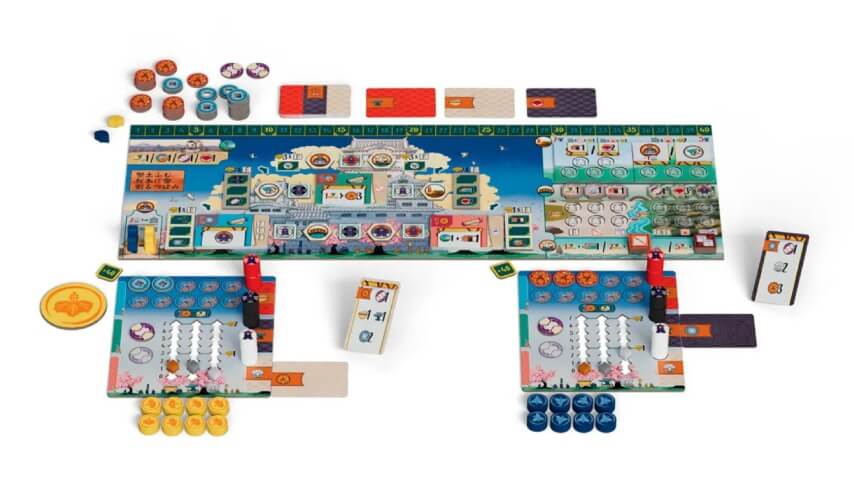
In the first half, each player will place their six tokens, two in each of the game’s three colors, into action spaces on the board. They’ll get those lantern rewards and then take the two actions shown to the left and right of the placed piece. Those include putting a seal in the gardens or warriors for (mostly) immediate rewards, moving their one courtier piece into the castle and up the seven steps to the top level, acquiring influence cards that give immediate bonuses and can be flipped for victory points, and other smaller actions that mostly yield resources. Turns can thus involve several steps, although they don’t chain in the same way that they do in the original game. There are six action spaces, each of which will take two tokens at most—but those can’t match, either.
In the second half of the game (turns seven through 12), players remove tokens from the main board and place them on the lantern spaces on their personal boards, taking the rewards from the associated row. You don’t have to take your own tokens; the 12 on the board are available to both players. You then take the two actions adjacent to the space from which you just took a token.
Scoring is much more complex here than in the original, and it’s probably the one area where I distinctly prefer the first White Castle game. As you play, you’re collecting various symbols from influence cards (as long as you use the action to flip them), seals placed in the gardens, and trade goods you can acquire. Some of them score via multipliers based on how high your courtier went in the castle or how many seals you placed in the two parts of the training yard. The paper cranes score as the product of how many blue ones you obtained and how many white ones, which you can get in the gardens and from influence cards. It’s a good scoring method if you want your third grader to work on her math facts, but it is a bit over the top for this weight.
The original game’s main point of scarcity, the orange daimyo seals, isn’t an issue in Duel, which means the one real point of imbalance in the original (if a player started out with a daimyo in their lantern row) no longer applies. It also means one of the largest areas of tension in the game isn’t here—I’ve found resources to be more plentiful all around, at least to the point where I was never a move away from doing something good. The key instead is to set yourself up so that every move you make in the second half of the game is productive; you want to avoid wasting a turn to get resources, and to maximize the value of the seals you’re placing because they’re finite.
The White Castle Duel plays in under an hour, and my 9-year-old had no problem grasping the mechanics and planning ahead one turn to get the right resources. If you like Isra and Shei’s games, you’re going to like this one too—it is very clearly one of their games in mechanics and feel. If you haven’t played any, I’d probably say start somewhere else, and I’d put this behind the original, Red Cathedral, and Flatiron in their canon, although I think all three of those are fantastic, too.


 Keep scrolling for more great stories.