Darkly funny and surprisingly moving (and not just on the bedframe), the romantasy fable Wicker is a delightful love story that unearths deeper feelings around belonging, security, and pleasure. It’s silly, sometimes odd, sometimes rather beguiling, but the story can occasionally nick a tender part of the heart that makes it all the more real despite its magical trimmings. The familiar fairy tale is slightly warped, very much for grownups, and at times, thought-provoking (up to you if you want those thoughts to be dirty).
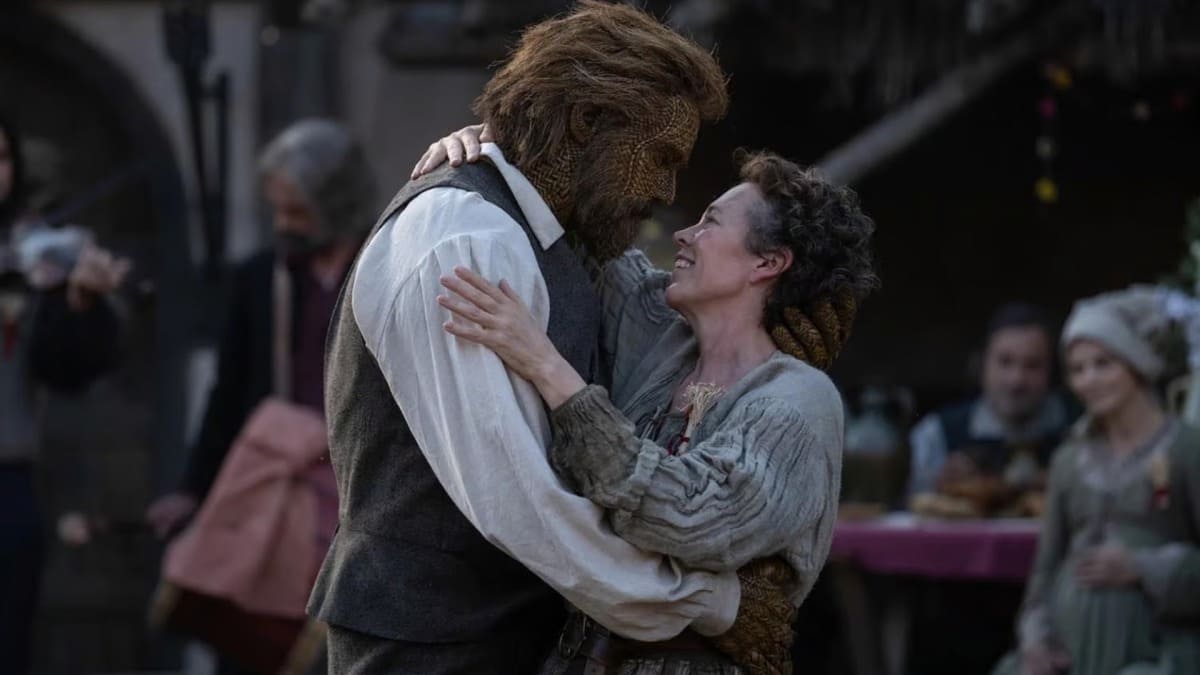
Adapted from Ursula Wills’ short story, “The Wicker Husband,” Alex Huston Fischer and Eleanor Wilson’s film follows a lonely fisherwoman (Olivia Colman) in a small medieval town. Ostracized by her fellow townsfolk for smelling like fish guts and not conforming to their beauty standards, she pays the local basketmaker (Peter Dinklage) to weave her a husband (Alexander Skarsgård). He does so out of wicker, almost a little too well, because before long, the newlyweds are the talk of the town—a town now threatened by their happiness. The women become jealous that their husbands aren’t putting in the same effort in bed or around the home, and the men feel threatened by the wicker husband’s devotion to his wife. Their insecurity threatens the couple’s happily ever after.
Huston Fischer and Wilson’s Wicker world begins like a patriarchal cautionary story set in a hyper-gendered realm: Women are wed with not a ring on their finger but a ceremonial collar around their neck, their identities are folded into their husband’s businesses or into childcare, and most men show outright hostility towards their partner’s wants and desires. Despite her worn-out frocks and the bullying she endures from town’s mean girls, like the tailor’s wife (Elizabeth Debicki), the fisherwoman seems to be the only one truly at peace with her own existence, even if it is lonely. The addition of her new wicker man complements her instead of tears her down, and builds up her confidence to stand up for herself against the cruel words. As rotten as the men are in the village, some of the women are just as cruel, carrying water for the patriarchy to disrupt a fellow woman’s happiness out of spite and jealousy.
As the fisherwoman, Colman is effervescent with a diamond-in-the-rough exterior that, thankfully, isn’t made over to look radically polished. The character is allowed to just be herself—tough as fish hooks on the outside, still vulnerable on the inside. The newfound love in the fisherwoman’s life gives her the chance for a transformation, both good and bad. When the tailor’s wife accuses the wicker husband of cheating, it damages their relationship and unleashes the fisherwoman’s pent-up insecurities about feeling desired, something no other human has shown her before. While Colman dedicates herself to capturing each change in her character’s emotional journey, Skarsgård, as the film’s Franken-husband, is much more sturdy in his devotion to his wife. With an almost obsessive focus on her, he readily declares his love for no other reason than just because. It can feel cheesy, sure, but as the romance-starved women in the town show, it ruins the status quo of sexless, loveless marriages to know that an alternative is possible. Skarsgård, buried underneath layers of makeup and an impressive woven wicker costume, talks with Christopher Walken-like pauses, fixes a resolute yet piercing stare at his character’s wife, and moves with such steady purpose, he becomes the partner the fisherwoman can finally lean on in more ways than one.
Outside the central couple, Wicker is populated by a quirky assemblage of supporting characters, like the unbothered bad doctor (Richard E. Grant) and his daughters, town queen bee (Marli Siu) and the tailor’s wife (Debicki), whose story grows complicated over time. Dinklage’s basketmaker is given to Shakespearean soliloquies and introspection over his assignment, a far cry from the brash innkeeper (Kiell Smith-Bynoe) who scoffs at his wife’s request for a dance and at the wicker man’s sensitivity towards the fisherwoman.
In keeping with its literary origins, Wicker is broken into storybook chapters, and while it chops up the flow of the story, it hastens the passage of time and the bizarre new twists that come with it. Oscar-winning cinematographer Lol Crawley (The Brutalist) embraces the romantic fantasy of the perfect husband built for a lonely woman, capturing their sunlit kisses and the natural rustic setting of the medieval time with great detail. Even close-ups of the wicker man’s hands and arching indulge the audience’s curiosity and show off the craft of creating such a remarkable costume and illusion, like when effects are added in to allow light to stream in through his wicker body.
Wicker is a strange fairy tale, both bizarre yet relatable in some matters of the heart. While some of the humor is shallow, somewhat reminiscent of Men Are From Mars, Women Are From Venus, the film’s handling of deeper insecurities is quite disarming. Even if you can ask the basketmaker to weave you the perfect partner, who would love you for who you are, that still can’t heal all of life’s many wounds. The chance for a happily ever after is up to our heroine, no matter what difficult road she takes or what material her husband is made from.
Director: Alex Huston Fischer, Eleanor Wilson
Writer: Alex Huston Fischer, Eleanor Wilson
Starring: Olivia Colman, Alexander Skarsgård, Richard E. Grant, Peter Dinklage, Elizabeth Debicki
Release Date: October 23, 2026


 Keep scrolling for more great stories.