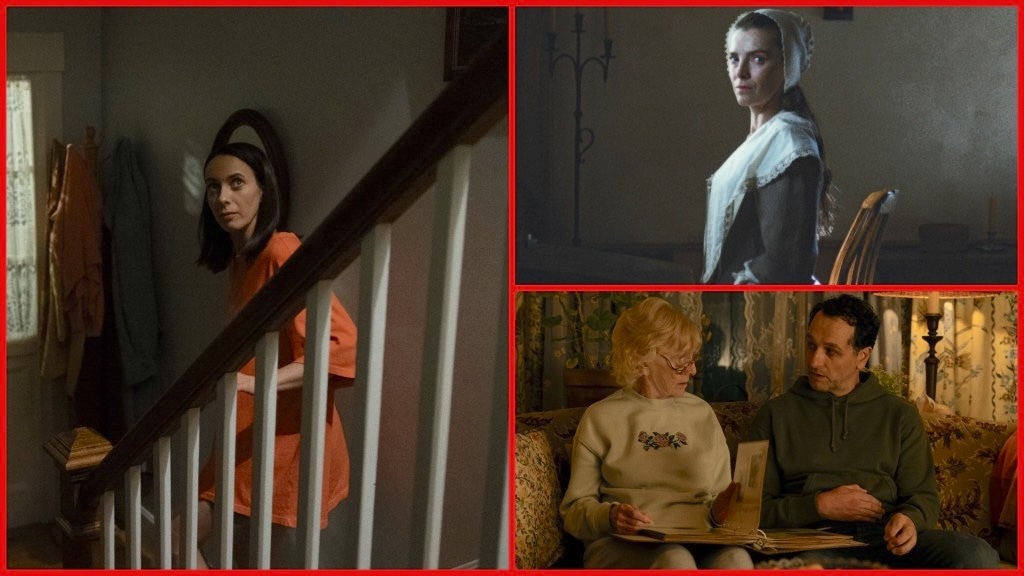
“Beach Reads” ends with a sweet moment where Patricia finds the companionship she’s been craving as Tom and Wyck invite her to join their horror hunt. But her real coup comes in episode eight, “Your Baggage,” which gives her a chance to relive her teenage slasher trauma. The episode makes the obvious yet insightful point that slashers like Michael Myers, Jason Voorhees, and Freddy Krueger are so successful because they keep targeting high schoolers. With two more decades under her belt, Patricia isn’t so easily foiled. Like most women who live alone, she’s learned to be hypervigilant and hypercompetent. It’s deeply satisfying to watch her follow the instructions that audiences have been shouting at the screen throughout horror-movie history: She pays attention to warning signs, gets out of the house ASAP, outruns the slow-moving killer, improvises a creative weapon, and refuses to let her guard down until she’s sure (really sure) the guy is dead. Maybe the ultimate “final girl” is actually a final woman.
It’s not just Patricia who proves the competence of women deemed “past their prime,” however. She gets a spiritual sister in the flashback episode “Our History,” which follows one Sarah Westcott (Betty Gilpin) and her eventful arrival on Widow’s Bay in 1702. Sarah is a self-described spinster suddenly tasked with marrying the island’s lord protector, Richard Warren (Hamish Linklater), and raising his five children. “It’s a rare blessing to marry at such an age,” she’s reminded, although Widow’s Bay has a lot of satirical fun playing around with the idea that, generally speaking, spinsterhood was actually far from the worst indignity a woman could suffer in the 18th century. Gilpin is a comedic tour de force as Sarah discovers that Richard is a possessed murderer. When Sarah manically explains her situation to the local pastor, Gilpin makes the most of stammered, revised-on-the-fly thoughts like “Perhaps the life of a childless woman without a husband, it is one I could come to bear. Enjoy! Enjoy thoroughly.”
Though the jury’s still out re: Sarah’s actual age, it seems clear that, as with Patricia, it’s her life experience that makes her such a competent horror protagonist. She observes, she asks questions, she knows when to speak up for herself and when to keep the peace. She’s been through enough to know that she can survive without following Richard’s marching orders to the letter. There’s a certain amount of command that comes with age: When she stumbles upon a secret council meeting trying to decide what to do about her husband, she immediately starts ordering the members about, complete with some “make haste” claps. And when she eventually decides to try and save her stepkids, it’s less out of maternal feeling (“I have but just met them”) and more because she’s an adult, they’re kids, and it’s the right thing to do. It’s at least briefly a type of Lone Wolf And Cub-derived story largely left to the purview of 40- and 50-something single men.
But season one saves its most moving celebration of “spinsterhood” for its finale. It turns out Sarah’s husband imbued his bloodline with a hereditary curse that won’t end until his last descendant is killed. So when Tom and co. discover there’s just one living relative left, they’re faced with an ethical dilemma: Is it okay to kill one person to save an island full of people? And is it more okay if your victim is 84, never married, and never had children? Patricia is the first to see how unfair the suggestion is. “Thank god I’m not a descendant or I guess my throat would already be slit,” she scoffs. But Tom needs a one-on-one encounter with his secretary Ruth Livingston (K Callan) to make up his mind.
Getting Widow’s Bay to a second season requires revealing that Ruth secretly gave birth to a child (at 40, no less!) and gave her up for adoption. But the episode doesn’t build its case for keeping her alive around that fact. Instead, showrunner Katie Dippold’s script celebrates Ruth as a person in her own right—a vibrant, caring member of her community with an active social life and a fascinating inner world; a woman who grows her own tea in her herb garden, cross-stitches hilariously long Tennessee Williams quotes, and shares her writing in a story club. She’s a caretaker, sure, but also a woman who has lived a sexy, exciting, difficult, full life and is now the memory keeper of generations of Widow’s Bay family history.
Most importantly, she’s also a woman with her own opinions, not just a problem for Tom to solve. When he tries to get her to alleviate his guilt about what he’s about to do by likening it to the trolley problem, Tom is shocked to discover Ruth doesn’t see the classic thought experiment the same way he does—that she might have a point of view that doesn’t fit into his limited conception of her as a selfless little old lady. Much as Patricia and Sarah have practical life experience that makes them good in a crisis, Ruth brings with her decades of hard-earned philosophical wisdom. She can see better than Tom that his desperate desire to control everything isn’t how life actually operates; that making a choice you think you “have” to make can be a damning self-fulfilling prophecy.
Giving so much of the finale screentime over to a 90-year-old character actress—especially when there are larger, series-altering events unfolding miles away in the town’s storm shelter—is a bold swing. But it fits with what the show has previously done with Patricia and Sarah. The latter may declare that a spinster’s “womanly destiny” is to wither in her father’s attic. But Widow’s Bay knows these fascinating, flawed, capable women deserve a place front and center.


 Keep scrolling for more great stories.