You have to watch Widow’s Bay

Like, literally: Don’t take your eyes off of the Apple TV horror-comedy for a second.

You have to watch Widow’s Bay

This article discusses plot points from the first season of Widow’s Bay.

When ABC canceled Police Squad! in 1982, network executive Tony Thomopoulos offered a number of explanations for why he pulled the plug on the televised precursor to the Naked Gun movies. Its lack of a laugh track gave the audience no indication of what was supposed to be funny and what wasn’t, Thomopoulos reasoned. Furthermore, any given frame of Police Squad! was so dense with visual humor, the show required full, undivided attention—a critique that years and years of retelling have boiled down to the self-contradicting bon mot, “the viewer had to watch it to appreciate it.”

You’d be forgiven for thinking that Thomopoulos’ remarks were made in 2026, not 1982. Years after livetweeting and fan-driven phenomena like ABC’s Shonda Rhimes-powered #TGIT made a second screen essential for engaging with some of TV’s biggest shows, the presumption that everyone watches everything while doing something else subtly (and in some cases, not so subtly) influences the way TV is made today. Netflix may officially deny that it’s not instructing screenwriters to restate plot points and character motivations in dialogue, but the number of times the Stranger Things kids reiterate the plan to defeat Vecna in that show’s feature-length finale begs to differ.

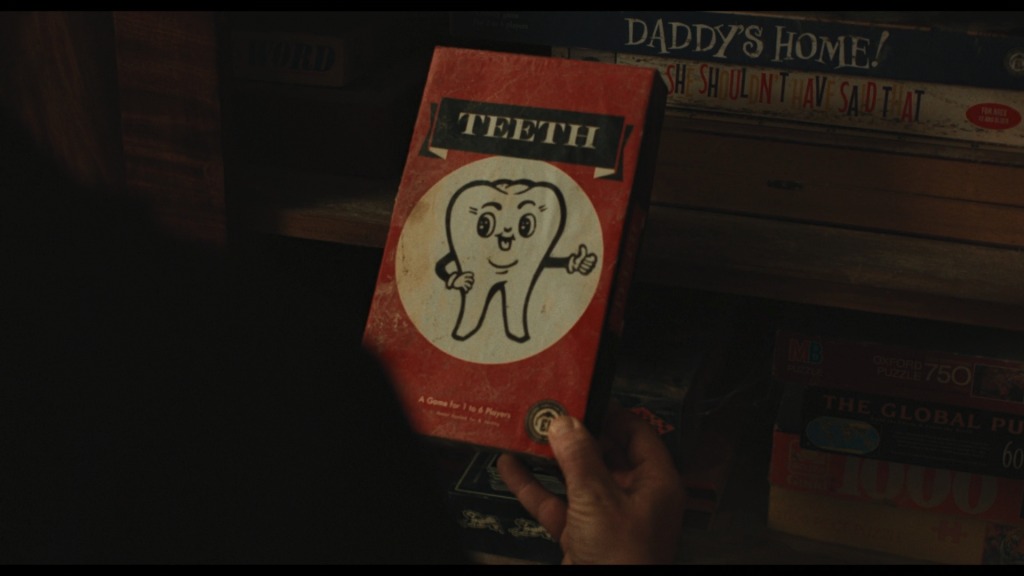
Thank heaven (or hell, as the case may be) for a show like Widow’s Bay. Not since the heyday of The Good Place has a live-action comedy made such effective use of visual humor as Kate Dippold’s alternately terrifying, alternately hilarious horror spoof set on a cursed New England island. It’s apparent from one of the earliest scenes of the series premiere, in which Mayor Tom Loftis (Matthew Rhys) flips through a wall calendar to reveal increasingly distressing images on each new page: a howling wolf for May, a full wolf pack (spying something just out of frame) for June, and an overturned car on a roadside for July. (The kicker: Tom flips to the cover of the calendar to reveal its title: “Wolves.” Just “Wolves.”) Apple TV made a savvy decision to release the premiere alongside episode two; not only was Widow’s Bay able to show it was more than its “What if Stephen King wrote Jaws, but it was funny?” premise, but Tom’s haunted-hotel ordeal in “Lodging” demonstrates that the visual gags of episode one are no fluke, via a cabinet full of board games, each more ominous and exquisitely designed than the last. The cracked Donna Reed Show scenario of Daddy’s Home gets a full playthrough with guest star Tim Baltz, and the self-explanatory analog dental simulator Teeth has already spawned some bootleg merch. But don’t sleep on the box that’s stacked under Daddy’s Home: She Shouldn’t Have Said That. Its sinister name and playful, vintage Milton Bradley logotype paints an entire, macabre picture in the mind—but in the grand tradition of Police Squad!, you’d completely miss it if you chose the wrong moment to glance at your phone.
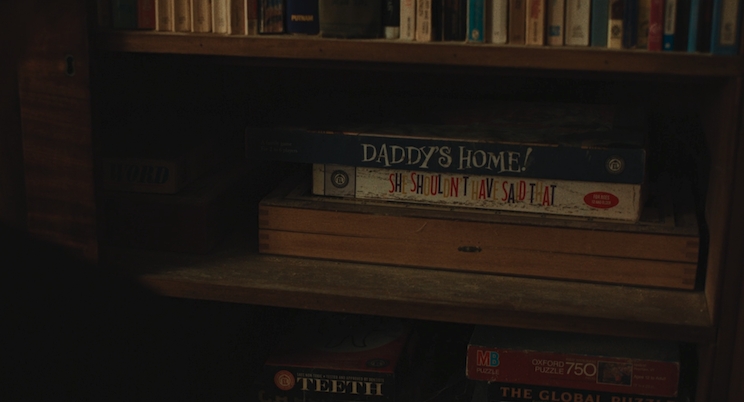
A cabinet filled with books and board games. The two games have vintage style typography: The one on top, in a blue box, is called Daddy's Home. The one below it, in a white box, is called She Shouldn't Have Said That

Screenshot: Apple TV

Widow’s Bay is a production designer’s dream, but the show’s commitment to comedy that you can see cuts across departments. The wardrobe and hair and makeup teams nudge the King fans in the ribs doing mayor’s assistant Patricia (Kate O’Flynn) up in Wendy Torrance and Carrie White drag, then splash the whole audience with the cold-pig’s-blood punchline of how she’s actually dressed for a suspiciously well-attended cocktail reception. A drug trip brought on by the island’s native fungus is a gift to the editors, who cut Tom’s communion with nature into a discombobulating string of blackouts and lost time, and cinematographer Cody Jacobs, who throws every freaky lens, angle, and camera trick in his toolbox at the storyline—and if any of it comes across as corny or overwrought, well, that just makes it funnier.

Eagle-eyed credit watchers may recognize Jacobs and the series’ other director of photography, Christian Sprenger, as frequent collaborators of Atlanta and Barry director Hiro Murai. Murai’s on hand here, too, bringing the deft management of tone and style that unified those series’ flights of fancy to Widow’s Bay. He’s backed by Andrew DeYoung and Sam Donovan, whose episodes walk a line of fearful and funny linked by their directors to two of the most visually distinctive TV shows of the 2020s, The Chair Company and Severance.

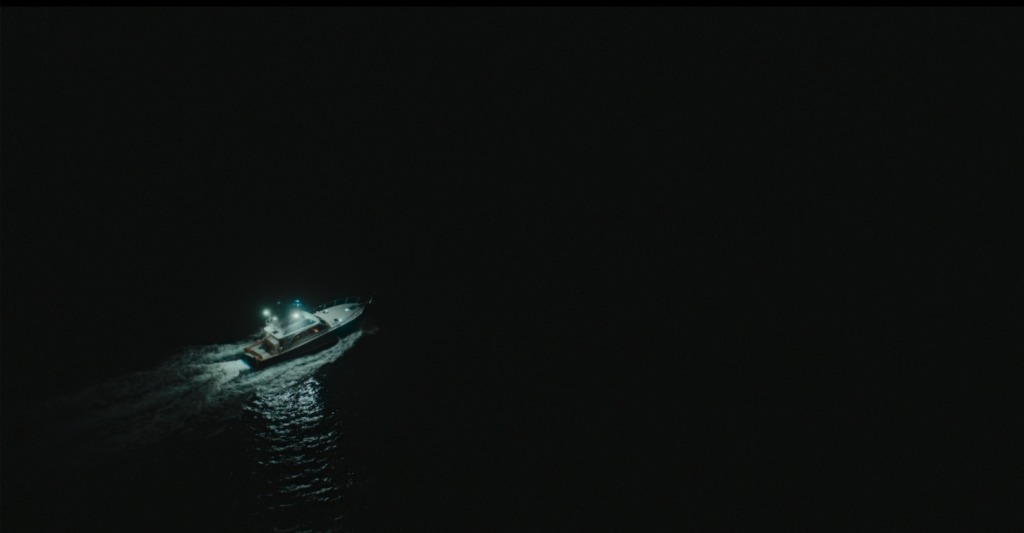
Overhead image of a boat driving at night, in completely dark and terrifying waters

Screenshot: Apple TV

The c.v. of the series’ fourth director, Ti West, attests to the other reason you can’t take your eyes off of Widow’s Bay for even a second: The visuals enhance the scares as well as the jokes. West’s flashback episode, “Our History,” boasts some gore-caked freakouts worthy of the X trilogy, but DeYoung one-ups him in the subsequent slasher riff “Your Baggage.” In the inky darkness of DeYoung and Jacobs’ compositions, the masked serial killer known as The Boogeyman can, and does, appear anywhere; it’s a chilling complement to the overhead shots of the nighttime cruise Tom and the Quint to his Mayor Vaughn, Wyck (Stephen Root), take in Donovan’s “Seasickness,” which render (with a vfx boost, I’d venture) the open water around their boat into an infinite void.

In these moments, it’s really only the cast’s reactions that act as a guide to whether or not we should laugh or scream. O’Flynn does a tremendous job of this during The Boogeyman’s pursuit of Patricia, conveying her character’s terror while underlining it with the eternal, “just my luck” frustration of a woman who’s forever begging to be taken seriously by a community that has every reason not to honor that request. Sometimes, the most compelling image results from simply pointing the camera at an actor; on that count, Widow’s Bay’s most valuable asset might be Matthew Rhys’ face. It helps the show tremendously that its star has the range, the look, and, thanks to The Americans and Perry Mason, the ample experience to convincingly say “I’m the most haunted man on television” with a single facial expression.

Erik Adams is The A.V. Club’s senior TV editor.

 
Join the discussion...
Keep scrolling for more great stories.