With Women Of Action, Caroline Siede digs into the history of women-driven action movies to explore what these stories say about gender and how depictions of female action heroes have evolved over time.
The 1990s loved a woman in uniform. Jamie Lee Curtis joined the police force in Blue Steel. Jodie Foster worked for the FBI in The Silence Of The Lambs. Michelle Yeoh became a supercop in Police Story 3. Captain Janeway debuted as the first female lead of a Star Trek show. Even Disney sent a princess to join the army. It was a decade where female power was measured by breaking glass ceilings and climbing institutional ranks. And nowhere is that more apparent than in one of the most thunderously on-the-nose female-led action movies ever made: 1997’s G.I. Jane.
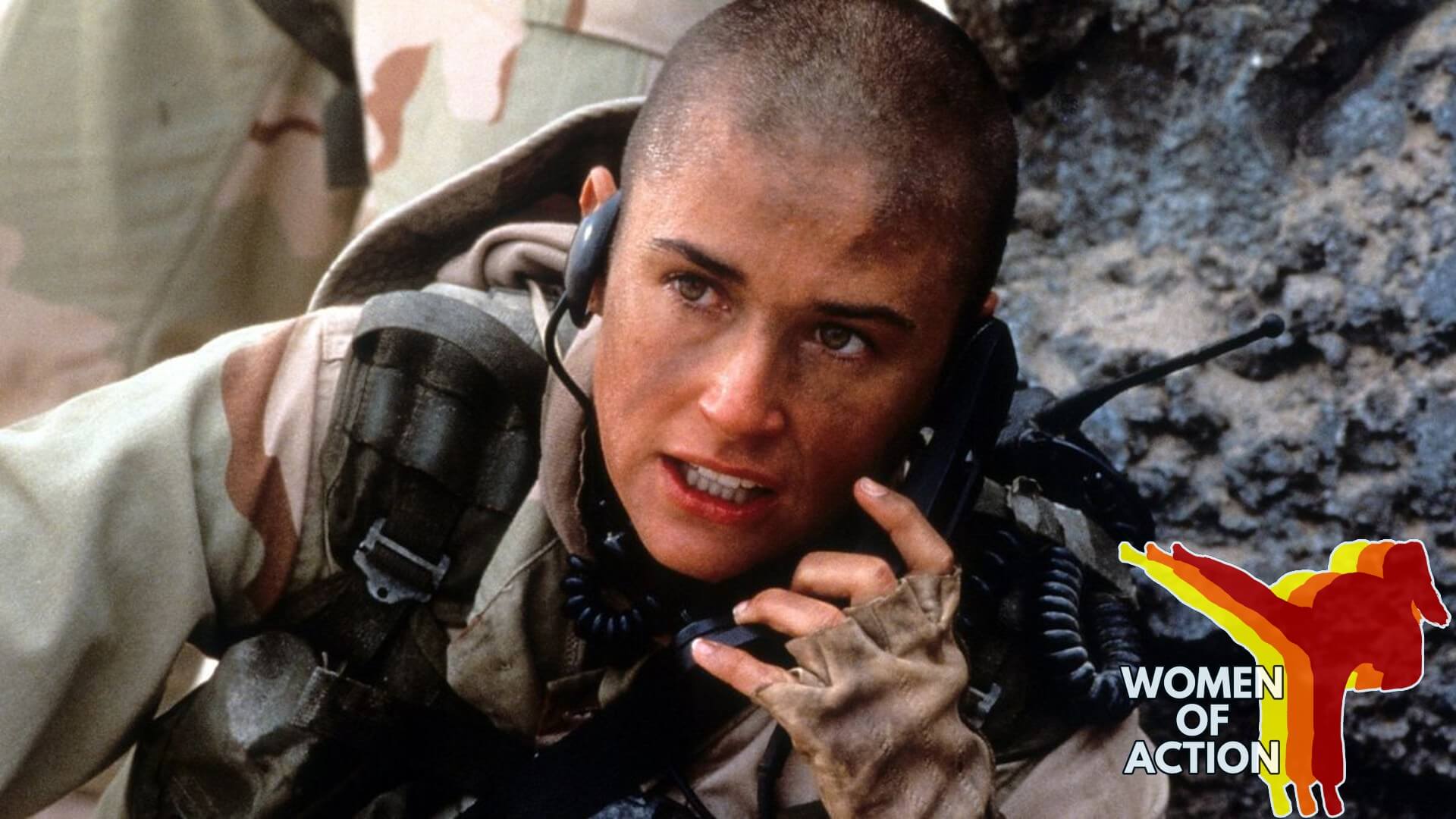
Call it Private Benjamin without the comedy or just a message movie without subtext, but the film that’s probably now best associated with Will Smith’s infamous Oscars slap has become a fascinating cultural curio in the nearly three decades since its release. On the one hand, it captures an impressively committed Demi Moore, shifting her image from romantic Brat Pack darling to hardcore, shaved-head Navy SEAL. On the other, it raises some thorny questions about what’s actually empowering when it comes to female action heroes. In other words: Ladies, is it feminist to join the military industrial complex?
Above all, G.I. Jane suffers from “the Barbie monologue problem,” wherein openly discussing sexist double standards feels dorky and heavy-handed even when it’s true. That in and of itself is a tool of patriarchy. Sexism is tied up in a certain kind of middle-school bully mentality; part of how it operates is in deeming the things women are passionate about embarrassing or unimportant. And that includes making it feel “uncool” to directly point out misogyny itself, even though there’s really no way to make a woman-led war movie—a genre that has elevated so many male actors’ careers—without directly tackling sexism.
And yet even knowing that, the first five minutes of G.I. Jane feel absolutely insane in their bluntness. The film opens with a dramatic helicopter shot into Washington D.C. where steely Senator Lillian DeHaven (Anne Bancroft doing her best Foghorn Leghorn) is grilling Secretary Of The Navy candidate Theodore Hayes (Daniel Von Bargen) on his uneven progress regarding women in the military. While he boasts about the Navy’s many roles for women and new sensitivity courses for male recruits, he’s been caught on the record making fun of a female aviator who died in a crash last year. “If a cannibal used a knife and fork, would you call that progress too?” Senator DeHaven sneers at his confirmation hearing.
As DeHaven explains to the press, because women aren’t allowed to serve in combat roles, nearly one-quarter of the jobs (and a lot of the swiftest career advancements) in the U.S. military are off-limits to them. So she cuts a backroom deal with the Department Of Defense: If they agree to start moving towards a fully “genderblind Navy,” she’ll support Hayes’ confirmation. Now all she needs to do is find the right test-case trainee to prove that female candidates can measure up to the men.
To its credit, G.I. Jane does get a bit more nuanced as it goes along. The men at the DoD want the experiment to fail, so they decide the female candidate will have to pass the hardest course in the Navy—the SEALs “Combined Reconnaissance Team,” which has a 60% dropout rate. Meanwhile, DeHaven mostly just wants her chosen test candidate to have the right kind of PR sheen. (“Is this the face you want to see on the cover of Newsweek?”) So she rules out anyone who looks too butch and, when she meets with topographical analyst Lieutenant Jordan O’Neil (Moore), she immediately asks if O’Neil has a boyfriend—they can’t hang the program on someone who’s “batting for the other side.”
G.I. Jane is at its most interesting when director Ridley Scott is at his most cynical. That’s the tone that helped make Ellen Ripley such a trailblazing female action hero in Alien in 1979 and gave Thelma & Louise its backbone in 1991. Unfortunately, Scott winds up pulling more from his brother Tony’s playbook; G.I. Jane is basically Top Gun for women, which might not be such a bad thing if it weren’t also Top Gun without the charm.
The biggest problem with G.I. Jane is that most of its characters just don’t pop. Apart from an intriguingly ambiguous supporting turn from Viggo Mortensen as intimidating Command Master Chief Urgayle, O’Neil’s fellow candidates all blend together into a macho buzzcut mass, with none of the personality of a Goose or an Iceman. Even more egregiously, O’Neil basically doesn’t get any characterization either. The movie tosses out some absolutely insane facts about her during DeHaven’s search for the ideal candidate—including that she was an Olympic contender for skeleton. But otherwise, the most personal thing we learn about her is that she likes to take candlelit bubble baths with her equally bland Naval boyfriend (Jason Beghe).
The issue isn’t with Moore, who sells the grit, determination, intelligence, and steely professionalism that defines O’Neil. The trouble is, the script doesn’t define its heroine as anything beyond that either. There’s no sense of how she got into the military or why she feels so passionate about moving through its ranks. And there’s barely a sense of what she does when she’s not on duty—no equivalent to the Top Gun bar scene, even as O’Neil’s friendship with some fellow female officers feels ripe for giving her some extra dimensions. (The project was conceived and originally written by Danielle Alexandra before The Fugitive co-writer David Twohy was hired for a more action-focused rewrite.)
While Moore plays O’Neil as a person, the script presents her more as an ideological ideal—something it’s at least sort of aware that it’s doing. When O’Neil clarifies that she’s not there to “make some kind of statement” or become “a poster girl for women’s rights,” her Captain shoots back, “If you were like everyone else, Lieutenant, I suspect we wouldn’t be making statements about not making statements, would we?” Yet that self-awareness doesn’t solve the issue.
There are some interesting debates that pop up throughout O’Neil’s time in training, like when Urgayle claims women in combat are an extra risk because men will feel compelled to save them over completing their mission—only for O’Neil to get him to admit that he earned a Navy Cross for saving a fellow soldier from a burning tank. (“So when a man tries to rescue another man he’s a hero, but when he tries to rescue a woman he’s just gone soft?”) But most of G.I. Jane is just about O’Neil trying to be “one of the guys,” right down to the famous scene where Moore shaves her head.
And that’s where the double-edged sword comes in. To root for O’Neil to get what she wants, we’re rooting for her to subsume not just her gender but her entire identity to the SEALs. Only, G.I. Jane spends most of its runtime detailing the grueling training program that strips SEALs of their human instincts and transforms them into dutiful cogs in an overtly abusive machine—one where Urgayle threatens to rape O’Neil in an enemy prison simulation just to see how her fellow candidates will respond. As organizations worth joining go, that’s a tough sell.
In that sense, G.I. Jane is more honest than Top Gun, which mostly just makes aerial combat training look like a fun video game. But the cruelty of G.I. Jane isn’t designed to critique the military so much as celebrate the strength of those who can make it through it. We’re supposed to cheer when O’Neil fights back against Urgayle by yelling, “Suck my dick.” And we’re supposed to celebrate when she proves her mettle in an improbable third act where the trainees are rerouted from a final operational readiness exercise to an actual combat zone.
Indeed, one of the most fascinating observations to come out of Vox‘s 2022 exploration of the relationship between Hollywood and the Pentagon is that movies don’t even have to depict the military in a positive light in order to serve as effective recruiting tools. Just seeing the military as an honor-bound, action-packed group can do the job. And while Scott decided not to work directly with the military after they demanded too many changes to the script (including nixing the head-shaving sequence), G.I. Jane certainly calls to mind the famed François Truffaut quote that, “Every film about war ends up being pro-war.”
But is it worse when that pro-war film stars a woman? The strongest thesis of G.I. Jane comes down to choice. It’s not that the military should have gender parity, so much that the same career opportunities that are open to men should be open to women too—that they shouldn’t be banned from jobs on submarines because there are no bathrooms for them. It’s just hard to totally celebrate that pro-choice message in a movie that also depicts how trainees are broken down to the point where they no longer make their own choices beyond what the SEALs demand of them.
All in all, G.I. Jane is perhaps most interesting as a weird stalling point in Moore’s career. The film easily could have launched her new start as an action star—like Mad Max: Fury Road did for Charlize Theron. (Her one-armed push-ups are certainly impressive enough.) But it came right on the heels of her infamous flop Striptease, the movie for which she used her Ghost and Indecent Proposal clout to earn the then highest-paid salary for an actress. Moore’s $12.5 million payout was deemed impossibly greedy in the press—nevermind that Tom Cruise and Jim Carrey each made $20 million the same year for Jerry Maguire and The Cable Guy, respectively—and the fact that she promoted Striptease with her G.I. Jane buzzcut added to a sense of public frustration with her celebrity persona.
Moore was overexposed and, perhaps more importantly, 35—the cutoff point for so many female ingénues. After her critically lauded work in G.I. Jane nevertheless earned her another Razzie for worst actress, she largely stepped away from Hollywood to raise her kids in Idaho. And though she briefly reemerged as an action heroine in 2003’s Charlie’s Angels: Full Throttle, the public obsession with her 40-year-old bikini bod became so overwhelming that she decided to step away again. She’s really only now making a full comeback in her 60s, thanks to the meta Hollywood satire of The Substance.
Ironically, G.I. Jane contributed to an era where Moore felt robbed of her choices as an actress. Instead of empowering her, it set her back. As Moore put it, “With Striptease, it was as if I had betrayed women, and with G.I. Jane, it was as if I had betrayed men.” And yet, in her 2019 memoir, Moore still calls G.I. Jane her proudest professional achievement, which sums up how weird and contradictory it feels as a film. For a cheesy ’90s action movie, G.I. Jane sure offers a lot to unpack. What’s less clear is whether it actually has something to say.
Next time: Halle Berry won an Oscar then made one of Hollywood’s most infamous flops with Catwoman.


 Keep scrolling for more great stories.