Argentina has made it to the FIFA World Cup final once more. That might seem like a foregone conclusion to novice viewers, since they won it all in 2022, but the team has had an arduous journey against some surprisingly resilient opponents—not to mention, against fate itself. Nothing is a given in the beautiful game. In fact, the “champion’s curse” has been the default for some time; from 2002 to 2018, five straight defending champs—soccer superpowers France, Brazil, Italy, Spain and Germany respectively—exited in embarrassment at the group stage. It’s been the most anxiety-inducing journey back to the top for Argentina, but also the most rewarding thanks to the young team’s passion for their aging mentor, a Machiavellian tactician with the grace of Fred Astaire.
The latest edition of the quadrennial is set to be a farewell to Argentine captain Lionel Messi, a sure contender for the greatest player of all time alongside his late countryman Diego Maradona. Messi was 31 when Argentina was eliminated from the 2018 tournament, at which point on-air announcers seemed certain it was his final appearance on the grand stage. He proved them wrong with a fairytale ending at 35, which was no easy feat, but news of his return to this World Cup at nearly 40 seemed concerning. The median age of a World Cup winner is 27, and Messi had long left his European club soccer days behind him, opting for the sport’s perceived retirement home for waning stars: the U.S.-based Major League Soccer. This left fans and detractors alike wondering if the maestro was past his prime, or if a hard enough tackle might break his hip. However, the 2026 group stage proved a thundering comeback. In the famous words of one Catalan commentator, which ring true after 20 years: “Encara Messi!”—it’s still Messi.
Argentina gained decisive and expected victories over Algeria, Austria, and Jordan in group play; the pleasant surprise was Messi’s role in each match. In a reintroduction to any viewer who hadn’t seen him play in four years, he opened the tournament with a blazing hat trick, followed by three more goals in the next two games, catapulting him to the title of top goalscorer in World Cup history. One goal after another, he bent the ball’s trajectory, and his own, into seemingly impossible permutations, like light and matter circling a singularity. Words can’t really encapsulate a player of his caliber, but cosmic analogies are almost enormous enough.
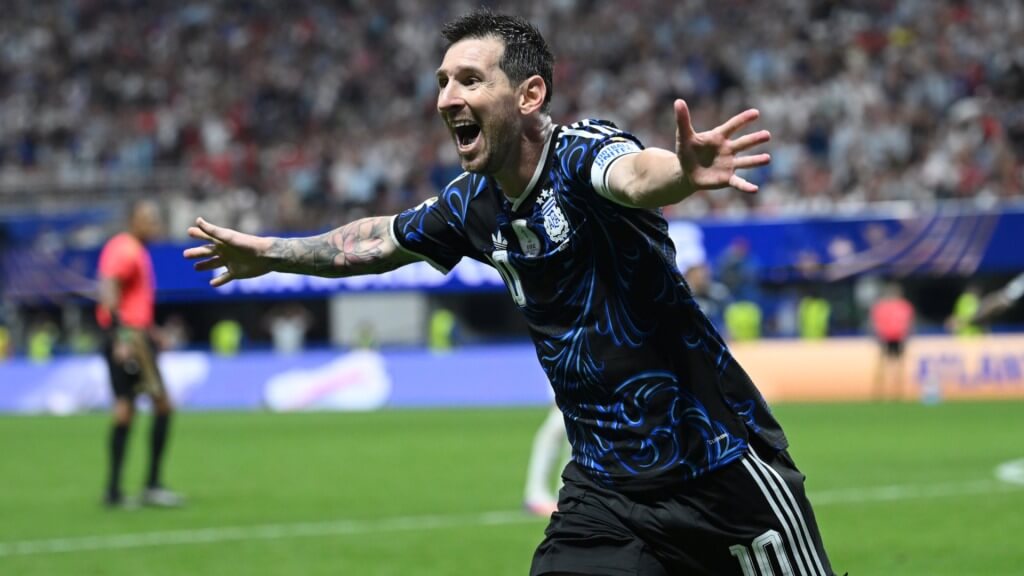
He’s not only an unstoppable force; he’s the great attractor. After each ripple in the back of the net, the captain’s teammates all rushed to his side. It’s not an uncommon onfield celebration, but in the case of the younger Argentine players, the collective euphoria is just as much about the team’s success as it is about commemorating their intrepid leader’s defiance of father time. “To you, who changed our lives… who made us believe that dreams are possible,” they wrote to him on his 39th birthday a few weeks ago, “the best part wasn’t watching it—it was experiencing it with you!”
Before long, images of the team hoisting Messi above their shoulders or tossing him in the air became a fixture of post-match broadcasts, as though he were part hero, part national mascot. They assemble just as quickly beside him on the pitch, to back him up and protect him during heated confrontations. It’s a two-way street; Messi loves praising his teammates unprompted in the press.
Critics noted that Argentina’s group stage opponents were less impressive in the grand scheme of things, but the narrative would shift considerably in the knockout stages. In the Round of 32, it seemed like first-time tournament entrants and cult favorites Cape Verde—who had just tied with heavy hitter and now-finalist Spain—might spell doom for the returning champions. They just managed to squeak by in extra time, in a thrilling bout that could’ve gone either way. Despite the positive result, it cast a shadow of doubt over Argentina’s ability to put away more formidable opponents.
These concerns weren’t unfounded. The next three games saw the team fighting from behind, only to snatch victory from the jaws of defeat after the 90-minute mark each time. Their Round of 16 clash with Egypt saw them trailing by two goals until late in the game, at which point Messi diverted from his now-standard solo attacks down the middle. Instead, he turned back the clock to his days at Spanish club Barcelona, crossing the ball to his teammates from the right, performing split-second mental and physical calculus to get it into spaces few others would find. After missing a penalty earlier in the game, he scored one goal, set up another and directed a third from afar, all within 15 minutes. Each time, from nothingness, would emerge a sliver of chance; it was sporting alchemy. Sorry for the mixed metaphors, but his performance in this World Cup invites such grandiose comparisons. It’s science and poetry and pure adrenaline, and a thousand other things.
Now imagine being in close proximity to this magic, day in and day out. That can go one of three ways. The first is an inferiority complex. The second is resentment. The third, however, is the harmonious interplay viewers at home can glimpse from the camera’s bird’s-eye view. Newcomers might be tempted to only track the ball across their screen, but Messi’s chess-like approach is a reminder to take a wider look at where every piece is placed, and how the board shifts in desperate moments. The strategy against Egypt saw Argentinas reach into their gut at the last minute and turn the game on its head. This feat would repeat itself in subsequent fixtures with Switzerland and England—matches most of the team’s fans watched through their fingers.
Each of these games featured the possibility of Argentina’s unceremonious exit, only for them to put pedal to the metal (with a hit of NOS) right at the finish line. It’s become an exciting routine, if a rather harrowing one, to see them level or trailing by a couple of goals as the clock ticks down, but the nail-biting agony of watching them nearly lose makes each victory more cathartic. It’s sports-watching 101, but it comes with some interesting caveats. In most scenarios, it would be gauche to support returning winners so fervently as they advance. But for this Argentina squad, their journey is, in part, about proving their aging leader still has gas left in the tank. Their doe-eyed admiration for him, as they collaborate for each impossible late-game push, has practically made them underdogs all over again. Messi is a weathered general out to prove to younger, faster teams that his biggest victories were no fluke, and each comeback and celebration is a testament to his shocking longevity. It turns the team’s narrative into a grand soap opera of Achillean adoration as they set up his goals—and, more recently, as he drifts right to set up theirs.
Perhaps it’s sheer gumption that’s gotten them this far—or perhaps it’s written in the stars. Fans have been quick to share a UNICEF photoshoot from 2007 in which Messi, a then-rising La Liga prodigy, can be seen bathing a smiling baby—who grew up to be none other than Spanish right winger Lamine Yamal, the teenager who inherited Messi’s number 10 jersey at Barcelona, and who he’s now set to face in Sunday’s final. It’s a bizarre twist of destiny you couldn’t possibly script, but it feeds further into the fated quality that has defined Argentina’s campaign, where they’ve had to fight tooth-and-nail to stay alive in the closing minutes. Perhaps they’re fueled by luck (some theorize the deck is stacked in their favor; you can dismiss this by actually watching the games), or perhaps they’re fueled by the undying love the younger players have for their captain and king—a love that radiates through whatever screen you’re watching them on. Either way, it’s gotten Argentina here.
Whatever the outcome of Sunday’s final, this is the postscript that was never meant to be, written around a legacy hero whose magical abilities keep extending his “prime” further into middle age—so far that kids who grew up watching him are either playing by his side, or stepping up to challenge him for the crown. Another trophy would be a wistful parting gift from Messi to his team, but if their locker-room chants are any indication, it’s something they desperately want to win for him in return, after all his years of service. “Por la última de Leo Argentina quiero verte bicampeón,” they can be heard singing. “For Leo’s last one, Argentina, I want to see you become back-to-back champions.”


 Keep scrolling for more great stories.