C

Neither Kogonada nor his characters can go home again in the aimless Zi

The director's retreat back to his indie, ethereal roots might've made for a good vacation, but it also makes for an insubstantial movie.

Neither Kogonada nor his characters can go home again in the aimless Zi

While some filmmakers double down on career shifts, embracing their new brand as a purveyor of CG-drenched spectacle or politically charged satire, many recoil from being pigeonholed—especially if the film they’re responding to was a failure. This rubber-banding retreat back to basics informs Kogonada’s self-consciously small-scale drama Zi, which arrives on the heels of his misguided bomb A Big Bold Beautiful Journey. It’s hard not to read this reaction, which saw the Midwestern director of films like After Yang, as a renewed statement of purpose, or at least an acknowledgement that he’d spent too much time on something he found to be purposeless. But attempting to define something only through opposition is a losing strategy: Zi might be nothing like his first studio film, but it’s frankly not much of anything at all, so insubstantial as to dissipate into thin air.

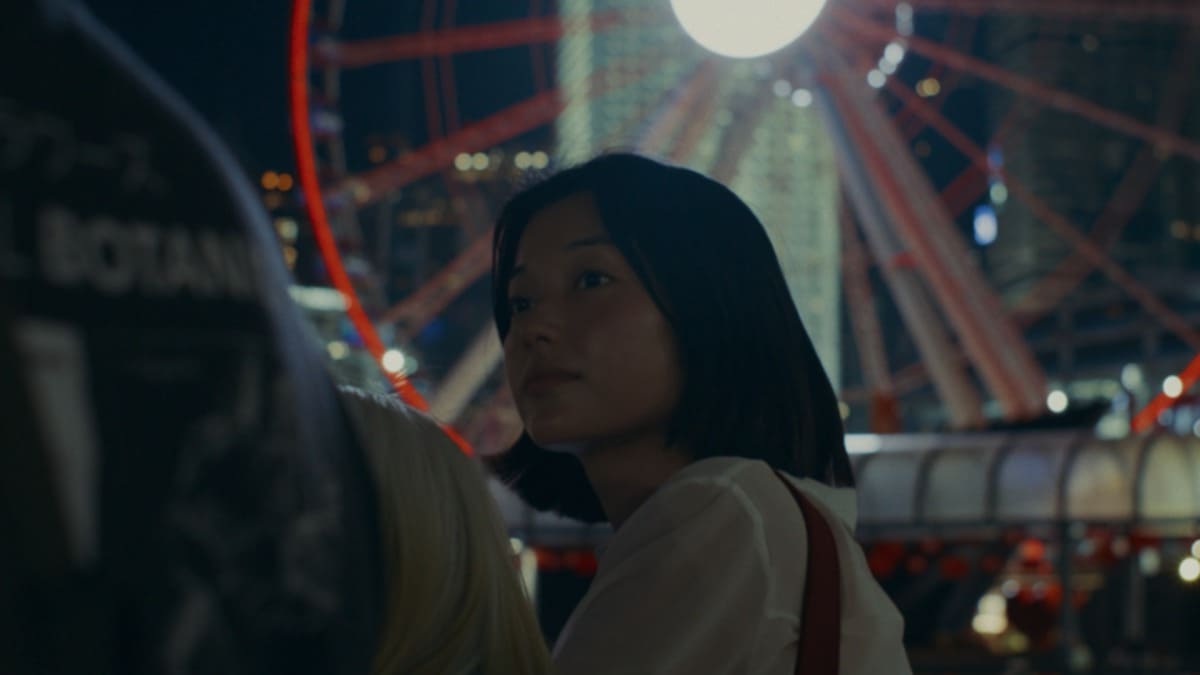
The intersection of three young wanderers—the violinist Zi (Michelle Mao), Arizonan ex-dancer Elle (Haley Lu Richardson), and Elle’s ex-fiancé Min (Jin Ha)—during a single night in Hong Kong hangs together with the loose spit-and-spirit adhesive binding so many 72-hour film projects made by friends over a few hectic days. This is not too far off from the truth of its production, which saw Kogonada, his three stars, his producers, and cinematographer Benjamin Loeb run around Hong Kong for a couple weeks, mostly making the film up as they went. This approach, while certainly liberating compared to the regimented shooting of a studio picture, makes some of Zi‘s asides, like the fact that its musician protagonist may be suffering from a brain tumor that allows her to see versions of herself displaced in time, more flighty and figurative than anything concrete that its characters might react to.

It’s this dedication to an ethereal aesthetic—the Academy-ratio frame squeezing the handheld camerawork, jittery cuts, and photo-processing effects into a boxy little arthouse View-Master—that reaffirms Kogonada’s preference for poetic unreality and undermines the grounded emotions he tries to tap in the same film. Those familiar with Kogonada’s previous work will find it striving to achieve Columbus‘ elegant highs, even casting Richardson as its chattiest character. Zi leaves a neurological clinic set onto a head-spinning Cléo From 5 To 7-like path, awaiting more (possibly dire) information about her condition. Her public weeping draws in Elle, a wig-wearing flirt whose penchant for recording sounds in her adopted home confirms her as a twee daydream—or just one fractured representative of her creator’s ennui—who in turn pulls in her brokenhearted ex, serendipitously a researcher at the same clinic.

Between Zi’s unmoored temporal confusion, Elle’s desire to flee her old life, and Min’s melancholy duties (not to mention his background as a Korean-born expat like Kogonada), it isn’t too hard to peel back this light narrative and find the personal demons underneath. What’s more difficult is finding substance in their evening-long conversations, sporadic and half-baked as they are. Elle’s driven by a desire to care for Zi; Min is drawn in by his old flame; Zi is looking for any port in this storm before her body betrays her. While the film breezily flits through the packed streets and stairways of Hong Kong, sometimes evoking Wong Kar-Wai’s choppy step printing and sometimes settling into Kogonada’s pleasantly strict architectural framings, its perpetual return to these sketched characters—stiffly performed, especially by Richardson—feels forced compared to the moments when it luxuriates in its dreamy urban atmosphere.

This late-night wandering, this last hurrah for a brain possibly on its last sensible synapses, navigating alleys and tunnels and karaoke joints and bazaars in search of something worth staying up for, is more about momentary resonance than any deeper connection. Perhaps that fits for the musical trio (alongside the violinist and dancer, Min reveals himself as a singer), more able to translate their emotions into expressions of sound and movement than words. It’s certainly the tack taken by the heavily deployed piano score, which, pretty as it is (it’s Ryuichi Sakamoto, after all), contains more emotion than the rest of Zi combined. 

Zi begins with the self-shattering experience of seeing your own body across the street, separating “you” from a version of you that you don’t recognize. This unsettling split, not reconciled but assuaged during the film’s disposable vignettes, would lead anyone to scramble for the tethers keeping them sane, and strapping their identity together. That may or may not have been the mindset of Kogonada after making the leap from indie to studio and back again—the feeling of seeing a possible future for yourself laid out in front of you, and not liking what you see—but his movie can’t commit to something so targeted and focused. Rather, it’s as aimless as its out-of-place trio, hoping that something to hold onto will rise up out of the night, out of the cityscape, to save it from its own uncertainty.

Director: Kogonada
Writer: Kogonada
Starring: Michelle Mao, Haley Lu Richardson, Jin Ha
Release Date: November 6, 2026

 
Join the discussion...
Keep scrolling for more great stories.