
2025 was the year comedians defended comedy from itself
Online and onstage, comics made the manosphere the butt of the joke.
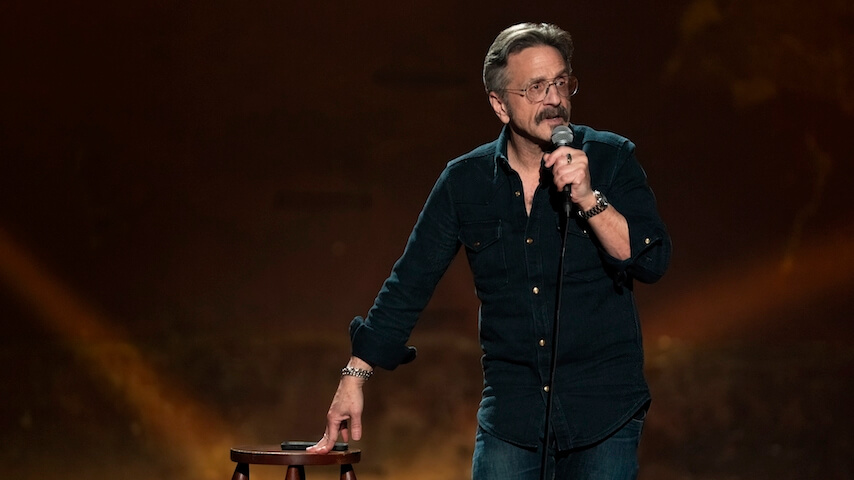
Marc Maron: Panicked (Photo: Karolina Wojtasik/HBO)
After Donald Trump cruised to another term last fall, pundits across the media declared that the comedians-turned-podcasters within the so-called “manosphere” helped deliver him to the White House. Trump and JD Vance’s appearances on the “anti-woke” talk shows Flagrant (co-hosted by Andrew Schulz), This Past Weekend W/ Theo Von, and, most crucially, The Joe Rogan Experience had made the former president a relatable candidate and one of the boys for a certain set. Tony Hinchcliffe’s racist joke about Puerto Rico being “a floating island of garbage” from Trump’s October 2024 campaign rally only bolstered the case for a billionaire candidate who spoke to the lonely young men who listen to Rogan talk to would-be oligarchs in unchallenging interviews for hours on end. The comics behind these shows, seemingly, got what they wanted: an openly fascist United States government that’s ruthless to minorities, antagonistic to foreign allies (sans Israel), economically aggressive to the working class, and openly trollish to its citizens. Not everyone in comedy was happy to get the credit.
Since the election, the comedy landscape has begun to fracture. As the manosphere continued to expand, comedians on the other side of the political divide, or simply looking for an easy thing to make fun of, have begun to point out how cynical, evil, and plainly unfunny all this shit is. Comics like Marc Maron, Anthony Jeselnik, and Stavros Halkias, among others, couldn’t abide the pervasiveness of Rogan’s comedy scene in Austin, where the Experience host moved his operations during the pandemic and convinced his podcasting buddies to join him. Rogan also opened the Comedy Mothership club, where guests are seemingly guaranteed a joke about trans people in every set. They were everywhere. The manosphere had expanded so much that even The Naked Gun reboot couldn’t ignore this collective currently afflicting American culture. These guys became unavoidable.
Comedy has long been an insular world, a boys’ club where comics protect their own. As Hinchcliffe’s Puerto Rico joke dominated the news cycle, Jon Stewart defended the stand-up as “just really doing what he does” as a roast comic. More embarrassingly, Stewart admitted, “There’s something wrong with me. I find this guy very funny” on national television. Marc Maron, the comic who popularized the comedian interview on his podcast, WTF, had a very different reaction. He deemed Hinchcliffe and his ilk as “part of the public face of a fascist political movement that seeks to destroy the democratic idea.”
“The anti-woke flank of the new fascism is being driven almost exclusively by comics, my peers,” Maron wrote in a blog post. “Whether or not they are self-serving or true believers in the new fascism is unimportant. They are of the movement. Whether they see themselves as acolytes or just comics doesn’t matter. Whether they are driven by the idea that what they are fighting for is a free speech issue or whether they are truly morally bankrupt racists doesn’t matter […] When comedians with podcasts have shameless, self-proclaimed white supremacists and fascists on their show to joke around like they are just entertainers or even just politicians, all it does is humanize and normalize fascism. When someone uses their platform for that reason, they are facilitating anti-American sentiment and promoting violent autocracy.”
Maron had been paying attention. The 2010s comedy boom had at least attempted to give stage time to heretofore unheard voices, with reckonings in comedy that grew out of the Black Lives Matter and MeToo movements. “A side effect of the comedy boom, where so many new media ecosystems flourished, the industry sort of fractured,” independent journalist (and former Paste staffer) Seth Simons tells The A.V. Club over Zoom. “At the same time that was flourishing, on the other side, there were these right-wing and extremist comics in their own media ecosystems that you wouldn’t know about if you’re over here listening to Comedy Bang! Bang!“
Simons has been covering extremism in comedy for the last decade and currently outlines their activity in the weekly doomscroll of a newsletter, Humorism. “These guys have won what in 2019 was called ‘the Comedy Civil War.’ They are the mainstream now. They’re the most famous comics in the world,” he says. Simons sees his newsletter as a document of “the most famous comics in the world” saying things that would have been a “huge scandal five years ago, but are now completely normal.” It’s more than slurs that have been “out of bounds” for more than a decade: “They’re articulating straightforwardly white-supremacist ideas, anti-immigrant ideas, anti-trans ideas, not just in jokes. It’s the stuff they say in plain speech.”
In the new year, Maron didn’t let up on his targets. After announcing the end of WTF, he used his farewell tour to expose these guys on other podcasts. He worked his disgust toward his peers into his HBO special, Panicked, which dropped in August: “I think if Hitler were alive today, he’d probably appear on Theo Von’s podcast.” It was a joke that Maron said he’d be “hard-pressed to think that [Von] didn’t think was funny.” Nevertheless, Maron’s relentless critiques seemingly gave other stand-ups the okay to, well, stand up to these guys. Over the summer, the two Rogan-adjacent hosts of Bad Friends, Bobby Lee and Andrew Santino, began criticizing the Austin scene on their respective podcasts. When Lee had Kill Tony regular Ari Matti on his podcast Tiger Belly, Matti said he enjoyed being in a “little trust circle” when he’s around other comics and they “say the N-word for the first time.” Lee responded, “I’m not with what you guys are doing in Austin. Well, let’s be real. I don’t like some of the words you guys use freely. It’s becoming hacky to me that you guys use these words for shock factor.” Stavros Halkias had a similar instance in September, when comic Jordan Jensen wouldn’t stop bringing up trans people and using slurs about them. “Okay, stop,” Halkias demanded, in a friendly manner. “You’ve really gotten ‘Austin trans brain’ […] It really is at the top of your head. You immediately brought it up as soon as the podcast started.” When Jensen continued, a visibly annoyed Halkias accused her of “practicing for Rogan.”
Still, while these comics have gone a bit scorched earth, there continues to be some congeniality backstage. Halkias stars on Tires with Shane Gillis, who hosted Holocaust deniers on his podcast. “It’s not normal to be friends with Nazis,” Simons says. “There is no other field, outside of actual right-wing think tanks and the right itself, where it is normal or acceptable to be friends with outright racists and Nazis and transphobes. Except for comedy.”
But those friendships were again tested when comedy’s biggest (and, in some cases, most disgraced) names, including Bill Burr, Dave Chappelle, and Louis C.K., censored themselves to perform for the Saudi Royal Family. “The perception that ‘we’re doing it to spread democracy to the world, or open up culture, that all felt a little disingenuous to me,'” Tim Heidecker said. On his podcast Office Hours, he and co-hosts DJ Douggpound and Vic Berger added new names to the lineup, such as Woody Allen and Bill Cosby. Other comedians couldn’t resist the low-hanging fruit of the obvious hypocrisy tree. “Now there’s a lot of drips, killjoys, and dweebazoids who are saying, ‘Oh, you shouldn’t do comedy over there because it’s whitewashing a regime that just in June killed a journalist and killed Jamal Khashogi and played a big role in 9/11,” Zach Woods joked in a deeply sarcastic TikTok video. “Shut up. Name one comedian who hasn’t whored themselves out to a dictator. Sinbad, in the ’80s, would perform for Nazis hiding out in Argentina.”
 Keep scrolling for more great stories.