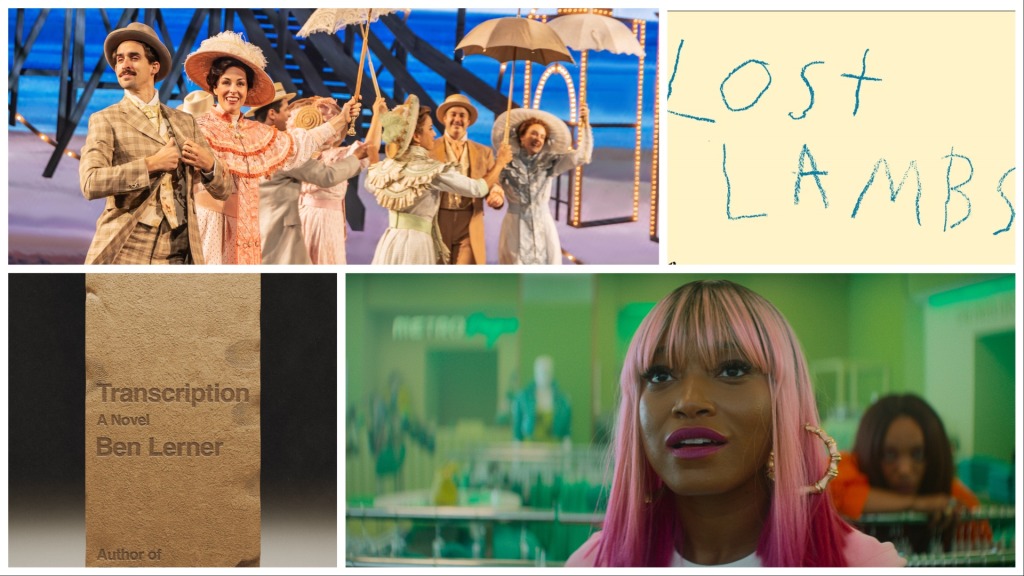
At least one film this year addressed this phenomenon head-on. I caught Boots Riley’s I Love Boosters at the Brooklyn Academy Of Music during its opening weekend. (Revelantly, BAM is a theater where you must arrive on time, because there are only a couple of previews and they start a few minutes before showtime. It’s certainly the least amount of advertising you’re likely to see at a new release.) The first two-thirds of Riley’s movie features a range of characters initially presented as gags—Crying Black Mother, Upstanding Community Member, Based Young Dude—who are eventually revealed to be members of a think tank who have literally shed their skin and adorned a new one to spread propaganda. Riley’s saying here, fairly explicitly, that you don’t actually know what these people on the screen represent, or who’s paying them to say what.
The obvious antidote to this is to get away from the screen, or at least the algorithm. Within the past year or so, I’ve deleted Twitter and TikTok from my phone, and while I can’t quite part with Instagram yet (for the primary reason that I actually know more of those people in physical life), my brain feels better. It’s because of this that I’ve finished 19 books in the first half of the year and have been spending my time not just at movie theaters, but theater theaters. Works contained in books and theaters generally aren’t filtered through a privately owned algorithm. They have defined beginnings and endings. And when you see someone acting or singing on stage, you can at least be pretty sure they’re a real person.
Of course, none of these things are “ad-free” in the traditional sense. Movies have trailers, books promote other works from the same publisher, and if the theater you’re seeing is on Broadway, it means passing dozens of billboards before opening a Playbill also filled with ads. But these ads are generally contained to their proper place. Advertising can be a necessary evil—much of the art we love relies on it for financial support. Getting a movie in a cinema typically requires an elaborate promotional campaign. But I want to be engaging with material that I’m sure is more than advertising, and with material that doesn’t only push us to consume more of it. One way I’ve done that is to ask whether something has a defined beginning and end. A social media feed does not. Franchises like Star Wars or Scream—franchises I once loved—used to but don’t anymore. They are campaigns that will continue indefinitely—probably forever, if you asked the corporations behind them what they wished. Even when you watch a singular movie on a streaming service, you have to be diligent if you want to enjoy its ending, lest Netflix or HBO Max start playing something else before the director’s name is on the screen.
The autoplay feature highlights how inherently this problem is tied up with tech and the modern methods of consumption. As a text, there’s no difference between watching I Love Boosters in a theater or at your home. But the streaming services feel hell-bent on stopping you from actually sitting with a work and taking even 30 seconds to absorb it. It reduces even the best offerings in the streaming library to specs on a feed, existing to keep you online and subscribed for as long as possible. Fortunately, Silicon Valley hasn’t figured out how to do this to theater or books (not yet, at least). I think back to the warm image that concludes Madeline Cash’s debut novel Lost Lambs often. When I finished Ben Lerner’s Transcription, I stared, nearly catatonic, at my wall for a few minutes. When Ragtime ended, I looked at my friend beside me as we both exhaled, realizing we had been holding our breath through the finale. There are parts of the audience experience that you cannot have when you’re immediately prompted to consume more.
Ultimately, this isn’t about taste or even media diet but about methods of consumption. In a time of industry constriction and fragmentation, it’s understandable (to an extent) that creativity is required to make money from media. But algorithms that are nothing but disguised advertisements and streaming services that only prompt us to consume more feel like they’re separating us from connecting with each other and authentically learning about each other’s points of view. That, to me, is the point of culture, media, and art, and the solution I’ve found has been in theater, books, and some film. It doesn’t mean I don’t engage with other stuff—I watch more YouTube than I’m willing to admit, and that’s entirely based on an algorithm—but the offline experiences feel extra-nourishing. As much of a bummer as it is that being online doesn’t feel like it used to, it feels good to remember what life and culture can be, unmediated by an algorithm.


 Keep scrolling for more great stories.