The last movie starring Supergirl, the younger and/or older cousin of Superman depending on your lore of choice, arrived over 40 years ago. There wasn’t much fanfare: Mainline Superman star Christopher Reeve wouldn’t deign to bless the shruggy (if hokily charming) 1984 spinoff Supergirl with his appearance, and Warner Bros. declined to distribute. This feels true to the comics version of Supergirl—in spirit if not in actual storytelling—who is frequently defined by how far to the side of Superman she’s placed by various creators. (An interim cinematic appearance designated her as an alt-universe version of Henry Cavill’s Superman, somehow materialized in a world alongside a Michael Keaton iteration of Batman; the end stages of the old DCEU were wild.) So it’s a particularly James Gunn-ish feat of counterintuition to place Kara Zor-El ahead of DC Comics mainstays like Batman, Wonder Woman, or the Green Lantern in the batting order for a new series of DC movies, with the new 2026 Supergirl serving as a way station between two Superman films.
Gunn, the architect of this latest on-screen DC Universe whose sensibility is detectable though not oppressive throughout Supergirl, has maintained that these decisions will be made by script readiness, not corporate strategy. But this movie’s priority seems more owed to the particular source material than the precise screenplay adaptation thereof. Supergirl: Woman Of Tomorrow, by Tom King and Bilquis Evely, is a recent comic-book miracle, an eight-issue miniseries that takes clear inspiration from the Coens-adapted Western novel True Grit. It casts Kara as a Rooster Cogburn figure assisting a young woman on a perhaps ill-considered but certainly well-justified quest for revenge across the galaxy.
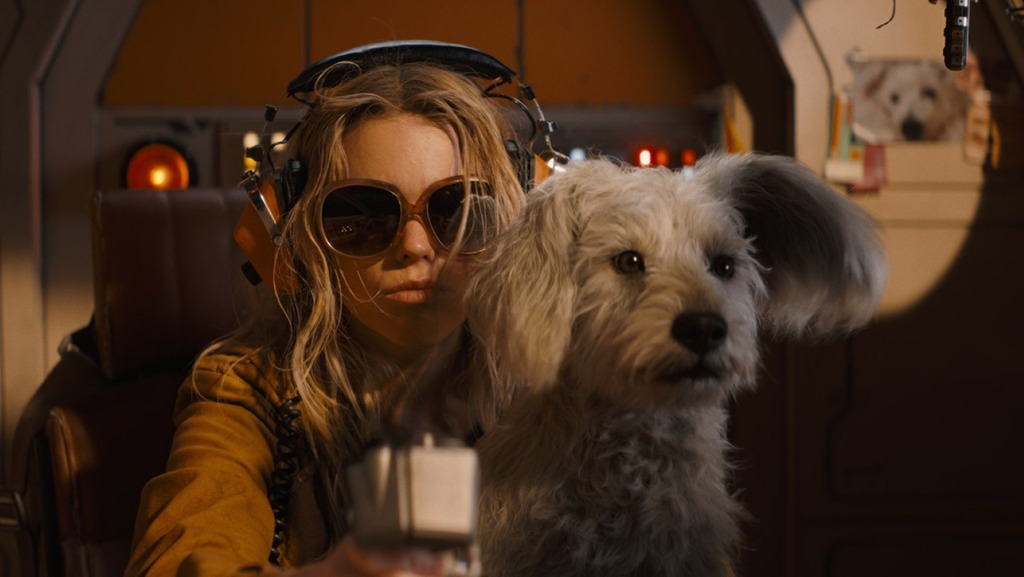
That story forms the backbone of this Supergirl (sans Woman Of Tomorrow; cleaner, apparently, or maybe Gunn nicked back that phrasing for his own upcoming Superman sequel, Man Of Tomorrow). The new film joins Kara (Milly Alcock) on one of her frequent jaunts outside the glow of Earth’s yellow sun, whose effects on her power set keep her from getting meaningfully drunk on her adopted homeworld. Kara doesn’t feel much affinity for that place anyway; unlike her cousin Clark, she arrived on the planet as a young woman, not a baby, following the destruction of her home. So she finds excuses to head off-planet with woman’s best friend—her rowdy superdog Krypto—for intergalactic pub crawls. As the movie opens, she’s ostensibly celebrating her 23rd birthday, though she doesn’t seem especially cheerful about it.
That doesn’t mean the Alcock makes for bad company, though. Quite the contrary: She plays Kara with a wry dissolution, mixing self-confidence with sorrow, that clarifies the character’s whole deal just as quickly as she made an impression in the closing moments of Superman. She may not be as old or grizzled as Jeff Bridges or John Wayne, but she brings a splendidly youthful ache to the reluctant-hero archetype. She feels for Ruthye (Eve Ridley), the young girl who has lost her family to the cruelty of scavenging warrior Krem Of The Yellow Hills (Matthias Schoenaerts) while making clear her skepticism over the utility of revenge (or the likelihood of little Ruthye exacting it properly). But when Krem endangers the creature that Kara loves the most, she agrees to track the villain down.
Director Craig Gillespie gets all of this business moving quickly—surprisingly so, given that his Cruella De Vil origin movie lasted an unconscionable 134 minutes. Supergirl includes bits of Kara’s origin, too, and if anything, it could have used a full two hours to give the material its due. The editing involved in getting the movie down to a lean 108 minutes is a little choppy, as if the filmmakers are antsily unaware of just how likable Alcock is in this role, or nervous about making a superhero movie with two female leads. Some manner of gender insecurity would also explain the presence of Lobo (Jason Momoa), a ridiculous alien mercenary character who has been shoehorned into a story that doesn’t need him—or wouldn’t, if Krem was a little scarier than the standard-issue weird-looking creep. Momoa is obviously having fun, but there are plenty of weirder, funnier alien guys filling the frame without forcing Momoa and screenwriter Ana Nogueira to make “bastich” (a sort of non-gendered fusion of “bastard” and “bitch”) sound like remotely workable dialogue.
It’s a particular shame that Lobo’s dialectical quirks were preserved over Ruthye’s, her loquaciousness from the comics having been pared down to a mild formality that slightly flattens Ridley’s performance. But for every instance of Supergirl simplifying the words, timeline, visual invention, or thematic concerns of its source, there’s a moment where the movie feels scruffier and more lively than so many of its comics-based brethren, which tend to water down their inspirations even further. This one still has Supergirl riding a mangy interplanetary bus, picking fights with a spaceship, and blasting an astonishingly good set of soundtrack tunes. (This will bring to mind Guardians Of The Galaxy for many, but honestly, the mixtape curation here is better.) Gillespie and go-to Alex Garland cinematographer Rob Hardy give the movie a colorfully grungy palette out of a Star Wars cantina or a Mad Max outpost.
The movie’s visual sensibility signals Supergirl’s broader success in threading the needle between a kid-friendly, hope-suffused superhero story and bleaker, grittier stuff—and in doing so, recognizing how those aspects of life are often interwoven, rather than diametrically opposed approaches to IP. That’s always been the push-pull of the Supergirl character, equally able to be portrayed as Superman’s gee-whiz kid-sister equivalent and his more jaded, literally alienated reflection. The joy of Supergirl is how it mixes the two without demoting its main gal to a sideshow.
Director: Craig Gillespie
Writer: Ana Nogueira
Starring: Milly Alcock, Eve Ridley, Matthias Schoenaerts, Jason Momoa, David Corenswet
Release Date: June 26, 2026


 Keep scrolling for more great stories.