In the early ’80s, Ken Burns developed a marvelous new technique for historical documentaries that seems totally obvious by modern standards. He would shoot video of photos, using the camera to create a sense of movement as he slowly zoomed in and panned and cut quickly from photo to photo with an accompanying narration. His work seemed to bring history alive, using actors and narrators to provide voices for old historical documents. Sometimes, in Fox Nation’s Houdini: Back From The Dead, I can see the future of documentaries like the Ken Burns ones. Fox advertised the documentary as using AI to bring Houdini back to life, and there are moments where you do feel like the dead have been resurrected. Then a Scarlet Johansson lookalike flashes some distinctively ahistorical cleavage to make Houdini’s wife jealous and that marvelous vision of the future of documentaries disappears as neatly as Houdini would disappear an elephant.
It is a perfect example of AI slop, a phrase we like to use for anything that is AI-heavy. Weird microdramas. Karma-farming fake videos on social media. “We are Charlie Kirk.” Yet usually the AI slop is coming from the fringes. People not already working in the entertainment world and eager to get a piece of the profit pie. This is coming from Fox, albeit the right wing news entertainment version of Fox and not The Simpsons-and-FX version owned by Disney. Fox Nation is a streaming service providing curated content for Fox News super fans. AI slop appearing there, a small service with limited content, makes the slop feel even more sloppy. Watching the doc, I could practically hear a cigar-chomping executive shouting “slop em up, boys.”
That’s a shame because occasionally Houdini: Back From The Dead is an entertaining and visually arresting documentary about a man who was constantly forced to reinvent himself when new technology came and changed the whole landscape of entertainment and media. It goes on tangents, including a suggestion Houdini died because he blasphemed God and the spiritualism movement of the 1920s, and those tangents can be wildly entertaining. They just can’t overcome the cynical nature of the whole affair. It isn’t really about Houdini and using new technology to better engage audiences with his story. It’s about having another thing to click on in the Fox Nation app.
Aesthetically, it’s “AI slop.” Technically, “AI slop” isn’t an aesthetic. Artists will (and have) said repeatedly that AI cannot have an aesthetic because it is made by computers, not people. I disagree, largely because we can all see AI slop and say “yup, that’s AI slop.” There is a visual language—only, the visual language of the AI slop aesthetic changes year to year and sometimes month to month. One upon a time, it was badly formed hands and Will Smith merging with his spaghetti. Objects would warp and shift in distinctly uncanny ways and we could feel the AI wrongness. It’s the aesthetic everyone clocked in the opening credits to Marvel’s Secret Invasion back in 2023.
Now AI can do hands and make Will Smith eat spaghetti while doing martial arts, and the aesthetic has changed too. In restaurant menus and church picnic signs, it’s characterized by a kind of visual maximalism. Cheese drips in globs off burgers and classic cars are polished past the point of shine to a haze meant to suggest it’s even shinier. Houdini: Back From The Dead encapsulates the AI slop aesthetic of motion picture in 2026. There’s no big gloopy-but-meant-to-be-enticing drips of cheese, but oftentimes people do seem to have that same haze around them that the classic cars get, and everyone moves, is lit, and acts, exactly like the AI people in commercials on YouTube.
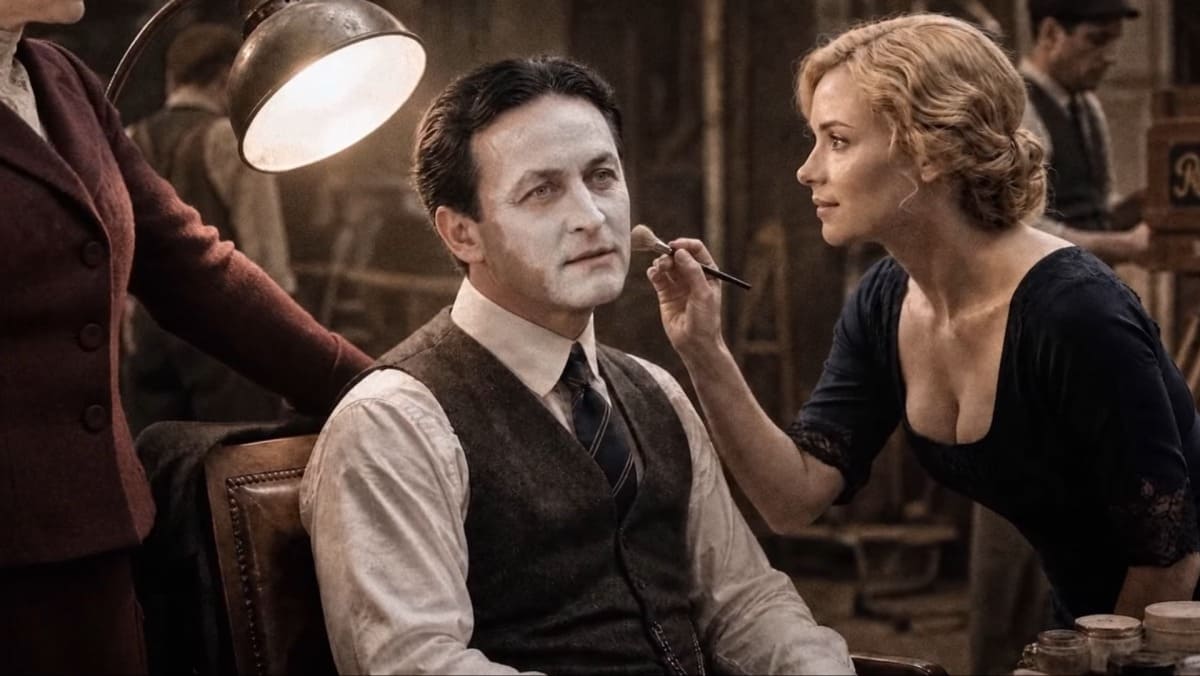
Houdini: Back From The Dead used real actors to play most of the roles and then AI to lay the historical figures over the performance—basically deepfakes. These characters all have lifeless eyes and mouths that are far more animated than the rest of their faces. It can make it feel like you’re mainlining a couple hours of those AI people selling supplements on Youtube between episodes of hoof-trimming videos. AI-resurrected Harry Houdini is frequently the worst offender. The conceit of the series is he is being interviewed, through the power of AI and possibly God, so the doc frequently cuts to an interview with him where he stares into the camera with soulless blue eyes and a winning smile.

Houdini: Back From The Dead
The likenesses of random celebrities haunt the entire project too. Whatever AI models were used to create this miniseries were clearly trained on modern cinema so extras don’t just look like randoms, they look like Scarlett Johansson or Henry Cavill. Sometimes they look like the AI equivalent of that one female model Pixar uses for every major human female character in its films.
The lighting is the most egregious offender. AI slop in 2026 has a bad habit of giving everyone an ethereal glow that cannot come from the actual visual light sources. Even though most of us can’t tell a key light from a fill light, we know bad lighting when we see it.
There are a surprising amount of scenes with well-deployed genuine historical footage. Harry Houdini happened to be part of the very first plane crash caught on film and the series recreates the incident, cutting between footage of the actual crash and an AI reimagining that escapes the slop aesthetic. As a man dangles from a rope 10,000 feet in the air his plane crashes into another sending him swinging right into the propeller that he narrowly avoids. The footage, pulled from Houdini’s 1919 film The Grim Game, has deteriorated with age and it can be hard to make out just how dangerous the stunt is, but the AI interjections work, yanking us back to 1919 and a stuntman narrowly avoiding losing his life to a plane propeller. It was the moment that really made me think of Ken Burns, imagining what someone who genuinely cares could do with this technology and a bit of time.
It’s oddly heartening that this Fox Nation miniseries, created so Fox can keep its tiny handful of viewers engaged in a world where Tubi, Pluto, and YouTube exist for free, manages to pull off a sequence like the plane crash one. It is a slop documentary made for the sake of the slop, but it still accomplishes something cool. In the hands of someone not just trying to ride the AI hype train, it could be a genuine tool for good storytelling. In the hands of Ken Burns, this same technology could produce a masterpiece. But it isn’t magic, despite the claims in the trailer. It’s still AI slop, which has a curious (debatable) aesthetic but is never going to be a reason to subscribe to a streaming service.
Alex Cranz writes about the intersection of technology and pop culture.


 Keep scrolling for more great stories.