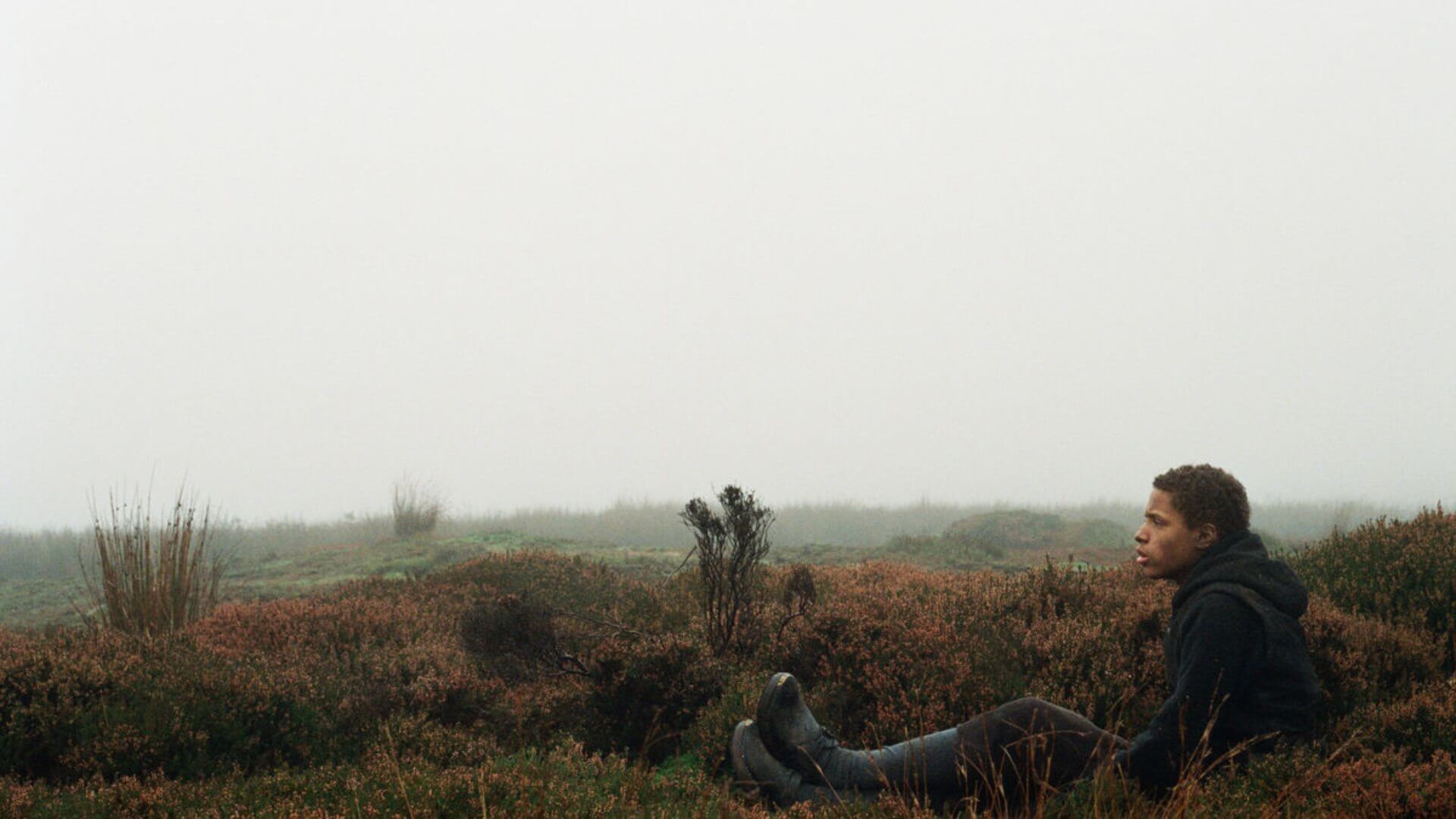
Two children, one a pale freckled girl and the other a boy with light brown skin, walk through a sodden moor, the mist on the ground so thick that the grass disappears only a few steps ahead of them. As the girl skips, the image shakes, then goes in and out of focus as the boy watchfully follows. She stops to playfully feed him a piece of bread, saying “Open yer mouf” with an unmistakable Northern English twang. Neither actor is obviously professional, though each has an air of authenticity. There’s no music; there’ll be none until the end credits. The only soundtrack of this take on Wuthering Heights is instead the perpetually whistling winds, the stray cry of a bird, and the rattle of a shivering tree branch tapping on a window.
Even the film’s maker struggled to know what to make of this vision of Wuthering Heights upon its release. Director Andrea Arnold was less generous about her Wuthering Heights than most; it was her opinion that she had “failed” with the film, having not “brought into balance all the different elements” of what was then, and is now, a decidedly radical approach to Emily Brontë’s novel. Some critics, like The A.V. Club‘s Keith Phipps, were effusive, while others were more muted—or at least more so than they had been about Arnold’s previous features, the Cannes prizewinners Red Road and Fish Tank. But 15 years on, all the ways that Arnold’s Wuthering Heights is so startlingly unlike other adaptations of Emily Brontë’s novel are why it looks like the truest version yet put on screen. Far from being a film that bends a well-loved text to a filmmaker’s distinctive vision, Arnold’s Wuthering Heights is evidence of an ideal union of author and director.
The agonized melodrama and swooning score of Wuthering Heights adaptations past were gone, as were the adults playing children and adolescents, with Cathy and Heathcliff in Arnold’s 2011 film played from childhood to teenage by age-appropriate actors. The cast spoke not in the customary costume-drama Received Pronunciation (except where it denoted a character’s higher status), but with broad Yorkshire accents; wore period clothes, not crisp but worn; and shared scenes in locations that appeared convincingly infested with mud and damp. There was no Masterpiece Theatre coziness or warmth—Arnold’s Wuthering Heights had cold in its bones.
In Brontë’s novel, fireplaces do not warm but “blaze,” while winds do not blow but “roar,” and the mood of a room may be likened to a “tempest” and the snow-covered moors to a “billowy, white ocean.” It’s a language of primal force—apt for Brontë’s world, with its pitiless nature and casual violence—and of an almost adolescent emotional intensity that matches that of its young protagonists. Arnold’s Wuthering Heights speaks the same language. Usually favoring a charged, handheld naturalism for her working-class stories set in contemporary suburban spaces, Arnold adapts her style here to suit rural 18th-century Yorkshire. Between scenes of non-professional performers and earthy character actors exchanging terse period dialogue, there are shuddering images, perhaps all snatched on the fly—a colossal tree quaking in a gale; a ferocious, panting dog chasing another through mud on the Earnshaw farm; birds flying in formation across a foreboding grey sky. Abandoning any period-piece classicism—that stately form so often used to translate classic texts like Wuthering Heights to film—in favor of an elemental cinema vérité, Arnold approximates Brontë’s wild poetry, in image and sound, like no other filmmaker.
Thematically, too, Arnold’s Wuthering Heights gets closer to the source text than most. Many Wuthering Heights adaptations foreground the bitter romance while other concerns became less prominent, but for Arnold as for Brontë, the love between Cathy and Heathcliff is but the poisoned heart of a larger story. Echoing Arnold’s work at large, 2011’s Wuthering Heights is, like Brontë’s novel, also about young people coming uneasily of age in an adult world, about the long consequences of violence and neglect, about how people are forged by their environments. A social realist filmmaker, Arnold (like Brontë) sympathizes with those on the delicate fringes of society, and understands that Heathcliff is not merely a smoldering romantic antihero, but a damaged, destructive individual whose character has been informed by his class, his gender, and—perhaps above all—his race.
“Mr. Heathcliff forms a singular contrast to his abode and style of living,” thinks the lodger Mr. Lockwood to himself early in Brontë’s novel. Described as a “dark-skinned gipsy” and “little Lascar,” with his father imagined to be “Emperor of China” and his mother “an Indian queen,” Heathcliff is ethnically ambiguous on the page; Brontë’s point is that at this time and in this place, Heathcliff’s non-whiteness marks him as an outsider, one whose wealth and power as an adult is notable, even suspicious. What’s at the root of characters regarding the younger Heathcliff—the Heathcliff of the ages depicted in Arnold’s film—variously as servant, “devil,” or fetishized exotic is that he has dark features at an especially racialized time in British history.
Where all previous English-language screen adaptations of Wuthering Heights had cast a white British actor—Laurence Olivier, Timothy Dalton, Ralph Fiennes, Tom Hardy—as Heathcliff, Arnold cast (as the younger and older Heathcliff, respectively) Solomon Glave and James Howson, mixed-race British actors of Afro-Caribbean descent. Their casting makes Arnold’s Wuthering Heights film the first (and to date only) one to make Heathcliff a visible Other in his world. Arnold’s, then, is the only Wuthering Heights to seriously appreciate the racism that contributes so significantly to how others treat Heathcliff, a character who must force his way onto a higher rung of society—one where Cathy, his paramour, is instantly welcomed in.
Illustrative of how much has changed (and how much hasn’t) in the last 15 years, Arnold’s Wuthering Heights generated controversy due to its casting of mixed-race performers as Heathcliff, while the casting of Jacob Elordi as Heathcliff in the 2026 Wuthering Heights has been controversial because of the actor’s whiteness. Emerald Fennell, whose colorblind cast for her Wuthering Heights includes Hong Chau as Nelly Dean and Shazad Latif as Edgar Linton, has given as her reason for casting Elordi that the actor “looked exactly like the illustration of Heathcliff” on the first copy of Wuthering Heights she owned.
The air quotes which hover around the title of Fennell’s newest version (“Wuthering Heights”) emphasizes that the film is just that: a version of the story, not necessarily Brontë’s, but one adapted by the filmmaker to fit her vision. There are pleasures to be found among other Wuthering Heights adaptations that showcase strong individual interpretations of the material, like William Wyler’s 1939 film, which is shot as a silvery gothic by master of black-and-white cinematography Gregg Toland, or Luis Buñuel’s 1954 film Abismos De Pasión, which, by relocating the action to rural Mexico, reframes the story as a heightened melodrama conducted in a state of sweltering, sun-fried delirium.
Andrea Arnold also takes liberties to fit a personal vision. While Wyler and Buñuel’s films delight in adapting Brontë’s (possibly) supernatural passages, Arnold’s film, realist perhaps to a fault, barely nods to the ghost story. Arnold also ignores the book’s second half, as many filmmakers have, while including in her adaptation scenes that underline the characters’ ferity—Hindley and his wife rutting in a field at night; Cathy licking the wounds on Heathcliff’s back—and which don’t appear in Brontë’s novel.
Even so, what’s remarkable about Arnold’s film is not how often it departs from Brontë’s text but how closely it aligns with it. The 2011 Wuthering Heights might have little of the shine of other, supposedly more reverential adaptations, but Brontë’s novel doesn’t suggest polish or cry out for reverence. Its language is fervent and untamed, its story not pretty but knotted and frequently cruel. Arnold’s Wuthering Heights is a radical adaptation, and one that after so many interpretations, is the only one to get something close to the savage, complex spirit of the book onto the screen.


 Keep scrolling for more great stories.