When we remember, we’re not remembering the original event, but the currently stored version of that event we’ve got locked in our minds. Over time, our memories of our memories overwrite one another, the details shifting slightly each time, like someone pranking you by moving your furniture inch by inch. Eventually, what we recall is better described as the story we tell ourselves about what happened, rather than what actually happened. The story two brothers tell themselves about their father, and about their childhood in Nigeria, in My Father’s Shadow is well-loved and well-worn—a prized object or a lucky charm rubbed between thumb and forefinger over and over again.
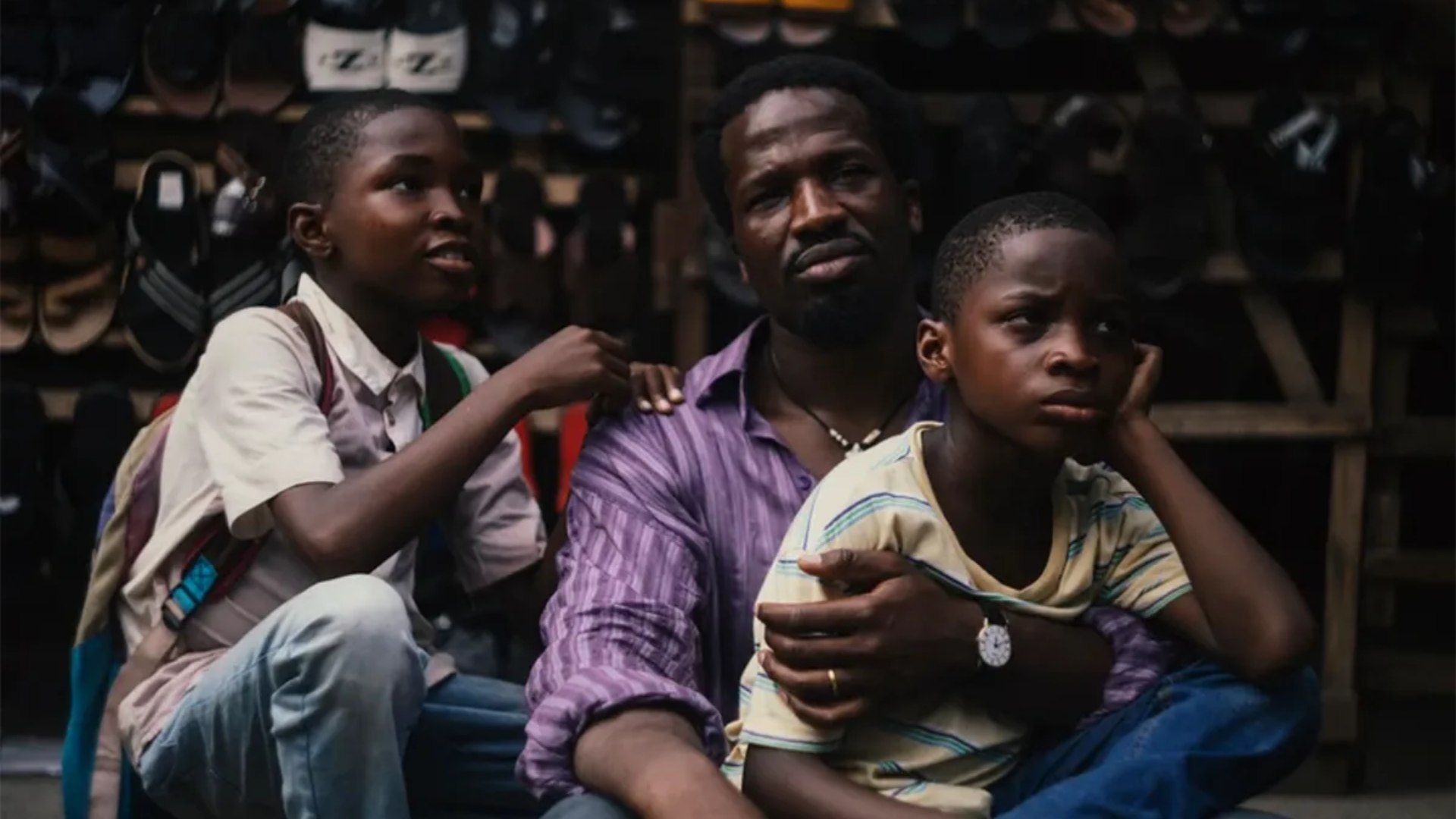
The sweet and arresting debut feature from British Nigerian writer-director Akinola Davies Jr., co-written with his brother Wale, My Father’s Shadow is a day-long drama, tracking two brothers’ impromptu trip to Lagos from their village. This takes place during the heart of a political struggle for their country, the 1993 Nigerian election crisis, and in the midst of a personal struggle for their family. Their father Folarin (Ṣọpẹ́ Dìrísù, His House), who works in the city, isn’t a regular fixture at their house. In fact, the kids—Akinola and Olaremi (respectively played by brothers Godwin and Chibuike Marvellous Egbo), ages eight and 11—seem to will him into existence while playing make-believe with their paper-doll pro wrestlers.
The only man cooler than The Undertaker to these ’90s kids is their dad, who’s only stopping by their house briefly before heading into Lagos to pursue some lost wages. The boys’ mom has left them alone for the day, and their hazy morning has been as boring and languid as the collective buzz of a thousand summer mornings. Jermaine Canute Bradley Edwards’ camera stares into the middle distance, zooming slowly (maybe ominously) into the stillness of the boys’ surroundings. The lighting is muted without dimming its blasts of colors, giving montages the effect of old home movies, an aesthetic that has come to define how we think of memory and here gives the film an air of impermanence. There’s a sense of danger in the air, a sense of magic in their father’s appearance. Of course they’re going to run off with their pop for an exciting and fantastical day trip.
The younger boy sharing the name of the filmmaker both reveals and belies the true nature of the fiction’s relationship with the past. There is memoir baked into My Father’s Shadow, but just as much historical fiction and even fantasy. As the trio make their way from the rural to the urban, catching rides in ever-shrinking vehicles as the nation’s gasoline shortage becomes apparent, their dreams of buying ice cream and bonding with their dad are realized beyond their wildest imaginations. They encounter colorful figures on the street and meals far fancier than those they can prepare themselves. They even get a private romp through an inactive amusement park. But on the edges of this rose-colored memory are the complex shades of reality. Even from the kids’ point-of-view, the film still catches glimpses of headlines about apartheid and military massacres, still hears radio chatter about contested elections, still feels the desperation in Folarin’s plea for the backpay he’s owed.
Dìrísù is excellent as both a larger-than-life father figure and a painfully human father. He tough-loves his boys, who are always ribbing each other in a pair of delightfully unself-conscious performances, and masks his stresses. Their bond comes to a head on a beach, in a quiet and intimate conversation juxtaposed with a violent gold rush for a nearby whale carcass. It feels like the way these boys remember their childhood in a nutshell—a little chaotic, a little desperate for resources and stability, but loving nonetheless. This idea also comes across in some of Davies’ frames that balance stillness and movement: Riding in the back of a pickup as the road and city disappear behind you; sitting on a bench while a Ferris wheel spins in the background.
Stronger still are the images that arise when the era’s political strife comes to a head. Folarin is clearly an idealistic supporter of opposition candidate M.K.O. Abiola, which comes across both in direct dialogue and his disgusted glares at truckloads of soldiers; his own role in the opposition is conveyed with more slyness, like how his city friends refer to him as a leader with the nickname Kapo. This of course makes the reigning dictator’s decision to deny the election results and cancel the election—a timely fear—even more personally harrowing. As the day fades into night, we see the danger inherent in a country struggling to come of age alongside Akinola and Olaremi. As the memory fades into history, My Father’s Shadow blurs into documentary footage, which then blurs with wishful thinking. It’s formally ambitious for such a contained film, but grants this small-scale story the well-considered gravity of something held close to the heart.
Director: Akinola Davies Jr.
Writer: Wale Davies, Akinola Davies Jr.
Starring: Ṣọpẹ́ Dìrísù, Chibuike Marvellous Egbo, Godwin Egbo
Release Date: February 13, 2026


 Keep scrolling for more great stories.