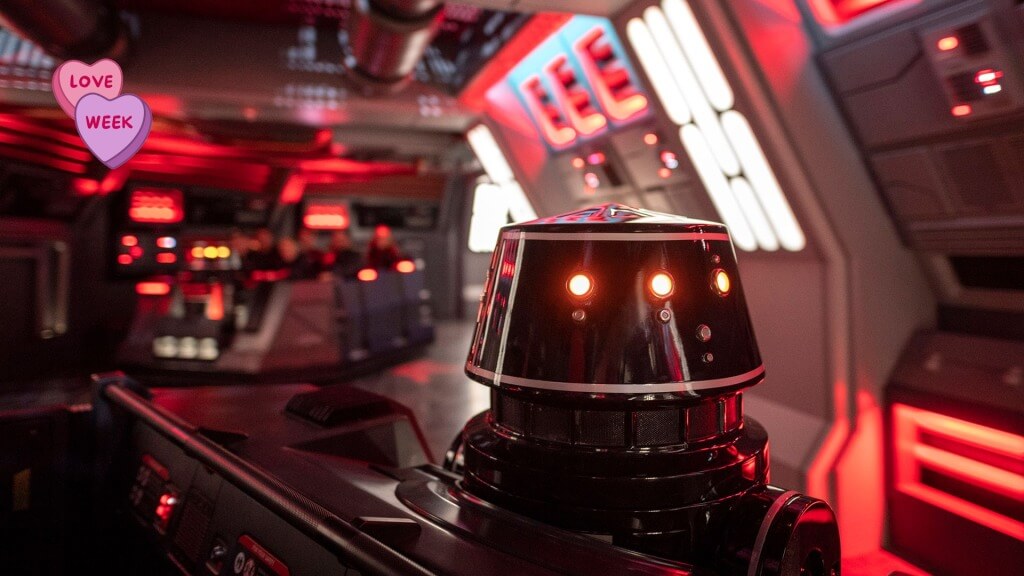
When Star Wars: Rise Of The Resistance opened at Disneyland and Disney World in 2019, it established a new benchmark for theme park attractions. It fully immerses its riders not just through elaborate design, environments, or special effects, but by combining multiple different experiences together in a single package. Starting with a queue that feels like a real clandestine base carved into rock, Rise Of The Resistance stacks setpiece on top of set piece during its 18 minute run: an initial ride vehicle that uses screens and animatronics opens onto a massive Starship Destroyer hangar bay full of Stormtroopers; real actors portraying First Order officers force guests towards a prison interrogation scene; a surprise breakout puts them in wireless ride vehicles that zoom past probe droids, mammoth AT-ATs, and room-sized laser cannons as Kylo Ren stalks them throughout the Destroyer. Multiple ride systems come together to keep guests constantly on edge, and the result is the best realization yet of the theme park’s traditional promise: to live the adventure. And underneath all of its technical wizardry and mouthdropping complexity lies a basic ride concept born in the 19th century, rooted in romance and our eternal, desperate need for intimacy.
ROTR and Epic Universe’s similarly amazing Monsters Unchained are what’s known as dark rides, the industry name for any indoor ride with a vehicle that follows a set path. It’s a broad term that encompasses a number of different ride systems: the boats of Pirates Of The Caribbean and It’s A Small World, the overhead rails of E.T. Adventure and Peter’s Pan Flight, the looping omnimover of the Haunted Mansion and Spaceship Earth, the free-range motion of Monsters Unchained’s industrial robotic arm, and the log of a log flume all drive different versions of dark rides. ROTR and Monsters Unchained represent state-of-the-art versions of the concept, but they’re just the latest advancements on an idea that stretches back to the 1800s.
Victorian morals forbade public displays of affection. At a time when baring almost any flesh was socially unacceptable, open contact between unmarried couples was downright scandalous. That doesn’t mean humans in 1890 were any less interested in romance, but it made it incredibly difficult for anybody who wasn’t married to commit any serious canoodling. A system of shortcuts, codes, and inferences became a second language to anybody interested in romance, a way to be understood without being overt, part of an overall sublimation of desire that allowed one to abide by the era’s strict moral restrictions. If you’ve ever read or seen The Age Of Innocence, or are familiar with almost any Victorian novel, you know the drill: sighs, euphemisms, and endless yearning until you could find a private place to cozy up to each other.
Those private places were hard to find. And so, at some undocumented point in the late 19th century, enterprising carnies and amusement park owners devised a clever plan. If they built a ride where two people could travel together through darkness, out of the sight of others, couples would jump at that opportunity for private alone time. Remember how hard it was to find a place to make out in middle school, so your friends would play games that let you hang out in a closet or go off in the woods alone together? Society at large in the 1890s was like those horny 13-year-olds hoping to paw each other, and the dark ride was cooked up to be their Seven Minutes In Heaven or hiding place in a game of Sardines.
First popularized as an “old mill” ride, where passengers rode a log through an out-of-work mill (whether real or recreated) or any other kind of unused building, these make-out sessions quickly became a standard, expected part of any fair or amusement park. In time, as morals loosened and the real appeal of these rides became hard to hide, they became known as tunnels of love; without the need to cover up what was really happening, operators could then decorate these rides with tableaux of hearts, flowers, and Cupids. On the other end of the thematic spectrum were haunted houses, where guests would ideally be scared into each other’s embrace by skeletons, zombies, and other monstrosities; horrors aside, these were just as interested in giving people the opportunity to snuggle up as a tunnel of love.
In time, the theming of these rides grew more elaborate. An early example of a themed dark ride that wasn’t just an unlit cave but an experience that told a story was A Trip To The Moon, which opened in 1901 at Buffalo’s Pan-American Exposition before moving to Coney Island. Guests “rode” a ship into space, before walking through lunar vignettes featuring elaborate decorations and costumed performers. (So, like ROTR, it was both a dark ride and a walkthrough exhibit.) Almost 40 years later, General Motors sponsored a 1939 World’s Fair exhibit called Futurama, which purported to display the city of the far future of 1960. Part of the experience was an 18-minute ride on an airplane-themed vehicle over a diorama of the future city, giving guests a leisurely bird’s eye view of the future. You can see that influence today in Peter Pan’s Flight and E.T. Adventure. Less complex dark rides could still be found at local amusement parks and traveling fairs throughout the country, but ambitious park operators started to capitalize on the form’s story-telling possibilities.
The dark ride took its next evolutionary step with the opening of Disneyland in 1955. To make his new park stand out from carnivals and fairs, Walt Disney put the narrative chops his company had developed through film to work in physical spaces. Three opening day attractions in Fantasyland used familiar dark ride techniques—vehicles on tracks, black light paint on scenery and cutout figures—to bring movies like Snow White, Peter Pan, and the second half of The Adventures Of Ichabod And Mr. Toad to creaky life. All three still exist today, albeit with a myriad of updates over the decades. 1959’s Submarine Voyage introduced a more expansive and immersive dark ride that recreated an undersea adventure and featured a slightly more complex narrative (it was later adapted into Disney World’s 20,000 Leagues Under The Sea attraction), whereas It’s a Small World (which debuted at the 1964 World’s Fair before reopening in expanded fashion at Disneyland in 1966) pushed existing dark ride techniques to their limit.
And then Disney’s Imagineers revolutionized the concept with 1967’s Pirates Of The Caribbean, a lengthy experience that told a cohesive narrative across multiple time periods and through intersecting vignettes—less a linear story than a narrative atmosphere, casting a cinematic impression of a pirate attack through elaborate sets and lifelike animatronic figures. (If Robert Altman ever designed a theme park ride, it would probably sound and feel a lot like the loosely connected narrative strands of Pirates.) From Pirates sprang the Haunted Mansion, the widescale edutainment dioramas of 1980s EPCOT, and everything else in the dark ride space up through the technological marvels of Rise Of The Resistance and Monsters Unchained.
Technology continued to push what dark rides could do; audio-animatronics kept getting more lifelike, computer-guided trackless ride systems disconnected motion from the immersion-breaking predictability of rails and boats, and the KUKA robotic arm, developed for manufacturing, introduced fast, wide-ranging motion that could be programmed to a precise degree. These innovations let ride designers tell increasingly complex and immersive stories in ways that aren’t possible in any other medium—becoming its own unique art form. And it all started with our natural human instinct to be close to one another, at a time when society did everything it could to prevent that.


 Keep scrolling for more great stories.