Back in June 2024, when Cats: The Jellicle Ball first premiered at the Perelman Performing Arts Center, whenever I told people that it was one of the best theater experiences I had ever had, they cocked their heads, looked at me funny, or gave a slight eyeroll. Sure, a production of Cats might be vaguely enjoyable, but borderline profound? An Andrew Lloyd Webber show? If the musical had, despite one of its showstoppers (the ubiquitous “Memory”), become both part of the theatrical firmament and also a joke, cemented by a lamentable 2019 film adaptation by Tom Hooper (nothing if not one of the purer examples of naive camp in the 21st century), what hope was there for one of the most famous musical theater figures of all time?
Lloyd Webber is one of the richest people in the music world, with an estimated net worth of £500 million, yet he is, despite only a smattering having successful runs on Broadway, emblematic of a kind of theater kid mentality all by himself. He is a composer nearly devoid of irony. When Hal Prince was preparing to direct the original production of Cats, he asked Lloyd Webber about the allegorical depths of the show, if it was, as David Fick recounts, “a metaphor for life in the United Kingdom, with some cats representing figures like Queen Victoria and Benjamin Disraeli and others the general populace.” Lloyd Webber replied, “Hal, it’s about cats.” Trevor Nunn ended up directing the show. He’s the kind of musical theater composer who inspires a reaction akin to hearing artillery fire when someone chooses one of his songs for karaoke: the opening sounds mean it’s already too late.
Even through his ambition of subject and framework—the Passion as rock opera, the Book Of Genesis’ Joseph as pop opera, Eva Perón’s life as, yeah, rock opera—there is a straightforwardness about his musicals that, despite wanting to filter history through popular culture, or mash the two together, drips with earnestness. They may be catchy and have moments of ingenuity, but they’re not, like, cool. They’re not transgressive and they seek the approval of the audience, and only that can be the conduit for their emotional and theatrical heights.
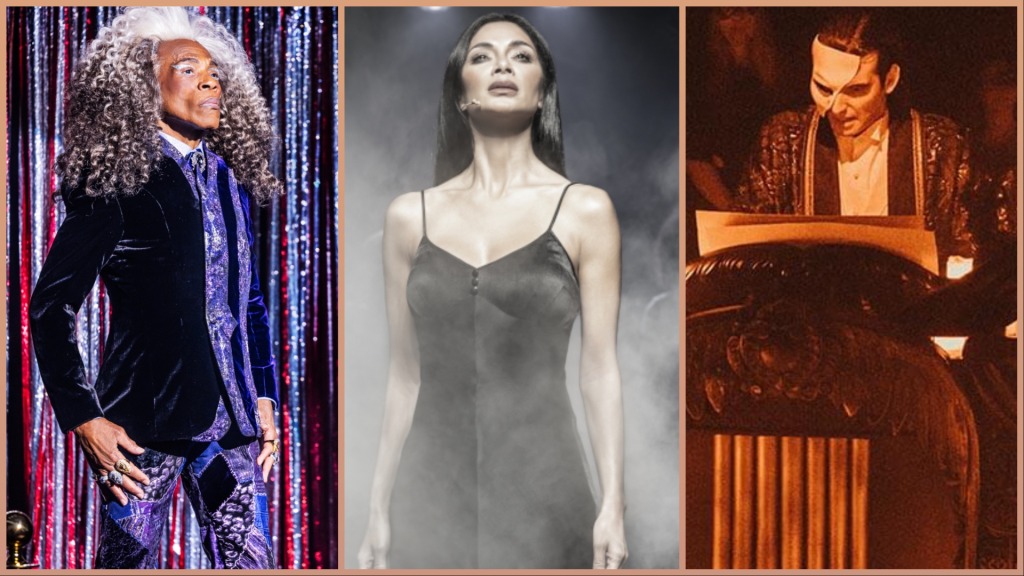
And yet, Cats: The Jellicle Ball, which has extended its run twice and become one of the hottest tickets Off Broadway, was one of the pieces of evidence that appeared to signal a slight change in the general attitude about Andrew Lloyd Webber, or at least his works. His adaptation of Sunset Boulevard, with book and lyrics by Don Black, Christopher Hampton, and Amy Powers, enjoyed a buzzy minimalist 2023 revival that transferred to Broadway in 2024 starring former Pussycat Doll Nicole Scherzinger and under the direction of current avant pop enfant terrible Jamie Lloyd. The production netted four Olivier Awards (Best Revival Of A Musical, Best Director For Lloyd, Best Actor For Tom Francis, and Best Actress For Scherzinger) and three Tonys (Best Lighting Design, Best Revival of a Musical, and Best Actress for Scherzinger). And though Phantom officially closed on Broadway after nearly 14,000 performances, it reopened in September 2025 as a reworked immersive theatrical experience under the title of Masquerade and directed by Jagged Little Pill’s Diane Paulus, featuring styling by fashion director (and Gaga collaborator) Nicola Formichetti. Lloyd even revived his own 2019 take on Evita on the West End with Rachel Zegler in 2025 with plans for a Broadway transfer next season, and his fever dream train/roller skating musical Starlight Express (not seen on Broadway since 1987) has been enjoying positive reviews in a 2024 production Troubadour Wembley Park Theatre. The composer is now frequently seen outside the doors of the Jellicle Cats’ pad, the Broadhurst Theatre, headphones wrapped around his head, spinning remixes of his own famous songs into Lady Gaga tracks.
You could say Lloyd Webber is in the period of his life and artistry where he’s letting people do what they want with his output, allowing for there to be a level of experimentation. These are not museum-piece productions or even stagings that feel the hint of a slavish dedication to the originals. They are, compellingly, recontextualizations of decades-old artifacts, and sometimes best-case scenarios for how revivals of famous and canon shows can be engaged with. In Cats: The Jellicle Ball has directors Zhailon Levingston and Bill Rauch and choreographers Arturo Lyons and Omari Wiles set the show in the world of ballroom; Evita has dancers running up and down stairs and Ms. Peron speak to the people on a balcony. Sunset Boulevard is all lights and black plain clothes costuming and lots of live video feed, and Masquerade turns Phantom into a haunted house attraction.
What is particularly enlivening about these revivals, and about the choice to re-engage with Lloyd Webber’s work as a popular artist, is that directors are testing the boundaries and constraints of the artist himself. Jamie Lloyd’s approach, at least as far as Sunset Boulevard goes (I have not yet seen Evita), seems to resist or work against the text in some ways: The director strips the show of period setting identifiers (it’s set in the ‘50s, but everyone wears dark contemporary street clothes) making it as bare and sparse as possible. He cast someone explicitly hot in the role of the monster Norma Desmond. He filters Lloyd Webber’s spectacle through the heavy use of live video feed, juxtaposed against the deadpan deliveries of the entire expressionless cast, more evident in the factory lineup staging of “Let’s Do Lunch.” But the impulse to take a sleek, streamlined view on Sunset Boulevard has the effect of laying bare the musical’s flaws: It’s overlong, it flattens the complexity of Norma as a character and relies too heavily on the meta-text of Nicole Scherzinger being the star without giving her enough good material to support it. The video feed makes it feel less like theater, but not quite a movie, trapped somewhere in the middle. As the camera switches between the leads and side characters with an apparent randomness, the production betrays a lack of coherent logic as to the live video’s extensive use, and, thus fails to distract from the matter of the libretto’s lyrics being rather clunky and the music sloppy and overwrought.
Conversely, Cats: The Jellicle Ball and Masquerade successfully reimagine Andrew Lloyd Webber’s musicals by playing to their existing strengths. Cats was always a dance competition musical, but what (arguably) weighed it down was a sense of stakes. The show’s inherent silliness (not a bad thing) eclipsed any emotional through-line, struggling to create enough connective tissue between the thematic content of T.S. Eliot’s poetry from song to song in an effort to create a cohesive piece of theater as a whole. Thus “Memory,” Cats’ standout number, has always felt relatively unmoored from the musical—emotional, graceful, but kind of unrelated to anything else that happens on stage. But in Levingston and Rauch’s hands, Eliot’s core ideas about loneliness, history, frivolity, tenderness, and ultimately, community are crystallized and made tangible by placing them in a context—the Black queer world of vogueing and ballroom—where those themes have a tactile resonance. They’re ideas that end up being connected to both individuals and the whole community, giving lyrics and phrases new meaning, such as sections like “The Naming Of The Cats” where they describe the different ways in which cats are addressed by family, friends, and authority.
With The Phantom Of The Opera, its original 1988 production sat in the middle of Broadway’s era of megamusicals, all bombast and spectacle over refined artistry and subtlety—lake fog, magic tricks, and that giant, plummeting chandelier. It ran for 35 years on Broadway, closing in 2023. As Christine followed the Phantom down to his subterranean lair beneath the Palais Garnier, the mental image of one of those touristy Halloween mazes or a pop up “haunted house” attraction (per The Washington Post in 1990) wasn’t far behind. Masquerade doubles down on this analogy, turning the musical into a guided amusement park attraction, and all for the better. Though the show’s pomposity and kitsch was surely enjoyable in its original iteration, transforming Phantom into a theme park ride feels not only like the next logical step, but, similarly to Cats: The Jellicle Ball, as it perhaps should have always been. Singers belt their faces off in front of you and the crowd of 30 or so; visitors wander down escalators and through a steady stream of plastic battery powered candles and stage fog; ticket buyers make their way through labyrinthine corridors whose walls are adorned with custom masks and art; and the (many) climactic sequences are up close and personal in a rather delightful way. Through this quasi-immersive production, The Phantom Of The Opera is able to both play up its kinkier and kitchier components, really letting the audience’s fantasies unwind, as well as embody what the show kind of always was.
Amplifying the aspects of Lloyd Webber’s work that prioritized extravaganza doesn’t overshadow or distract from his skill as a composer (and master of flagrant derivation) so much as it helps cultivate a theatrical language through which his texts are best articulated. Andrew Lloyd Webber is not simply music, as good or mediocre as it is, so much as he is representative of what Andrea Long Chu describes as an attempt to “give definite shape to the abstract emotionality of music.” It is music and magic tricks and theme park rides and and and.
As Long Chu argues in her excellent essay, Broadway, as an enthusiastic purveyor of the megamusical, has been remade in Lloyd Webber’s image ever since, for better or worse. From Les Misérables to Wicked to Hamilton to Hadestown to this year’s Schmigadoon!, the theater world has either responded by doing the opposite and focusing on intimacy and carefully wrought drama and music, or followed in the Brit’s footsteps, or tried having it both ways. And with productions like The Lost Boys and Stranger Things: The First Shadow, megashows that rely on pyrotechnics and people flying around on wires are dealing with a theatrical landscape that seeks to cater to audiences hungering for bluster, but must contend with dwindling resources and risk-averse producing armies. (The Lost Boys features 53 credited producers. Cats: The Jellicle Ball has 64. The original production had four.)
Radical revivals are perhaps old hat at this point—we had a sexy Oklahoma! from Daniel Fish in 2019, Sondheim (who basically loved all revivals of his work) sanctioned the gender-swapped revival of Company in 2019/2021, and Target Margin Theatre did a very Brechtian production of Show Boat, retitled Show/Boat: A River just last year—but what’s significant about reimagining Lloyd Webber’s work is that it situated commercial populism within ecstatic and virtuosic pageantry, and audiences’ capacity, visual language, and ability to finance those things has radically changed. If everything on stage has something to say about spectacle—be it the literal pyrotechnics on stage or the bluster of the political landscape—how can older works be renewed, with even a modicum of integrity, for an audience both deeply earnest and primed for cynicism? In this case, by taking stock of what Lloyd Webber, a maestro of the British schmaltz and grandiloquence, means to musical theater (and what commercial Broadway theater means to the form), and bending and breaking the form’s technical attributes to do so.
Technically, Lloyd Webber doesn’t need his reputation to be salvaged: He’s obscenely wealthy and his output is mostly beloved. But having his already extremely popular musicals poked and prodded at in this stage of his career is both a testament to his longevity as well as to the theater artists willing and interested in seeing the limits and boundaries of the work itself. It’s not just a poptimistic take that shades these works, but an interest in how populism and commercialism have shaped theater history and where it may go next. Lloyd Webber is a prism through which we can view and understand how the Broadway industry has changed. It may become austere and self-serious, or it may become an even crazier theme park ride, or it may become a platform to explore the histories and communities of underserved peoples. Hopefully, it will encourage theater artists to not only reconceptualize the productions of already canonized artists, but fuel their own creativity and originality into the distant future, when Andrew Lloyd Webber may be only but a memory.


 Keep scrolling for more great stories.