Within two hours of starting Angeline Era, I was already lost. The game is split into several overworld maps. I had wandered from the game’s opening area, falling down cliff sides and scraping my way through brambles, only to find myself on the opposite side of a river. I wanted to go back where I had came, but could find no way forward. I played levels in an effort to open pathways and wandered through almost every nook and cranny I could find, but no bridge appeared. In a flash I realized that if I ran on a road, I could gain speed. After two hours of searching, I simply jumped across the river.
You might have read dozens of stories like this in the early days of Elden Ring or Breath of the Wild. Both those games lose that sense of discovery over dozens of hours, though. Despite being massive in scale, they can only offer so many surprises. Angeline Era is not so much a response to those games as it is a path less explored. It offers exploration that is sprawling but still intimate. In an age of open world excess, Angeline Era offers sharp, personal design.
For over 10 years, Melos Han-Tani and Marina Kittika–under the unified banner Analgesic Productions–have produced exciting and approachable games. It is easy, and not unjustified, to compare the duo’s work to much of Nintendo’s output, particularly from the Game Boy Color and N64. Analgesic’s work has a whimsical, fairy tale quality buttressed with a central formalism. It’s accessible and experimental. Every one of their games iterates on a tried-and-true game design and surrounds it with an absurd existentialism and melancholic humor. Comparisons to Link’s Awakening and Majora’s Mask are apt.
Yet, their work has moved further afield from the realms of Nintendo imitation as it has gone on. Arguably, their games’ relationship to Nintendo has always been overstated. Commercial independent games rely on ready made genre comparisons, which Analgesic’s games both play into and elude. Sephonie is a 3D platformer with hardly any nostalgic impulse at all. It rejects both the playground design of Mario 64 and the collect-a-thon of games in the Rare lineage, building out a ludic language which demands active adjustment. It’s far from hostile or antagonistic, yet it is not placating. You have to play it intentionally.
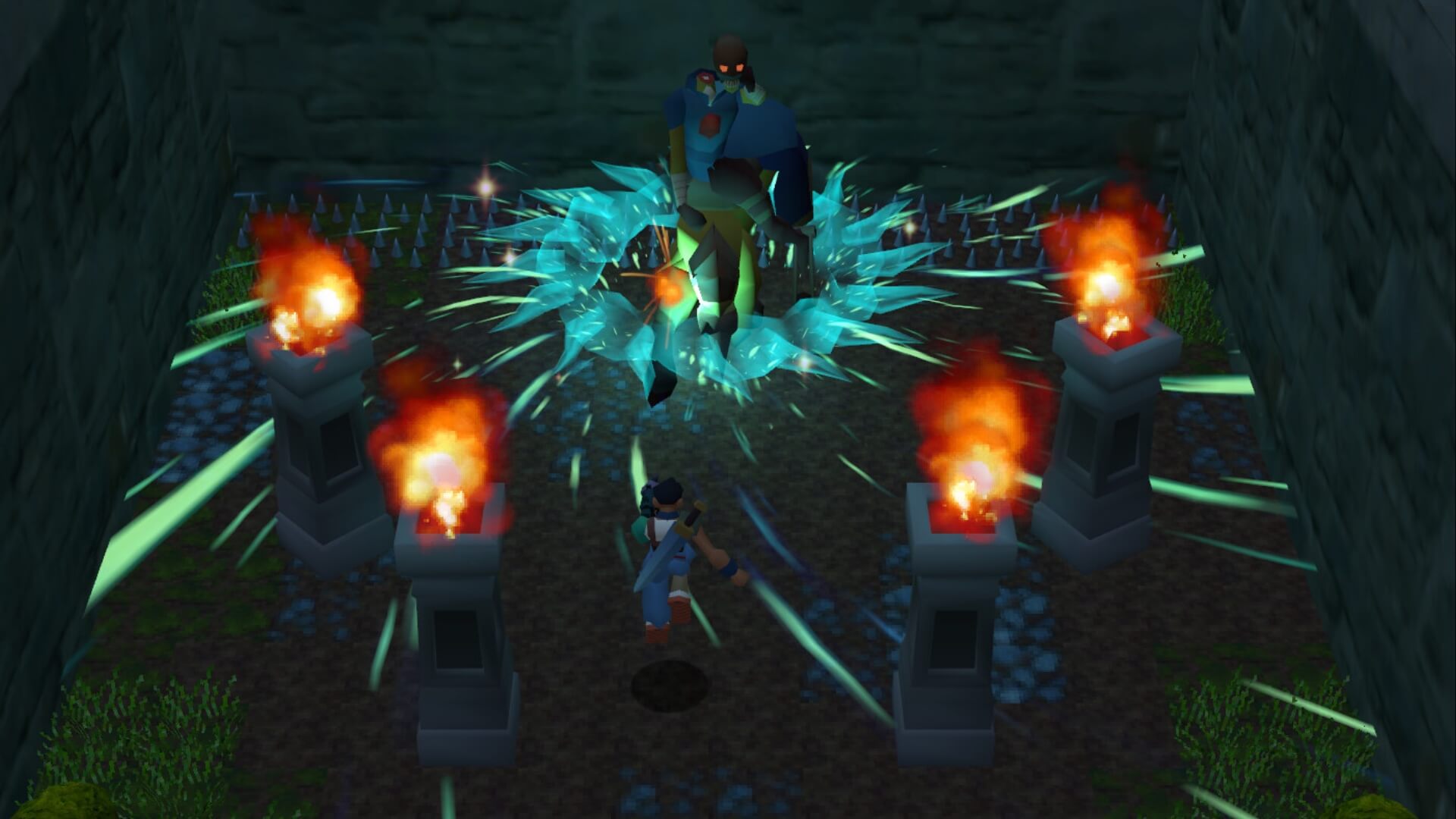
Angeline Era requires less adjustment, yet still is off-center from most popular independent games In broad strokes it’s a return to the structure of Anodyne 2. These are both games with a central overworld which hides individual levels. Instead of the top-down, Zelda approach of both Anodynes, Angeline Era uses bump combat. To attack an enemy, you just have to run into them. The game becomes about reading enemy attacks and dodging projectiles, rather than attacking. This variety of RPG combat was “popularized” by games like the Ys series and it does constitute a vibrant subgenre. Yet, it is hardly in the mainstream, especially in North American or European markets.
Still, Angeline Era made me want to go and explore this lineage. The sharp simplicity of bump combat means that there are only few things for a player to do at any given time. You can eat food to get some extra health and buy new abilities in towns scattered across the world, but the game’s verbs are few. Therefore, the variety of the design concentrates itself on enemy configurations and level layouts. The purity of this approach makes Angeline Era readily conversational. The highest difficulty level is called “Melos’s Trick,” implying a jokey antagonism between player and developer. Even on the game’s lower difficulties, you might feel you’ve been subject to the ire of an unseen god. Yet the game is generous with its systems. Difficulty is easy to change (it will even offer to bump you up to a higher difficulty if you are playing well). The game is playful, rather than demanding.
Narratively, it strikes a balance between comic absurdity and earnest melancholy. Like Sephonie, Angeline Era takes place in our world, albeit in a fictional place wherein the fantastic is confined. Protagonist Tets is a visitor to the titular Era, drawn there by an angelic vision. While Anodyne 2 and Even the Ocean respectively dealt in Christianity and climate change analogs, Sephonie is about COVID in almost direct terms, and Angeline Era’s fantasy conflict is between pagan folklore fae and Christian angels. Tets’ quest is mythical, yet his urges are human. He has a naive faith, an urge to be seen as heroic, even to prove the foolishness of other people. The conflict his quest interacts with is much older than him and the people he fights often wiser.
It is that attention to emotional detail that makes Angeline Era more than a well-tuned action game. It feels vast because there is the consistent suggestion of unseen depth. Of course, like any other video game, Angeline Era has hard limits. I am looking forward to seeing speedrunners chart the edges of those limits. But the game’s vastness does not rely on mere video game convention. Its constant invocation of biblical imagery and themes gives it almost a mythical sensibility. This is a place with a history and that history is, in part, our own.
Owning something to the past is hardly unique, but Angeline Era values that connection far more than most video games. I have often bemoaned games’ lack of figures like Martin Scorsese or Brian De Palma. Both these film-makers developed a sensibility of their own over their careers, yet have a clear reverence for the past. They both know that they owe something to the filmmakers which came before them. The nostalgia of the video industry rewrites, rather than honors, the past. And only a narrow slice of it at that. Analgesic Productions‘ work engages with both the classics and the games just off the beaten path. Angeline Era is commercially viable, with well-defined thrills, but make no mistake: artists created it.
Angeline Era was developed by Melos Han-Tani, Marina Kittaka, and Analgesic Productions, and published by Analgesic Productions. It is available for PC.


 Keep scrolling for more great stories.